AI API infrastructure
for production workloads.
Omev recognises your business task, routes it between our own models and checks the result against your requirements. Grow repetitive AI workloads with a routing policy built around your cost per accepted output — not just the cheapest token.
For SaaS companies and platforms whose AI bill is now a line item finance asks about.
$5 free credit · 10 days · no card · OpenAI-compatible · No migration
Your AI bill grows every time your product grows.
Usage-based pricing means your cost of goods scales with your own success. Every new customer, workspace and feature adds calls you pay for. Most software gets cheaper per unit as it grows; this does not, so every point of growth arrives with its own bill attached.
Frontier models earn their price — on hard work
For reasoning, code, agents and anything customer-critical, the best models are worth every cent. Keep them there. The problem is not the frontier model. It is everything else that routes through it by default.
The volume that scales fastest is repetitive
The work that grows with usage is well specified, schema-shaped and high volume. Clear input, clear output, no room for interpretation. Those jobs rarely need your most expensive model — and if you have already moved some of them onto a cheaper tier, you have made this argument yourself.
The cheapest response is not always the cheapest result
A low token rate can hide the cost of checks, cleanup and retries. Omev recognises the task, selects its own models and validates against your client profile. Routing is optimised around the total cost of an output that meets your criteria, not just the first response.
Every job priced above the level it needed comes out of your margin — one call at a time.
What our customers say.
“AI generation can get expensive pretty quickly. So around six months ago, we added Omev AI to a few parts of our infrastructure in Outrank. The results have been on par with the leading models we use, while helping us reduce generation costs. We keep the same quality bar, but the economics are simply better. We still use different models for different parts of the product, and Omev AI is now one of them.”

“I wanted to test omev.be as part of the AI/SEO workflow rather than just playing with it in a chat interface. What I liked was that it’s actually exposed as an OpenAI-compatible API, so integrating it into an existing application was straightforward. I’m still early enough that I wouldn’t claim any SEO/business results yet, but from a developer perspective the experience was surprisingly frictionless. The fact that the output is designed around specific SEO tasks rather than generic AI responses makes the integration more practical.”

Why Omev AI
Your task. Your criteria. Our execution.
OpenRouter, LiteLLM or a direct model API can be part of your stack. Omev takes on the model selection, client rules and result checks for the business tasks you send us.
Omev AI
Execution tailored to your workload.
- Recognises the business task in each request
- Applies your acceptance criteria and client profile
- Selects an Omev model or sequence for that task type
- Checks the result against your requirements
- Repairs or falls back between our own models when checks fail
- Uses production results to improve cost per accepted output
Available to every registered customer. Routing runs between our own models.
OpenRouter / LiteLLM
Model and provider selection, availability, cost controls and fallbacks. They also support capabilities such as automatic routing or configurable guardrails.
Your team assembles the business workflow and defines how a result is accepted for each client.
Direct model API
Call a model using the provider's generation and output controls. Your team builds the surrounding task logic, client profiles, validation and recovery workflow.
Measure cost per accepted output.
Total execution cost ÷ results that meet your criteria. Include generation, checks, repairs and retries when comparing routes.
Compare the routing capabilities
Routing itself is not exclusive to Omev. See the official documentation for OpenRouter Auto Router, LiteLLM routing and LiteLLM guardrails. Our offer is the managed, client-specific task workflow described above.
Built around your requirements
Same task. Different client. Different AI behavior.
The product facts stay the same. Switch the client profile to see how the requirements, processing steps and output change.
Same request and source facts
Write a product description
- Ridge bottle
- 750 ml
- Stainless steel
- Screw-top lid
- 280 g
- Matte graphite
A factual marketplace listing with exact product attributes.
Client acceptance criteria
- 120–160 words
- JSON schema
- Exact product attributes
- No exaggerated claims
- Amazon listing style
How Omev handles this profile
- 01Structured product draft
- 02Attribute and schema checks
- 03Repair any mismatched fields
Omev selects the model or sequence from our own models. Repair and fallback run on our side when checks fail.
Checks: Description length · Required JSON fields · Source attributes · Unsupported claims
Example output · JSON
The Ridge bottle combines a 750 ml capacity with a stainless steel body, a screw-top lid and a matte graphite finish.
View full example
{
  "name": "Ridge bottle",
  "description": "The Ridge bottle combines a 750 ml capacity with a stainless steel body, a screw-top lid and a matte graphite finish. Its listed weight is 280 g. These specifications give shoppers a straightforward way to compare the bottle with other options.\n\nChoose by the details that matter to you: capacity, material, lid type, weight or finish. The 750 ml figure describes the stated capacity, while stainless steel identifies the body material. The screw-top design describes the closure, and matte graphite identifies the finish.\n\nProduct details are kept together so you can review them before making your choice. If you are comparing several bottles, use the same fields for each one and check the Ridge specifications against your preferences. Explore the listing to decide whether Ridge belongs on your shortlist.",
  "attributes": {
    "capacity": "750 ml",
    "material": "stainless steel",
    "lid": "screw-top",
    "weight": "280 g",
    "finish": "matte graphite"
  }
}
A longer description that answers product search intent.
Client acceptance criteria
- 250–300 words
- Product search intent
- Relevant entity coverage
- A clear CTA
- Internal link suggestions
How Omev handles this profile
- 01Search intent and draft
- 02Entity and content review
- 03Repair missing sections
Omev selects the model or sequence from our own models. Repair and fallback run on our side when checks fail.
Checks: Length and search intent · Product entity coverage · Source facts · CTA and suggested links
Example output · Markdown + suggested links
Looking for a 750 ml stainless steel bottle? The Ridge bottle brings its key specifications together in a matte graphite design.
View full example
# Ridge 750 ml stainless steel bottle

Looking for a 750 ml stainless steel bottle? The Ridge bottle brings its key specifications together in a matte graphite design. It has a stainless steel body, a screw-top lid and a listed weight of 280 g, giving you a clear starting point for comparing bottles by the details that matter to you.

## Capacity and material

The stated capacity is 750 ml. If capacity is your first filter, use that figure to compare Ridge with the other bottles on your shortlist. Its body is stainless steel, so shoppers searching specifically for that material can identify it directly in the product details.

## Lid, weight and finish

Ridge uses a screw-top lid. The listed weight is 280 g, and the finish is matte graphite. Together, those details describe the closure, weight and appearance without asking you to infer specifications from a product photograph.

## Compare the details before choosing

A useful bottle comparison starts with consistent fields. Put capacity, body material, lid type, weight and finish side by side. For Ridge, those fields read 750 ml, stainless steel, screw-top, 280 g and matte graphite. This gives you a product summary you can check against your own preferences and the specifications of other options.

The description keeps the product name and its attributes together so you can return to the same information while browsing. Whether you begin your search with capacity or material, the key details remain easy to find.

Explore the bottle collection and compare Ridge with your shortlist.

Suggested internal links:
- Bottle collection
- Stainless steel bottles
The client's brand voice, vocabulary and delivery format.
Client acceptance criteria
- A calm, direct voice
- Use “everyday carry”
- Avoid “revolutionary” and “game-changing”
- A fixed Markdown structure
- Preserve the product facts
How Omev handles this profile
- 01Brand profile and draft
- 02Voice and phrase review
- 03Repair off-brand wording
Omev selects the model or sequence from our own models. Repair and fallback run on our side when checks fail.
Checks: Brand vocabulary · Forbidden phrases · Markdown structure · Source facts
Example output · Branded Markdown
Your everyday carry, in matte graphite. Meet Ridge: a 750 ml stainless steel bottle with a screw-top lid and a listed weight of 280 g.
View full example
## Meet Ridge

Your everyday carry, in matte graphite. Meet Ridge: a 750 ml stainless steel bottle with a screw-top lid and a listed weight of 280 g.

### The details

- Capacity: 750 ml
- Body: stainless steel
- Lid: screw-top
- Weight: 280 g
- Finish: matte graphite

### Make it yours

Start with the details that matter to you. Capacity, material, lid, weight and finish are all here, ready to compare with the rest of your everyday carry.

Explore Ridge.
Illustrative client profiles and outputs. Your policy is built from your requests and agreed criteria.
After you register
From your real requests to a route built for you.
Register with your work email. We follow up personally to start with your workload; Omev runs the analysis, routing and checks automatically. This onboarding is available to every registered customer.
- 01
Share your real work
Register and share a sample of production requests. Omev automatically groups them by task type and establishes your current models and cost baseline from the information you provide.
Your tasks and baseline
- 02
Define good. Benchmark it.
Agree the required facts, format, voice and quality criteria. Omev benchmarks its own models and sequences against those requirements and your current output.
Criteria and measured results
- 03
Connect your tailored route
Omev builds your routing policy and provides an OpenAI-compatible endpoint. Start with one task type; model selection, validation, repair and fallback run on our side.
Your policy and endpoint
- 04
Improve with real usage
Omev collects cost, latency, validation and retry telemetry. Production results feed automatic routing improvements measured against your acceptance criteria.
A policy informed by real results
Starts with registration and a personal follow-up.
Keep frontier models for the hard stuff.
Stop overpaying for the rest.
You do not need to leave OpenAI, Claude or Gemini. Keep them on the work where frontier-level intelligence changes the answer, and send the repetitive, high-volume share of your traffic to Omev instead. Within that workload, Omev automatically selects from our own models, applies your client profile and checks the output against your criteria.
Keep on your current provider
- Complex reasoning and multi-step decisions
- Coding and agentic workflows
- Open-ended prompts with no fixed shape
- Decisions where being wrong is expensive — moderation, eligibility, anything a customer can appeal
- Anything where frontier-level intelligence is the product
Route to Omev
- Structured extraction into a fixed JSON schema
- Classification and tagging against a fixed taxonomy, where a wrong label is cheap to correct
- Translation and localisation passes
- Titles, metadata and other short fields
- Product, listing and catalogue descriptions
- Rewriting, summarising and reformatting at volume
- Bulk content generation from a brief
Start with one task type. Keep the rest of your stack.
After the benchmark, connect that workload to your OpenAI-compatible endpoint. Omev handles model selection, validation, repair and fallback between our models. Your team connects the calls you choose and checks compatibility with your integration in the API docs.
Benchmark My Workload →Find the use case you run at scale.
Choose the repeated workflow where volume—not difficulty—drives the bill. Each page shows the work, the unit economics and the safest way to test it.
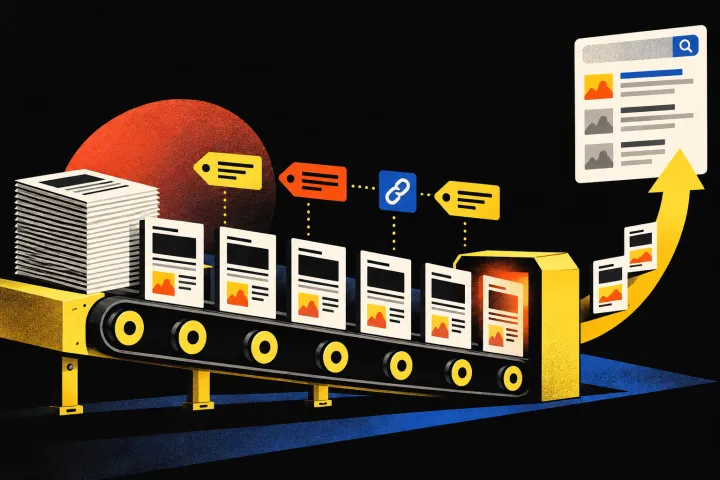
SEO content
Bodies, metadata, anchors and refreshes. $0.15 in / $1.25 out per 1M tokens.

GEO content
Answer pages, comparisons and source-backed refreshes for AI search.

Social media
Scale every client voice without collapsing them into the same AI style.
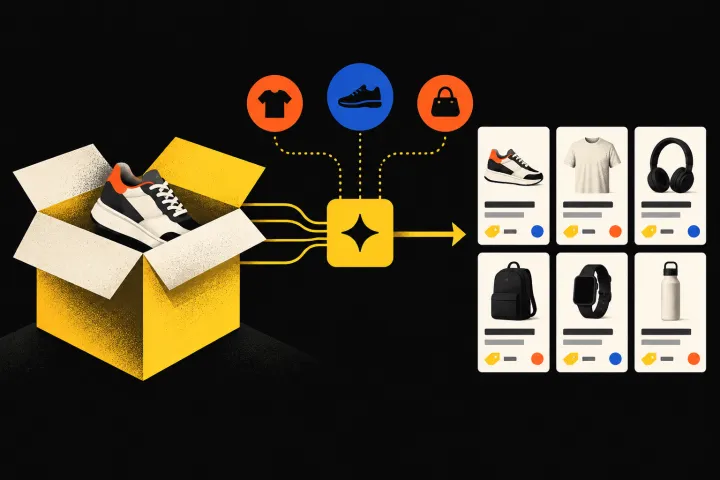
E-commerce
Turn fragmented supplier data into structured, publish-ready product records.

Localization API
Apply product context, terminology and market rules to every localized release.

Text humanization
Turn stiff AI drafts into natural, on-brand customer-facing text.

Image API
Keep product and brand references consistent across bulk image generation.

Video generation
Text or image to video from $0.039 a second. Early access.

Audience intelligence
What your buyers ask, argue about and never say to you — with the quotes, links and counts behind every claim.

Text analysis
Sentiment and entities from $0.50 per 1M characters. Categories, entity sentiment and moderation also available.

For Agencies
Keep every client's rules separate while one team produces more.
Text runs self-serve on your API key. Image and video access is enabled per account — video is in early access, and failed image generations are not billed.
What is the repetitive share of your bill actually costing you?
You know your monthly spend, so start there — no token arithmetic required. Enter what you spend, pick what runs that work today, then drag the share of it that is repetitive.
- Current spend
- $10,000
- Routable workload
- $6,000
- Estimated new bill
- $6,375
An estimate, not a quote. It prices the routed share against the matched Omev tier at list price on one representative request shape — 3,000 input and 2,000 output tokens, an assumption rather than a measurement — leaves the rest of your bill exactly where it is, and ignores any discount you have negotiated. If that work already runs on a light model, the gap is far smaller: against GPT-5.6 Luna on the same shape it is about 2%, and Luna can be cheaper on output-heavy prompts. In that case, use the benchmark to decide on total cost per accepted output rather than the rate card alone. This is arithmetic on the numbers you typed in, not a measurement of your prompts. The only figure worth acting on is the one you get from running 20 to 50 of your own production prompts through both.
Add acceptance rate and review time to the estimate →Built for companies already running AI in production.
Omev is for you if
- You already call the OpenAI, Claude or Gemini APIs from production code
- AI is part of your product or your operations, not an experiment beside them
- Your AI spend is a line item finance now asks about
- A large share of your calls are repetitive and well specified
- You run text, images or video at volume — thousands of calls a day, not dozens
- You can name the one task type you would move first
Probably not for you if
- Your prompts and outputs cannot be used to train our models — that use is mandatory here, with no opt-out
- You need SOC 2, ISO 27001 or a contractual SLA to clear your own security review — we hold none of them today
- Every request genuinely needs frontier-level reasoning or open-ended judgement
- Your AI bill is small enough that a day of engineering costs more than a year of the saving
None of those are hedges. Training on customer content is a condition of using the Service, not a setting, so a workload that cannot live with it should stop here rather than find out after integration. And on a small bill the saving is real in percentage terms and trivial in absolute ones — tens of dollars a month, against a day of engineering and a security review. Optimise it when the integration pays for itself. We would rather say so than sell you a benchmark that cannot.
Typical customers
OpenAI-compatible integration
Your existing stack. Omev's routing and checks.
Connect the agreed workload through an OpenAI-compatible endpoint. Your client profile, model selection, output validation and repair logic run on our side. Your team tests the supported parameters and decides which traffic to send.
Built on our own models
Omev AI is not a wrapper and not an API reseller. The output you pay for is produced by two models we fine-tuned ourselves, trained on our own SEO corpus and served on our own GPU infrastructure. Where we use commercial vendor APIs, we use them in accordance with their terms of service. On top of our models we run our own routing, task contracts and output validation, which is what turns a raw model call into a finished SEO task.
What that means in practice
You are not buying access to someone else's API. There is no third party account opened in your name, no provider keys or credits resold to you, and no provider endpoint proxied through us. Our API is compatible with the OpenAI SDK at the protocol level only, so your existing client works without changes. Where external capacity is used inside our routing layer, it is our own infrastructure decision under our own contract, at our price and within the vendor's terms of service, invisible to you, the same way any online service relies on infrastructure vendors.
How we operate
Omev AI is a business to business product with public pricing, a live service and a working support channel. Our Terms of Service, Privacy Policy, Acceptable Use Policy, Billing and Cancellation terms, AI and Customer Content policy and the list of subprocessors are published on this site. NSFW, face swap and deepfake use is prohibited by our Acceptable Use Policy. We do not make claims about models we do not run.
We don't keep a list of banned niches.
If your vertical keeps getting refused, hedged or quietly watered down by a general-purpose model, that is a category policy talking — not a technical limit. Ours is written around conduct, not subject matter.
What we don't do
We do not maintain a blocklist of industries, topics or client types. We do not decide that your market is too commercial, too competitive or too unglamorous to write about, and we do not refuse a brief because of the sector it came from.
You are the publisher. You know your market, your regulator and your audience better than a content filter does.
What is genuinely out of bounds
- Anything unlawful, deceptive or fraudulent
- Sexual content that is unlawful, and non-consensual intimate material
- Impersonation, deepfakes and face swaps
- Fabricated citations, reviews or endorsements passed off as true
- Personal data on self-service plans, and credentials or payment secrets anywhere
- Standing in for a doctor, lender, employer or court in a decision about a person
These are conduct rules, not topic rules, and they are published in full — read the Acceptable Use Policy. One obligation sits with you rather than us: where the law requires it, you must disclose that content was generated by AI.
Already on OpenAI, Claude or Gemini?
See which high-volume workloads you can move to Omev, what the published rate difference becomes at your scale and how to switch one production route without rebuilding the stack.
vs the OpenAI API
GPT-6 Astra & GPT-5.6
Read the comparison →vs the Claude API
Sonnet 5 & Haiku 4.5
Read the comparison →vs the Gemini API
Gemini 3.8 Flash & 3.5 Flash-Lite
Read the comparison →Or price your own token volume against every model, or browse all alternatives.
See what's inside before you sign up.
No black box. Your key, your live credit and every task you run — plus a playground that hands back working code. Click through the real screens.
Dashboard
How much is left and where it went.
Credit left
$99.60
Tasks, last 7 days
21
$0.32 · spent in this period
Your key
sk-U77…RPJQ
The full key is shown only once, when it is issued.
Quick start
curl https://llmapi.omev.be/v1/chat/completions \
  -H "Authorization: Bearer sk-U77…RPJQ" \
  -H "Content-Type: application/json" \
  -d '{"model":"omev-lite","messages":[{"role":"user",
       "content":"Write a meta description for a page about running shoes"}]}'
Put your full key in place of the mask and run the call.
A key and $5 credit on signup
Issued the moment you confirm your email — no review queue, no card.
Spend and tasks, in the open
Credit left, tasks run and cost per model — not a monthly surprise.
A playground that returns code
Pick an example, send it, and copy the working call in your language.
Transparent pricing. Two plans, no surprise invoices.
Personalised routing is available on both plans. Start with $5 of free credit, use published token rates or agree an individual contract.
Pay as you go
Self-serve. Top up by card and spend what you use.
- ✓Token pricing — full rates below
- ✓Personalised task routing and result checks
- ✓Top up by card from $10
- ✓Topped-up credit valid 30 days
- ✓No monthly fee, no seat fee, no commitment
- ✓$5 free credit · 10 days · no card
Enterprise
For teams that need individual terms.
- ✓Custom volume and rate limits
- ✓Per-finished-task pricing available by contract
- ✓Individual contract and Enterprise DPA
- ✓Dedicated support channel
- ✓Invoicing and negotiated terms
What counts as a task? One finished production action — the kind you'd otherwise do by hand or clean up after a general model. One request in, one ready-to-use result out.
For example, one task = one product description · one string set translated into a locale · one meta title & description · one set of catalogue attributes extracted · one post repurposed into its formats · one batch of image prompts.
Pay as you go bills the tokens a task consumes, at the rates below. Pricing per finished task instead is an Enterprise arrangement, set by contract.
Token rates
No tiers by request volume. No seat fees. Pay exactly for what you use — top up by card from $10; credit stays valid for 30 days after top-up.
Omev Lite
High volumeThe repetitive share of your pipeline
- ✓Titles, metadata and other short constrained fields
- ✓Classification and tagging against a fixed taxonomy
- ✓Structured extraction into a fixed JSON schema
- ✓Translation and localisation passes
- ✓Product, listing and catalogue descriptions
- ✓Bulk rewriting, summarising and reformatting
- ✓Image and creative prompt generation
Omev Pro
Most PopularReasoning-heavy and long-context work
- ✓Content plans, briefs and outlines
- ✓Long-form drafting that has to hold an argument together
- ✓Long-context work across several source documents
- ✓Editorial and quality review passes
- ✓Tasks with several constraints that depend on each other
- ✓Anything where the answer needs judgement, not just shape
Those are the rates, not a quality claim. We publish no benchmark scores of our own — a score on someone else's prompts tells you nothing about yours. Send us 20 to 50 of your production prompts and judge the output against what you run today.
Images and video
Image products are priced per delivered image. Choose direct 1K, async 1K or direct 2K/4K for the workflow; failed requests are not billed.
Omev Image Lite
A 1K image returned inline in the same response. Best for product flows where someone is waiting.
71% below Google Standard
Omev Image Jobs
Queue bulk 1K work, then poll or take a callback. Best for catalogue and scheduled generation.
38% below Google Batch
Omev Image Pro
Direct 2K or 4K generation in an OpenAI-compatible images response shape.
2K/4K direct · no 1K comparison
The 1K comparisons use Google's published Gemini 3.1 Flash Image rates — $0.067 for Standard and $0.034 for Batch. Lite is compared with Standard; asynchronous Jobs with Batch. Pro generates 2K/4K images, so it is not presented as a cheaper version of a 1K product.
Choose the delivery shape and output size the workflow needs.
Lite returns a 1K image inline when someone is waiting. Jobs queues 1K work for a catalogue or scheduled run; result URLs stay available for 48 hours and aspect ratios cover auto, 1:1, 3:2 and 2:3. Pro returns 2K or 4K images directly when the finished asset needs more resolution.
Omev Video Lite
Omev Video Standard
Omev Video Long
Start from text or an image. Choose the tier by clip length.
Lite and Standard cover 4–12 seconds. Long covers 16–30 seconds. The current offer confirms text or an existing image; resolution, audio, output shape and delivery are confirmed when early access is enabled for the account.
Get image & video access →USD · Image and video access is enabled per account · Failed image generations are not billed · Confirm video failure billing during setup
Questions before you route
Cost & billing
Is Omev billed per token or per task?+−
How do I know my monthly cost before I commit?+−
What do I get with the free trial?+−
How can it be so much cheaper than the big APIs?+−
Can I keep my existing OpenAI code?+−
Routing & migration
Do I need to replace OpenAI, Claude or Gemini?+−
Which workloads actually suit this?+−
Can we start with only part of our traffic?+−
Can you benchmark our workload before we integrate?+−
What happens if Omev is unavailable?+−
Quality & output
How is the output different from a general model?+−
Do you support structured output for pipelines?+−
What happens when an output is wrong or broken?+−
Do you restrict what topics or niches we can write about?+−
How do you keep routing changes aligned with our quality requirements?+−
Do you generate images and video too?+−
How is image and video generation billed?+−
Do we have to choose a model for every task?+−
Scale
Are there rate limits?+−
What if our volume spikes?+−
Should we cache or deduplicate requests on our side?+−
Data & Enterprise
Is Omev a wrapper around ChatGPT or Claude?+−
Do you train on our data?+−
Can Omev be customized to our specific task types?+−
Do you offer a white-label option?+−
Can you hold the latency our product needs?+−
Does the output keep improving for our use case over time?+−
Test it on your own prompts, not on our claims.
Register with your work email. We follow up personally to benchmark your real requests against your criteria and current costs. Start with one task type and a routing policy built for your workload.
Benchmark My Workload →$5 free credit · 10 days · no card · Keep your current provider connected