AI model router · built for repeatable work

An AI router that knows what good looks like.

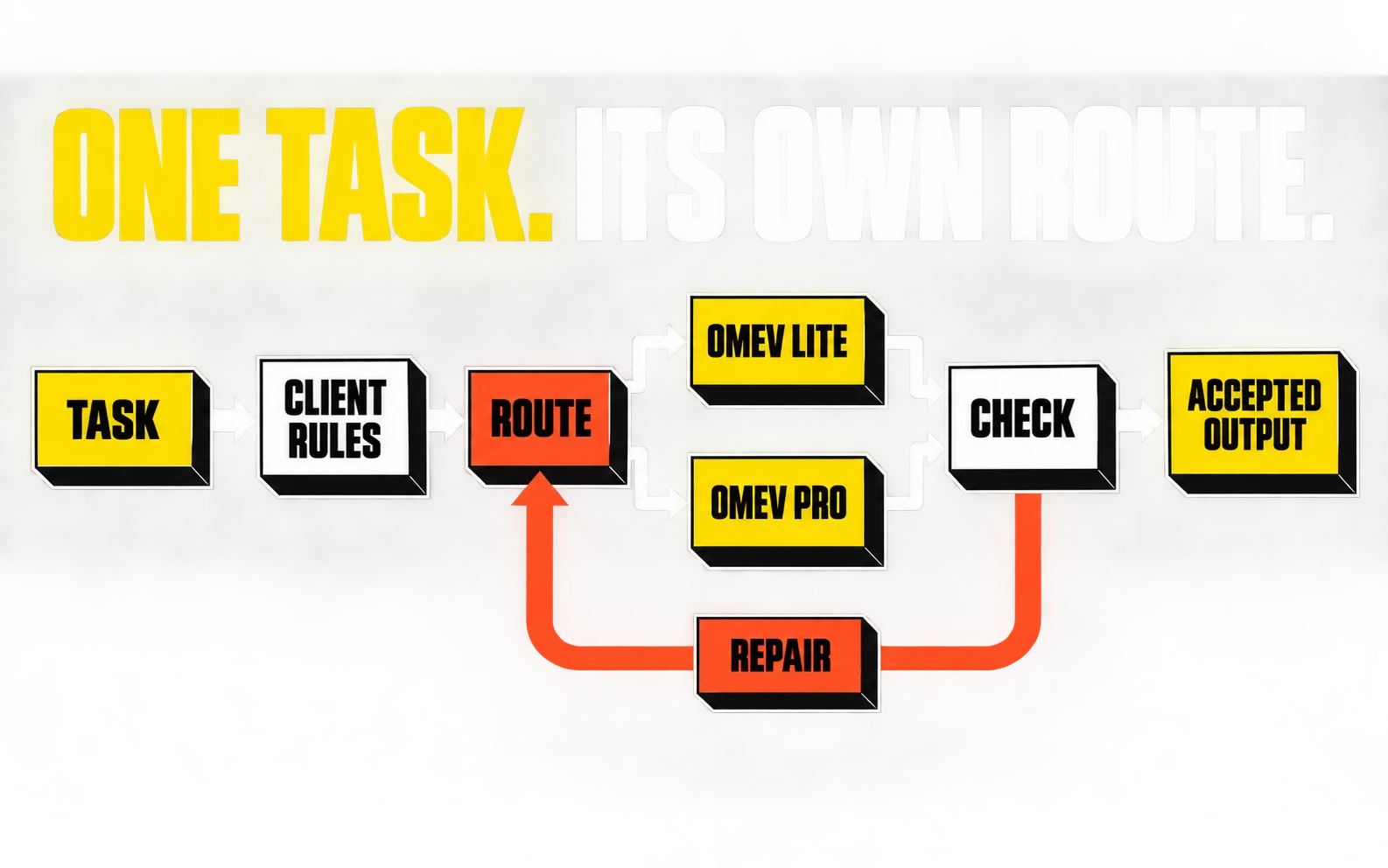
Omev recognises the job, applies your rules, routes it between our own models, checks the result and repairs failures. You get one OpenAI-compatible endpoint and a different execution path for each type of work.

Optimise the cost of work your team accepts—not merely the price of the first generation.

$5 free credit · 10 days · no card · Keep your current provider connected

One task passes through client rules, routes between Omev Lite and Omev Pro, is checked and repaired if needed, then becomes an accepted output.

Router is an overloaded word

A model gateway moves requests. Omev owns the work around the result.

Both approaches can be useful. The choice is whether your team wants access to many named models—or wants one repeated business job to arrive already checked against its own rules.

Typical AI gateway or LLM router

Your team builds the business workflow.

  • Gives one access layer to several models or providers
  • Chooses a model by cost, speed, availability or your rules
  • Leaves task-specific business logic and acceptance to your team
  • Fits teams that need named models and provider control

Omev AI router

The route starts with what the job must deliver.

  • Recognises the type of business job
  • Applies your facts, format, voice and acceptance criteria
  • Routes between Omev's own models or model sequences
  • Checks the result and runs repair or fallback when it misses
  • Optimises the total cost of work your team can accept

Need a particular third-party model, provider failover or a broad catalogue? Keep that work on a gateway or direct API. Omev is for the repeatable tasks where the finished result matters more than the model name.

Try the idea

Same endpoint. A different route for each job.

Choose a workload. The input, rules, model path and checks change together—without turning your application into a growing pile of one-off logic.

The job

Turn supplier data into a publish-ready product record.

What good means here

  • Keep exact product facts
  • Return the agreed fields
  • Match the marketplace format

What Omev does

  1. 01Start with Omev Lite
  2. 02Check facts and required fields
  3. 03Use Omev Pro only when the first result needs repair

Business result

A product record ready for your team to review, with the cheaper path used whenever it passes.

Measure: Cost per publish-ready SKU

Illustrative routes. Your rules and the model sequence come from the benchmark on your own work.

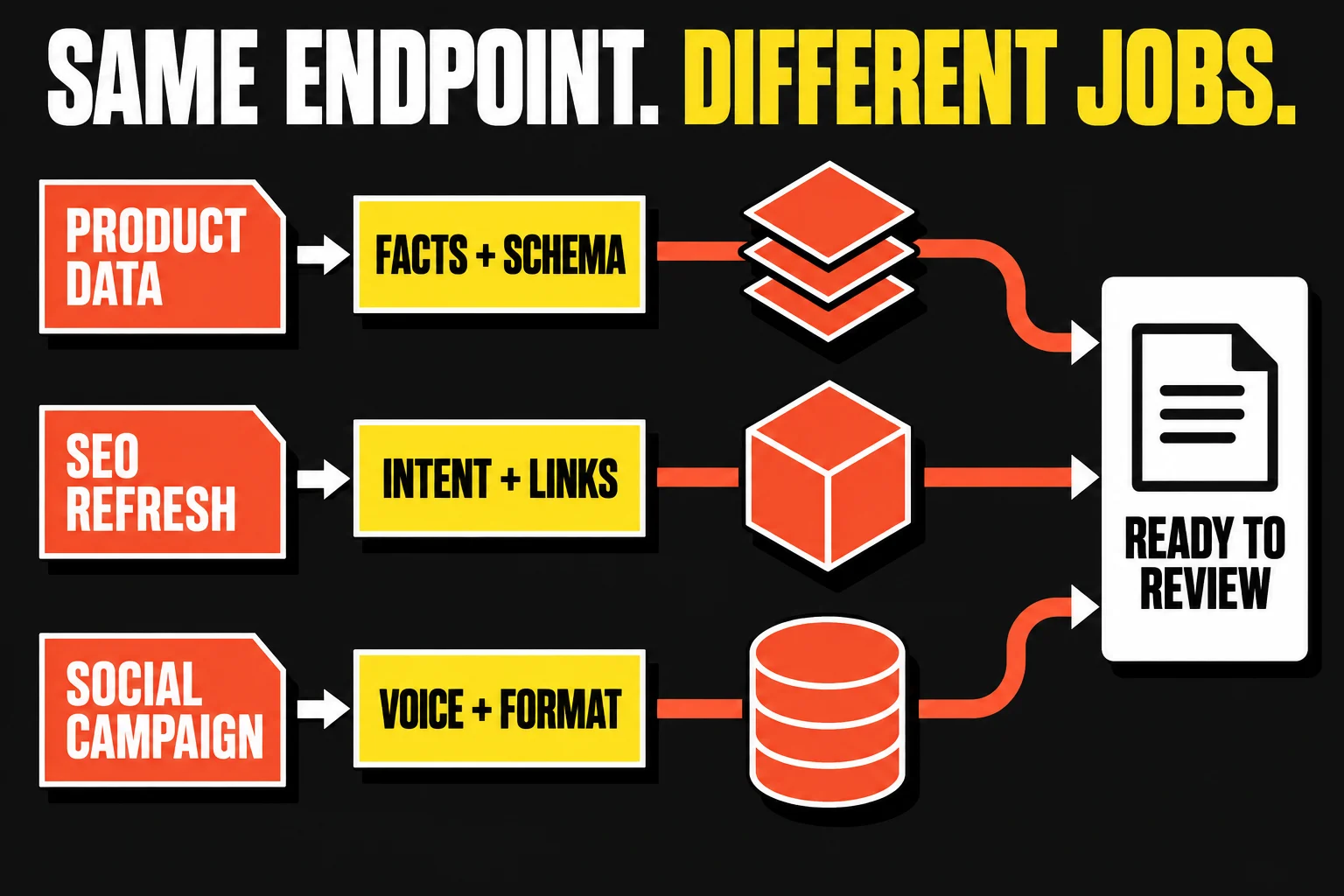
Product data, an SEO refresh and a social campaign each follow different rules and paths before reaching the same ready-to-review stage.

One connection, fewer exceptions

Your product keeps the simple interface. The work changes behind it.

Product data needs factual discipline. SEO needs intent and links. Social content needs each client's voice. Omev keeps those rules attached to the job and returns work in the form your team expects.

Your engineers still own when to call Omev and any independent service-level fallback. Omev owns the model choice, checks and repair inside the route you benchmark with us.

What happens after signup

Start with evidence, not a platform migration.

Every registered customer can get a tailored route. The first goal is not to move everything. It is to prove one repeated job against the output and cost you have today.

  1. 01

    Share your real work

    Register and share a sample of production requests. Omev automatically groups them by task type and establishes your current models and cost baseline from the information you provide.

    You leave with: Your tasks and baseline

  2. 02

    Define good. Benchmark it.

    Agree the required facts, format, voice and quality criteria. Omev benchmarks its own models and sequences against those requirements and your current output.

    You leave with: Criteria and measured results

  3. 03

    Connect your tailored route

    Omev builds your routing policy and provides an OpenAI-compatible endpoint. Start with one task type; model selection, validation, repair and fallback run on our side.

    You leave with: Your policy and endpoint

  4. 04

    Improve with real usage

    Omev collects cost, latency, validation and retry telemetry. Production results feed automatic routing improvements measured against your acceptance criteria.

    You leave with: A policy informed by real results

Best first workloads

Route the work you repeat and can judge.

A strong first job has meaningful volume, stable input, clear rules and a result your team already knows how to approve.

Questions before you route a workload

AI router FAQ

What is an AI router?

An AI router decides how a request should be handled instead of sending every job through the same model and workflow. Omev first identifies the business task, applies your rules, selects from its own models, checks the result and repairs or retries it when required.

Is an AI router the same as an AI gateway?

Not always. A gateway commonly gives one access layer to several third-party models and providers. Omev is not a marketplace for outside models. It runs the task workflow between Omev's own models and measures whether the finished result meets your agreed criteria.

Does Omev route requests to OpenAI, Anthropic or Gemini?

No. Omev routes work between its own models and model sequences. Keep a direct provider or gateway when you need a named third-party model, a broad model catalogue or provider-level controls.

What does cost per accepted output mean?

It is the full cost of generation, checks, repairs and retries divided by the results that meet your requirements. It is more useful than token price alone because rejected work still consumes budget and review time.

Do we have to move every AI request?

No. Start with one repeated task you can measure clearly. Keep your current provider connected and move only the share that passes the benchmark and your operational checks.

How does Omev learn our rules?

After registration, share a representative sample of real requests and the result your team accepts. Omev groups the work by task type, agrees the facts, format and quality checks with you, benchmarks its own models and builds the routing policy around those results.

Can we keep an OpenAI-compatible integration?

Omev provides an OpenAI-compatible endpoint for supported text calls. Your technical team should verify the request fields and failure handling for the task being moved; the public API documentation covers those implementation details.

Who can use tailored routing?

It is available to every registered customer. The safest start is one workload with clear acceptance criteria, then expand after the production results hold up.
Benchmark one route on work you already run.

Bring a representative sample, your current baseline and the rules a finished result must pass. We will follow up personally and build the first routing policy around that evidence.

Benchmark My Workload →
$5 free credit · 10 days · no cardKeep your current providerImplementation details ↗