Move the final rewrite to OmevAI—and make every generated draft sound like your product.
Add one humanization pass that removes mechanical phrasing, repetition and generic tone at about 78% less token cost than Claude Haiku 4.5 on the default profile. Keep the original generation call; move only the layer that shapes the final voice.
Register with your work email. We will follow up personally about the workflow and voice you want to test.
$5 free credit · 10 days · no card
Built for SaaS products, marketplaces and content platforms where customer-facing AI text grows with usage. Start with one high-volume workflow, measure how much editing disappears, then expand the pass across the product.

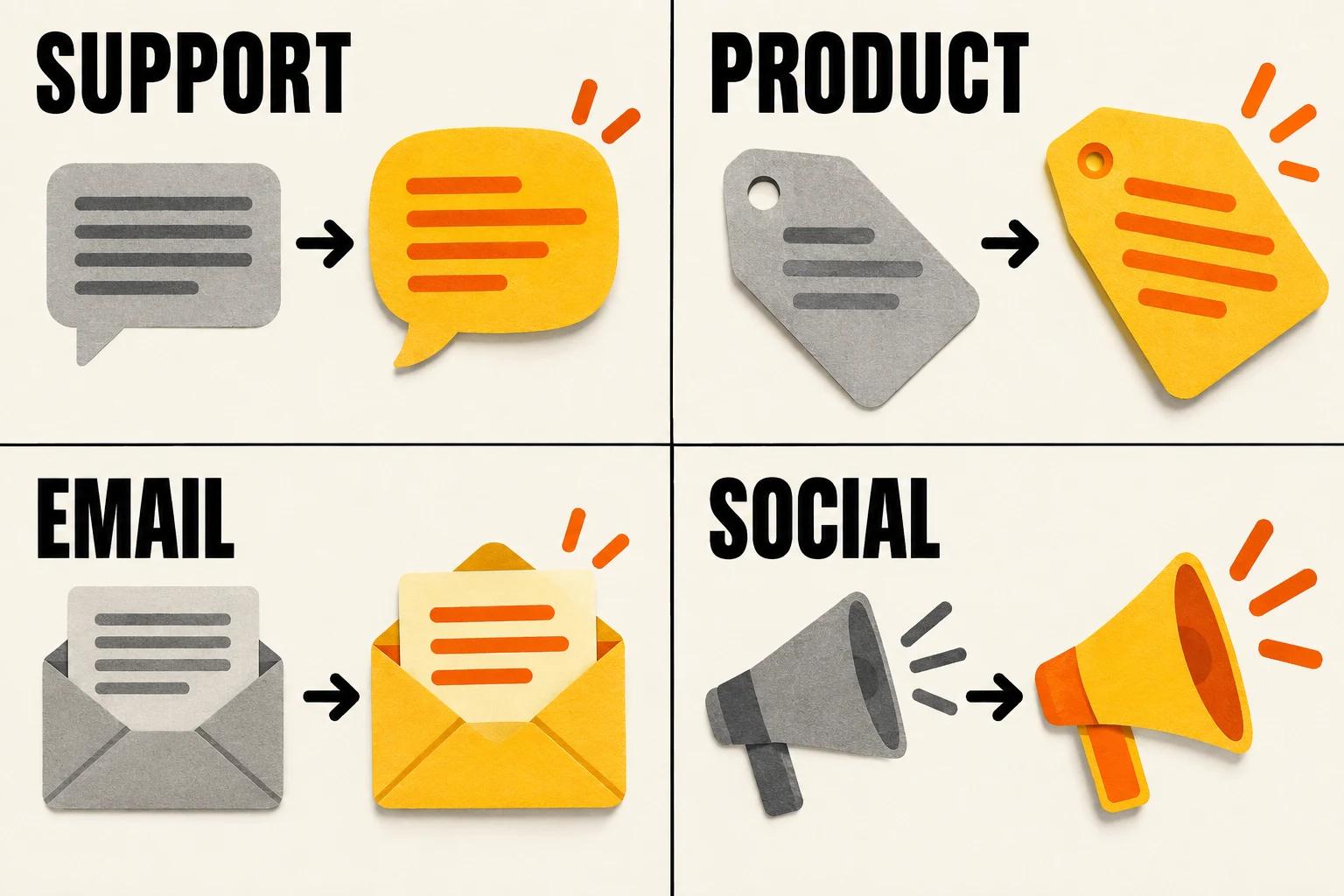
Before → after
The difference should be obvious in one paragraph.
Choose a workflow. The source stays true; the rhythm, clarity and tone stop sounding like a default template.
Machine-written draft
“We are pleased to inform you that your request has been received and our team will address it in the shortest possible time.”
Humanized output
“Thanks for sending this over. Our team has it, and we’ll get back to you shortly.”
Illustrative rewrites, not a quality benchmark. Your result depends on the source text, voice instructions and model you choose.
The generation is automated. The last edit usually is not.
A product can generate every reply, description or message automatically and still leave a person fixing the same final problems: stiff openings, repeated transitions, inflated wording and a voice that belongs to no brand. That manual pass becomes part of the cost of every customer, listing and campaign.
Humanization is useful when it becomes one repeatable layer after generation—not another writing project. Keep the original provider, prompt and facts. Move only the final voice pass, measure how much editing remains, then expand it wherever the same cleanup repeats.
At 100,000 rewrites of roughly 300 input and 180 output tokens, the list-price estimate is $27 on OmevAI Lite versus $120 on Claude Haiku 4.5—$93 kept each month before any reduction in manual editing.
What does the humanization pass cost at your volume?
Start with the number of customer-facing drafts rewritten each month. The default is a short source and a slightly shorter final version; replace the assumptions with your own token profile.
- Humanized outputs
- 100,000
- On Claude Haiku 4.5
- $120
- On OmevAI Lite
- $27.00
Per draft: $0.0012 on Claude Haiku 4.5 against $0.0003 on OmevAI Lite.
Benchmark My Humanization Cost →How this is calculated
The token profile is an editable assumption, not a measured average. Both sides use the same input and output volume at published standard short-context rates, before caching, Batch pricing, cache-write charges, long-context uplifts, reasoning-token differences or retries. The default uses Claude Haiku 4.5; select the model running your rewrite today and validate the move on your own drafts.
Check Claude Haiku 4.5 at Anthropic ↗Move the repeatable voice layer to OmevAI. Keep the decisions with your team.
The message, facts and approval rules stay yours. OmevAI handles the final language pass that repeats across every customer-facing workflow.
Keep human-owned
- Pricing, policies, guarantees and claims somebody has to approve.
- Founder messages, campaign concepts and flagship copy written for a specific moment.
- Sensitive support escalations where the response depends on the account history.
- The source facts and the decision about what the message should say.
Humanize at scale
- First-pass support replies built from an approved answer.
- Product and listing copy generated from structured fields.
- Lifecycle messages repeated across segments and triggers.
- Assistant responses that need one consistent product voice.
Six text workflows where the final voice pass can pay for itself.
Start where the text already follows a repeatable shape and the manual cleanup grows with usage. Each one is tagged with the OmevAI product it belongs on.
AI assistant responses
OmevAI ProGive every generated answer the same clear product voice before it reaches the user, without moving the assistant itself.
Support reply drafts
OmevAI LiteTurn an approved answer into a direct, natural reply before an agent reviews or sends it.
Product and marketplace copy
OmevAI LiteRemove template residue from descriptions generated from the same supplier fields across thousands of listings.
Email and lifecycle messages
OmevAI LiteKeep onboarding, retention and win-back copy consistent without making every trigger sound identical.
Creator and social tools
OmevAI ProGive users a publishable draft with a chosen tone instead of a paragraph they immediately rewrite elsewhere.
Localization finishing pass
OmevAI ProSmooth literal phrasing after translation while preserving the message and the structure already approved.

One voice across the product
Your customer should not hear a different company in every workflow.
Support, product copy, lifecycle email and generated pages may start from different systems. The final pass can apply the same voice rules to all of them without forcing those systems into one platform.
What this looks like in production.
Support platform
A SaaS produces 300,000 first-pass replies a month from approved help content. Agents still remove formal openings and generic closing lines before sending.
Route only the final rewrite, compare edit time and acceptance on a representative queue, and keep the current generation call unchanged.
Marketplace catalogue
Every new merchant feed creates descriptions with the right attributes but the same mechanical sentence pattern.
Apply the marketplace voice after enrichment, preserve the structured facts and test one low-risk category first.
SaaS copilot
A user-facing assistant answers correctly but sounds different across product areas because each team maintains its own prompt.
Use one shared voice pass after the existing answers, then compare it against the current response before expanding traffic.
How much has to change.
Add one transformation after the text you already generate. Your source model, business rules, storage and review flow stay where they are.
Start with one workflow and run both versions side by side. What matters is not whether the rewrite looks different—it is whether customers and editors keep it with fewer changes.
Read the API docs →What it costs.
OmevAI Lite is $0.15 per 1M input tokens and $1.25 per 1M output tokens for short, repeatable rewrites. OmevAI Pro is $0.625 in and $5.00 out when the voice brief or context is richer. Pay as you go, with no seat or monthly commitment.
OmevAI Pro
$0.625 in / $5.00 out per 1M tokens
OmevAI Lite
$0.15 in / $1.25 out per 1M tokens
List prices, checked 15 September 2026 · token rate card and calculator
What we can actually prove.
Every claim below is either arithmetic on published rate cards or a fact you can check. We do not publish quality benchmarks we ran on ourselves — we run yours instead.
Move 100,000 short humanization passes from Claude Haiku 4.5 to OmevAI Lite and the list-price token bill falls from $120 to $27.
How this is supported
Illustrative profile: 300 input and 180 output tokens each, or 30M input and 18M output tokens. OmevAI Lite: 30 × $0.15 + 18 × $1.25 = $27. Claude Haiku 4.5: 30 × $1 + 18 × $5 = $120. That is $93 kept each month, or $1,116 a year, at standard rates checked 15 September 2026.
If GPT-5.6 Terra runs the richer voice pass today, the same token volume prices at $108.75 on OmevAI Pro versus $276 on Terra.
How this is supported
The same illustrative 30M input and 18M output tokens. OmevAI Pro: 30 × $0.625 + 18 × $5 = $108.75. GPT-5.6 Terra: 30 × $2 + 18 × $12 = $276. This is price arithmetic only, not a claim that the models produce equivalent output.
At 500,000 short rewrites a month, moving from Claude Haiku 4.5 to OmevAI Lite keeps $465 a month—or $5,580 a year.
How this is supported
Five times the illustrative 100,000-pass profile is $600 on Claude Haiku 4.5 and $135 on OmevAI Lite. The difference is $465 a month before discounts, retries or the value of any editing time removed.
Current reference rates
Compare the migration against the current tier that runs the work.
This page uses Claude Haiku 4.5 as the default economy-tier reference and GPT-5.6 Terra for richer passes. The calculator still lets you select another current model and see the same workload at its published rate.
Questions before you add the humanization pass.
Is this an AI-detector bypass tool?
No. The workload is customer-facing rewriting: clarity, rhythm, tone and brand voice. We do not position it as making text undetectable, and an AI detector score is not the success metric for the benchmark.
Is humanization just paraphrasing?
A useful pass does more than swap synonyms. It can shorten formal constructions, remove repetition, vary sentence rhythm, follow a tone brief and preserve the requested structure. Test those behaviours on your own drafts rather than accepting a generic quality claim.
How do we keep our brand voice?
Bring a short voice brief, examples you would publish and examples you would reject. Keep the rules concrete—preferred vocabulary, sentence length, banned phrases and formatting—then run the same set before and after every prompt change.
Should we use Lite or Pro?
Start with Lite for short, repetitive rewrites with a stable template. Use Pro when the pass needs more context, a richer voice brief or greater variation across longer drafts. The benchmark should decide whether the extra context changes the result enough to justify the rate.
Do we have to replace the model generating the original text?
No. Keep the generation call where it is and add humanization as a separate pass for one workflow. That makes the comparison and rollback small.
How do we test it?
Register with your work email and bring a representative batch of drafts plus the voice rules your team already uses. Run the current and humanized versions side by side, then compare how much editing remains before publication.
Other use cases








Move one rewrite workflow and start keeping the difference.
Register with your work email. We will benchmark one representative humanization workflow, return the outputs and show what moving the same monthly volume saves in tokens and editing effort.
$5 free credit · 10 days · no card · Keep your current provider connected