Localization that already knows your product.
One API applies your glossary, terminology locks, product names, tone and market rules while preserving variables, HTML, links, numbers and character limits. Every response includes the localized text and the checks it passed.
Register with your work email. We will follow up personally about the source content, markets and localization rules you want to test.
$5 free credit · 10 days · no card
Built for SaaS products, marketplaces, PIM and localization platforms that need every release to sound native without breaking the product, format or search intent behind it.
Source + policy in · localized text + validation out
See what the engine protects—not just what it translates.
Switch workflows to inspect the source, locked terminology, forbidden translations and format rules beside the localized output and validation report.
Localization input
Source
Invite {{member_count}} teammates to Acme Cloud
Glossary · locked
Forbidden translations
Format and market constraints
- German (Germany) · informal ‘du’
- Maximum 70 characters
- Preserve {{member_count}} exactly
Localized output
Lade {{member_count}} Teammitglieder zu Acme Cloud ein
Validation report
- Terminology compliance Pass
- Teammitglieder used; Acme Cloud remains unchanged.
- Format compliance Pass
- {{member_count}} preserved exactly; output remains within 70 characters.
- Market and tone Adapted
- German (Germany) with the requested direct, informal product voice.
Localization input
Source
<p>Upgrade to <strong>Acme Cloud Pro</strong> and save 25%.</p> <a href="{{pricing_url}}">View plans</a>
Glossary · locked
Forbidden translations
Format and market constraints
- French (France) · professional tone
- Preserve HTML tags and href value
- Preserve product name, number and variable
Localized output
<p>Passez à <strong>Acme Cloud Pro</strong> et économisez 25 %.</p> <a href="{{pricing_url}}">Voir les offres</a>
Validation report
- Terminology compliance Pass
- Approved verb used; product name remains locked.
- Format compliance Pass
- Paragraph, strong tag, link and {{pricing_url}} remain intact.
- Numbers and offer Adapted
- 25% retained and formatted for the French market as 25 %.
Localization input
Source
Title: Project planning software for remote teams Description: Plan work, share updates and keep every remote project moving in one workspace.
Glossary · locked
Forbidden translations
Format and market constraints
- Spanish (Spain) · clear B2B tone
- Preserve SEO intent: software de planificación de proyectos
- Title ≤ 60 characters · description ≤ 155
Localized output
Title: Software de planificación de proyectos remotos Description: Planifica el trabajo, comparte avances y mantén cada proyecto remoto en marcha desde un solo espacio de trabajo.
Validation report
- Terminology compliance Pass
- Both approved glossary terms are present; forbidden alternatives are absent.
- SEO intent Adapted
- The target planning-software intent remains explicit in the title.
- Format compliance Pass
- Title and description remain within the supplied character limits.
Illustrative outputs, not a quality benchmark. Your benchmark should use real source strings, approved translations, market rules and the same reviewers who approve production releases.
What does the generation layer cost as markets grow?
Start with the localization spend and market count you already know. This estimates the token-priced generation layer; compare editing distance, errors and reviewer time separately to calculate the accepted workflow cost.
Omev advantage at 18 markets
Save $1,500/month on generation.
$18,000/year · 50% below the compared rate card
Today's $1,000 across 6 markets scaled by 3.0× for the same workload per market.
Your projected Omev savings
$1,500
saved per month
$18,000 saved per year
50% lower generation cost for the compared repeatable workload.
Benchmark My Localization Workflow →$5 free credit · 10 days · no card
How this is calculated
The calculation assumes your current spend covers today's market count, workload per market stays constant and tokens are split evenly between input and output. It compares published list-price generation only—not retries, translator review or integration work. Use one representative batch to calculate cost per 1,000 accepted strings.
The expensive translation is the one that breaks the release.
A sentence can be linguistically correct and still fail production: a variable changes, a link breaks, a product name drifts, a button exceeds its limit or a search page loses the intent it was meant to capture.
Treat localization as a product-aware workflow. The engine receives the source plus glossary, terminology locks, forbidden alternatives, format rules, tone and market context; it returns the localized text with a validation report your reviewer can act on.
Optimize reviewer-ready localization—not cost per translated token.
The localization metrics
Measure what the reviewer still has to repair.
Use the same source, glossary and acceptance rules when you compare routes. Token spend matters after terminology, format and market intent survive the release.
Editing distance
How much of the localized output a reviewer changes before approval, measured consistently across the sample.
Terminology errors
Missing glossary terms, forbidden translations or altered product names found during review.
Format errors
Broken variables, HTML, links, numbers, schemas or character limits per batch.
Cost per 1,000 strings
Generation, retries and review cost normalized to one thousand accepted localized strings.
Reviewer time
Minutes spent validating and correcting each batch, market or thousand strings.
Keep market judgement. Automate the rules it creates.
Your team defines the product language and what ‘approved’ means. OmevAI applies those decisions to every repeated string, page and release.
Keep human-owned
- Product positioning, source meaning and market strategy.
- The approved glossary, forbidden alternatives and product names.
- Tone, search intent and market-specific adaptation decisions.
- Final approval and translator corrections for high-impact content.
Automate with OmevAI
- Glossary-aware translation with terminology locks.
- Preservation of variables, HTML, links, numbers and product names.
- Character-limit, format and structured-output checks.
- Tone and market adaptation for each locale.
- Multilingual SEO localization that preserves search intent.
- Policy updates built from approved translator corrections.
Six product-aware localization workflows.
Start with the content types where terminology, format and market rules repeat across every release. Each one is tagged with the OmevAI product it belongs on.
UI strings with variables and character limits
OmevAI LiteLocalize buttons, tooltips and product messages while preserving placeholders, product names and the space available in the interface.
HTML pages with links, numbers and structure
OmevAI LiteTranslate the visible copy without changing tags, href values, percentages, plan names or the structure the page depends on.
Product and catalogue localization
OmevAI ProApply product context, approved terminology, units and market templates across large listing and PIM update queues.
Multilingual SEO pages and metadata
OmevAI ProPreserve search intent, target terminology, title limits and internal links instead of translating keywords literally.
Marketing and lifecycle localization
OmevAI ProAdapt tone, offer framing and calls to action for each market while keeping approved product claims and campaign structure intact.
Continuous policy improvement from reviewer edits
OmevAI LiteFeed approved translator corrections back into the glossary, tone and market policy so the same issue does not repeat in the next batch.
What this looks like in production.
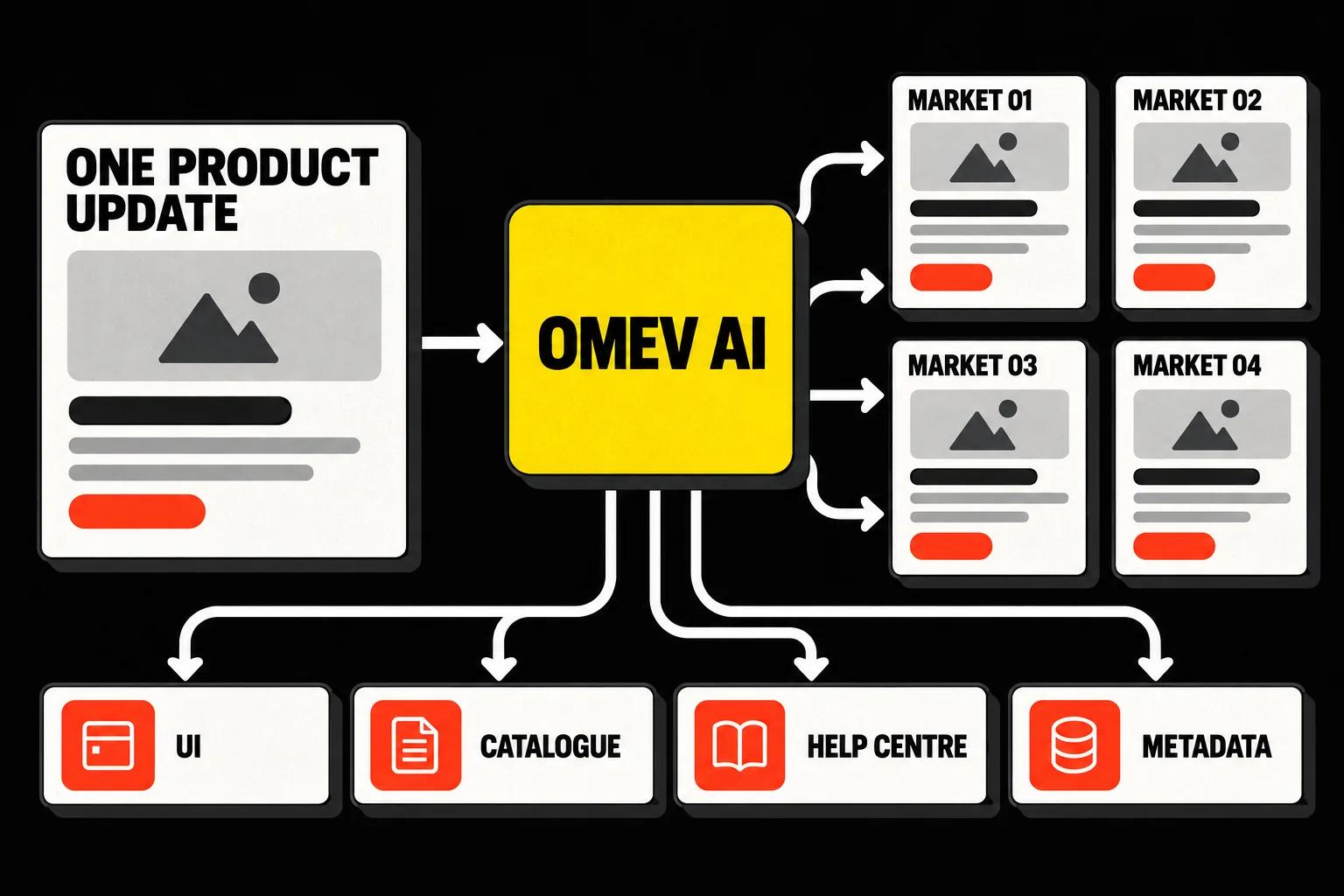
A SaaS ships one UI release across eighteen markets
The batch contains variables, plan names, numbers and strict button limits. Each market also has approved product terminology and a different formality rule.
OmevAI applies the matching locale policy, preserves the runtime values and returns a validation report before the strings enter the existing review queue.
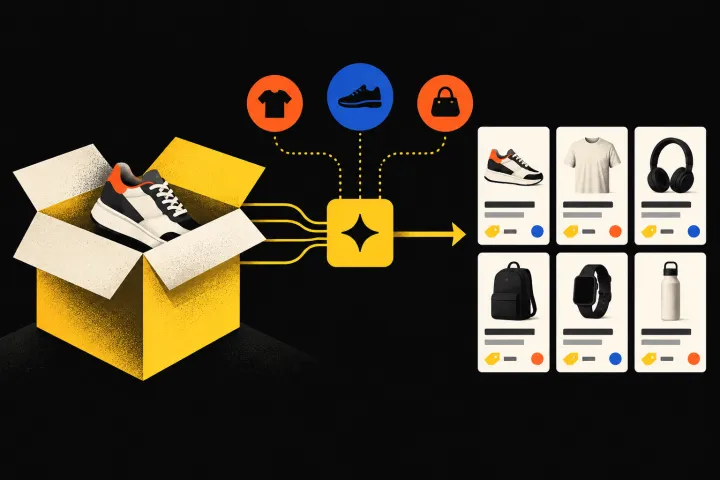
A marketplace localizes product records, not loose paragraphs
An approved catalogue update includes product names, structured attributes, units, HTML fragments and links that must remain connected across locales.
The localized record follows the market template while product identifiers, protected names and structural fields stay intact.
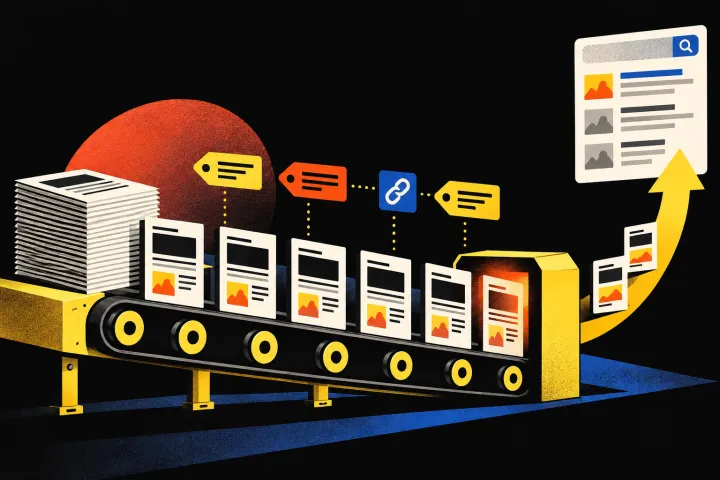
A content platform expands one SEO page into new markets
Literal translation would preserve the sentences but lose the local query, title length and approved internal-link language.
OmevAI receives the search intent, glossary and limits with the source, then reports terminology and format compliance beside the localized metadata.
How much has to change.
Connect one selected content type or locale. Your TMS, PIM, translation memory and review queue remain in place; OmevAI receives the source with its product context, glossary and rules, then returns localized content plus validation results.
Start with a batch containing variables, HTML, product names and market-specific terminology. After review, feed approved translator corrections back into the locale policy and rerun the same acceptance checks on the next batch.
Read the API docs →What it costs.
OmevAI Lite is $0.15 per 1M input tokens and $1.25 per 1M output tokens for structured volume. OmevAI Pro is $0.625 in and $5.00 out when longer content needs more context. Pay as you go, with no seat or monthly commitment.
OmevAI Lite
$0.15 in / $1.25 out per 1M tokens
OmevAI Pro
$0.625 in / $5.00 out per 1M tokens
List prices, checked 15 September 2026 · token rate card and calculator
What we can actually prove.
Every claim below is either arithmetic on published rate cards or a fact you can check. We do not publish quality benchmarks we ran on ourselves — we run yours instead.
$1,000 of recurring Gemini 3.5 Flash-Lite generation prices at $500 on OmevAI Lite under the calculator's token-mix assumption.
How this is supported
At an even input/output split, the blended list rate is $1.40 per 1M tokens on Gemini 3.5 Flash-Lite and $0.70 on OmevAI Lite. $1,000 × $0.70 / $1.40 = $500. This compares price only, tier for tier, using published list rates checked 15 September 2026.
At the same workload per market, growing from six markets to eighteen creates a $1,500 monthly list-rate difference in the default example.
How this is supported
If $1,000 covers the same repeatable workload in six markets, eighteen markets project to $3,000 on Gemini 3.5 Flash-Lite. At the same even token split, that workload prices at $1,500 on OmevAI Lite. The calculator lets you replace every starting number.
The generation portion of an illustrative twelve-market help-centre refresh is $108 on OmevAI Pro at the stated profile.
How this is supported
Illustrative workload: 14,400 localized articles at 1,600 input and 1,300 output tokens each. That is 23.04M input and 18.72M output tokens. Applied to the published list rates, the totals are $108 on OmevAI Pro, $270.72 on GPT-5.6 Terra and $233.28 on Claude Sonnet 5.
Questions before you connect a localization workflow.
Can we lock glossary terms and forbid specific translations?
Yes. Send approved terms, product names, translations that must never appear and any market-specific alternatives with the source. The validation report should show whether required terminology is present and forbidden alternatives are absent.
What happens to variables, HTML, links and numbers?
Include the required preservation rules with the request. OmevAI can keep placeholders, tags, attributes, URLs, numbers and protected product names intact, then return format checks beside the localized text. Benchmark the exact structures your production content uses.
Can it respect character limits and structured output?
Yes. Supply the maximum length, required fields or output schema for each content type. Treat a string that exceeds the limit or changes the structure as a failed validation, not a successful translation.
How does multilingual SEO differ from literal translation?
Provide the page's search intent, target terminology, title and description limits, and approved link language for the market. The localized output can adapt to those rules while the validation report confirms that the intended topic and format remain present.
How do translator corrections improve later batches?
Approved corrections can update the client's glossary, preferred phrasing, forbidden alternatives, tone and locale rules. Apply those policy changes to later batches and track whether editing distance and repeated error types fall on the same content class.
How should we benchmark the workflow?
Use a representative sample containing variables, markup, product terms and market-specific content. Compare editing distance, terminology errors, format errors, reviewer time and total cost per 1,000 accepted strings under the same review criteria.
Other use cases








Benchmark one content type across your real market rules.
Register with your work email. We will run a representative localization sample with your glossary, protected formats and acceptance criteria, then return the outputs and validation results for reviewer comparison.
$5 free credit · 10 days · no card · Keep your current provider connected