20 brands. 20 voices. One API.
Scale social content without making every client sound like the same AI. Apply each brand's voice, terminology, forbidden phrases and platform rules to every campaign variant—then measure the cost of posts editors actually approve.
Register with your work email. We will follow up personally about the brands, campaign and approval criteria you want to test.
$5 free credit · 10 days · no card
Built for social media SaaS, agencies and marketing platforms managing many brands at once. Start with one campaign and three client policies, compare approval and editing effort, then expand the route across the publishing queue.
Same brief · different client policy
The campaign stays consistent. The brands do not sound identical.
Switch profiles to see how voice, required terminology, forbidden phrases and platform format change the output without changing the underlying launch facts.
Same campaign brief
Announce the Ridge bottle: 750 ml, stainless steel, screw-top lid, matte graphite. Launches Friday. CTA: join the waitlist.
Client-specific policy
- Voice
- Direct, energetic and practical. Short sentences. One restrained emoji.
- Platform and format
- Instagram · Hook · product facts · waitlist CTA
- Use
- pack listeveryday carryRidge
- Never use
- game-changingultimateluxury
Platform-ready output
Friday's pack-list update: Ridge. ⛰️ 750 ml. Stainless steel. Screw-top lid. Matte graphite. Built to earn a place in your everyday carry. Join the waitlist.
Client-specific policy
- Voice
- Quiet, precise and minimal. No hype, emojis or exclamation marks.
- Platform and format
- LinkedIn · Three short paragraphs · understated CTA
- Use
- matte graphitestainless steelconsidered
- Never use
- must-haverevolutionaryperfect
Platform-ready output
Meet Ridge. A considered 750 ml bottle in stainless steel, finished in matte graphite with a screw-top lid. Launching Friday. Join the waitlist for release details.
Client-specific policy
- Voice
- Compact, playful and current. Product first; no corporate phrasing.
- Platform and format
- TikTok · On-screen hook · caption · CTA
- Use
- Friday dropdaily rotationRidge
- Never use
- premiumhydration solutioninnovative
Platform-ready output
ON SCREEN: YOUR FRIDAY DROP Ridge lands Friday: 750 ml, stainless steel, matte graphite, screw-top. Ready for the daily rotation. Join the waitlist.
Illustrative outputs, not a quality benchmark. Your policy is built from your real voice guide, approved terminology, exclusions, channel rules and examples.
Generation cost before editor time
What does one approved campaign batch cost to generate?
Enter the source campaigns your customers create, how many platforms each one reaches and the model running that work today. Then add approval rate and editor time to your benchmark outside the token calculation.
500,000 Platform-ready variants a month
$1,788
kept each month on generation before editor time.
If this workload runs monthly: $21,450 kept per year.
Benchmark My Brand Voices →$5 free credit · 10 days · no card
How this is calculated
The default assumes 2,000 input and 500 output tokens per platform-ready variant: source material, client policy and platform brief in; one draft out. These are assumptions, not measurements. The calculator covers generation only—not retries, approval rate or editor time. Compare cost per approved post on a representative batch before publishing.
Start with one publishing job. Keep your current provider connected.
The expensive post is the one an editor has to rewrite.
When every client runs through one generic prompt, the output converges: the same rhythm, the same claims and the same polished AI voice. A low token price does not rescue a workflow whose editors rewrite every draft before it reaches the queue.
Treat each client policy as part of production: voice, approved terminology, forbidden phrases, channel format and campaign rules. Then repurpose the approved idea, generate several creative angles and check every version against the right brand before it reaches review.
Judge the route by cost per approved post—not cost per first draft.
The approval metrics
Measure whether the brand voice survives the workflow.
Token cost is only the generation line. Benchmark the complete path from brief to approved post and keep the acceptance criteria fixed while you compare routes.
Cost per approved post
Generation, retries and editor time divided by the posts that clear review.
Approved without rewrite
The share that reaches approval without an editor changing the copy.
Editor time
Minutes spent reviewing and correcting each campaign batch or 100 posts.
Batch cost
The total production cost for one campaign across its brands, platforms and formats.
Approved variations
How many distinct creative angles pass the client policy and remain useful for testing.
Keep the campaign idea human. Scale each client's policy automatically.
Your team decides what the campaign means and what claims it can make. OmevAI applies the right client policy to every repeated format and variation.
Keep human-owned
- Campaign strategy, offer, claims and the original point of view.
- The source-of-truth voice guide and approved client terminology.
- Final approval of public replies, sensitive copy and high-risk campaigns.
- Performance analysis and the decision about the next creative direction.
Scale with OmevAI
- Adaptation to each brand voice and client-specific policy.
- Checks for forbidden phrases, required terms and delivery format.
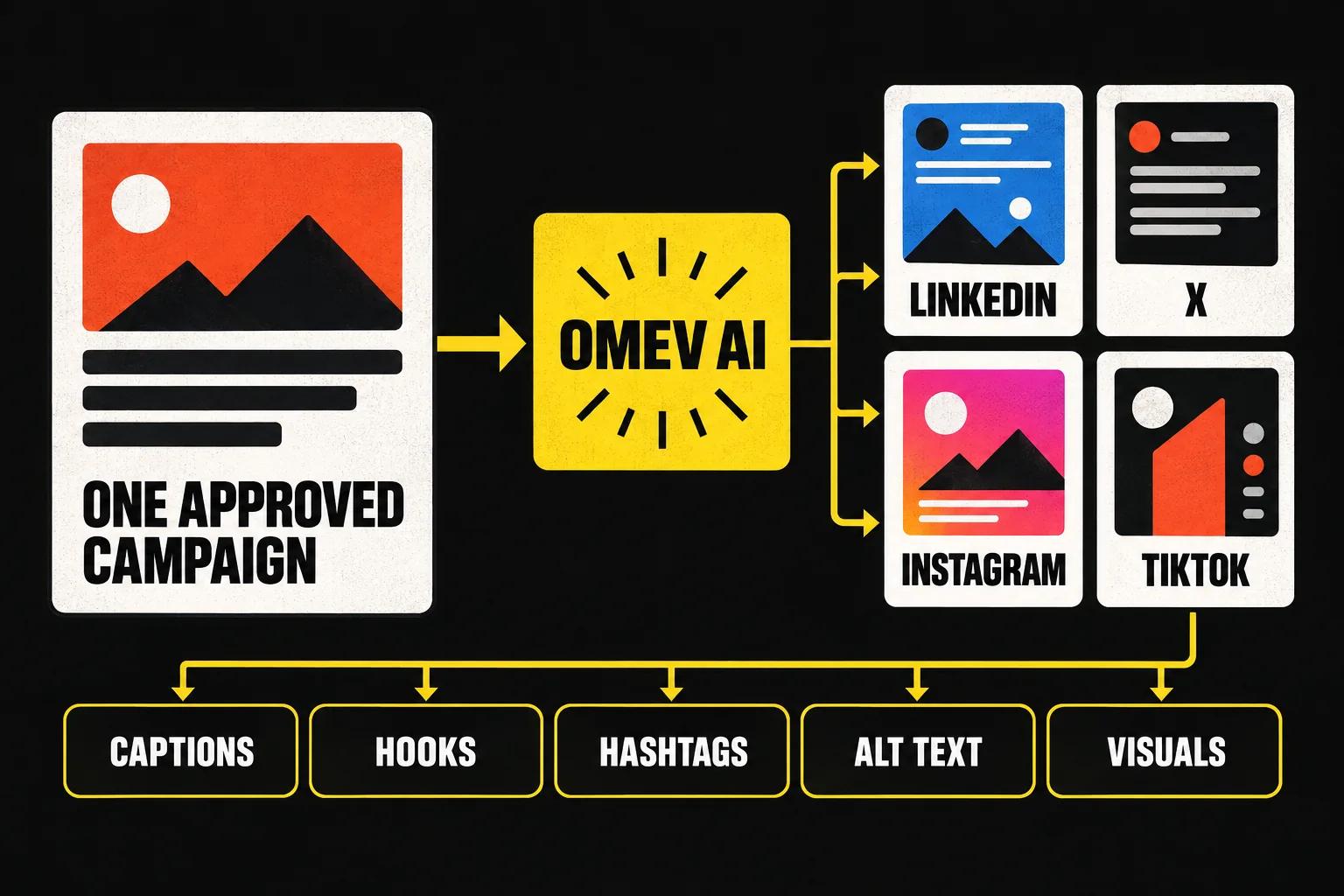
- Platform-specific captions, hooks, hashtags and alt text.
- Repurposing one approved asset into every required social format.
- Multiple creative angles for campaign testing.
- Campaign-level consistency across a full publishing calendar.
Six multi-brand workflows to scale first.
Start with one approved campaign and the client policies that have to survive every variation. Each one is tagged with the OmevAI product it belongs on.
Brand voice adaptation for every client
OmevAI LiteAttach the right voice, vocabulary and exclusions to each account so twenty brands do not collapse into one house style.
Platform-specific formats
OmevAI LiteTurn one approved idea into the length, structure, CTA and metadata each network expects without rewriting the campaign logic.
Content repurposing from approved assets
OmevAI LiteConvert a webinar, article, product launch or campaign brief into a complete social package while preserving its facts and message.
Creative angles for campaign testing
OmevAI LiteGenerate distinct hooks and approaches under the same client policy instead of returning cosmetic rewrites of one AI draft.
Campaign-level consistency
OmevAI LiteKeep terminology, offer framing and voice stable across a launch calendar even when different formats are generated in separate batches.
Policy checks before review
OmevAI LiteCatch forbidden phrases, missing required terms and wrong platform structures before the content enters the client's approval queue.
Additional social workflow
Generate campaign visuals in bulk.
Create channel-ready image variants beside the copy. Direct generation starts at $0.0192 per delivered 1K image; bulk and other delivery options are priced on the image API page.
What this looks like in production.
An agency runs one launch across twenty client voices
The source brief is shared, but every client has its own tone, mandatory vocabulary, forbidden phrases and approval standard.
Store one policy per client, generate the campaign batches separately and compare approval without rewrite before expanding volume.
A scheduler turns one approved asset into a week of content
A webinar or article becomes LinkedIn posts, Instagram captions, short hooks, hashtags and alt text for the same campaign.
The approved message stays fixed while the format changes. Measure batch cost, editor minutes and consistency across the calendar.
An ad platform generates angles instead of near-duplicates
One campaign brief needs several genuinely different approaches, all within the same client policy and claim boundaries.
Count the variations that pass review and remain distinct enough to test—not the number of drafts returned.
How much has to change.
Connect the publishing jobs you choose to test and give each client its own policy: voice, terminology, exclusions, platform formats and acceptance criteria. OmevAI applies that policy, selects between its own models and checks the result on our side.
Start with one campaign across three representative brands. Keep the scheduler, approval queue and current provider connected while you compare approval without rewrite, editor time, batch cost and cost per approved post.
Read the API docs →What it costs.
OmevAI Lite is $0.15 per 1M input tokens and $1.25 per 1M output tokens. Campaign images start at $0.0192 per delivered 1K image; Image Jobs is $0.021 and Image Pro is $0.024. Pay as you go starts with a $10 balance top-up, with no seat or monthly commitment.
OmevAI Lite
$0.15 in / $1.25 out per 1M tokens
OmevAI Image Lite
$0.0192 per delivered image
1K (1024×1024) · Direct response
OmevAI Image Jobs
$0.0210 per delivered image
1K output · Async bulk
OmevAI Image Pro
$0.0240 per delivered image
1K-class output · Direct response · embedded text
List prices, checked 15 September 2026 · token rate card and calculator · image and video rate card
What we can actually prove.
Every claim below is either arithmetic on published rate cards or a fact you can check. We do not publish quality benchmarks we ran on ourselves — we run yours instead.
The generation portion of 500,000 social variants is about $463 on OmevAI Lite versus $2,250 on Claude Haiku 4.5 at list rates.
How this is supported
At 2,000 input and 500 output tokens each, 500,000 versions use 1,000M input and 250M output tokens. OmevAI Lite: 1,000 × $0.15 + 250 × $1.25 = $462.50. Claude Haiku 4.5: 1,000 × $1 + 250 × $5 = $2,250. That is $1,787.50 kept each month, or $21,450 a year, at standard list rates without cache or batch discounts.
The same social generation volume costs half as much on OmevAI Lite as on Gemini 3.5 Flash-Lite at standard list rates.
How this is supported
At the same 500,000-version profile, Gemini 3.5 Flash-Lite is $925 versus $462.50 on OmevAI Lite. Its $0.30 input / $2.50 output rates are exactly twice OmevAI Lite's $0.15 / $1.25.
The $5 signup credit covers about 5,400 draft variants at the default token profile.
How this is supported
One version is $0.000925 on OmevAI Lite at 2,000 input and 500 output tokens. $5 divided by $0.000925 is 5,405. The credit is valid for 10 days and requires no card; actual coverage moves with your prompts.
Questions before you scale multi-brand content.
How does OmevAI keep twenty brands from sounding the same?
Each client gets its own policy: voice, required terminology, forbidden phrases, platform formats and acceptance criteria. OmevAI applies the matching policy to the task, routes it between its own models and checks the result before it reaches your review flow. Benchmark this on real client examples rather than trusting a generic tone claim.
Can policies include forbidden phrases and approved terminology?
Yes. Provide the terms a client requires, the phrases it never uses, tone rules, format constraints and approved examples. The same client policy can also carry campaign-specific approval rules.
Does the same policy work across every platform?
The brand policy stays consistent, while the delivery format changes by platform. Define the length, structure, CTA, metadata and other channel rules for each format, then test whether the campaign still sounds like the same brand across the complete batch.
Can we repurpose existing content instead of starting from a blank prompt?
Yes. Use an approved article, webinar, campaign brief or product launch as the source. OmevAI can create platform-specific versions and several creative angles while preserving the approved facts and client policy.
What should we measure in the benchmark?
Track cost per approved post, the percentage approved without rewrite, editor time, total batch cost and how many distinct variations pass the client policy. Token cost is useful, but it is not the outcome if editors still rewrite every post.
Can we benchmark without publishing anything?
Yes. Run the same campaign through OmevAI and your current workflow, keep every output outside the publishing queue and have the same editors apply the same client criteria. Start with three representative brands before expanding.
Other use cases








Benchmark one campaign across your client policies.
Register with your work email. We will run a representative campaign across your brand voices, return the outputs and compare approval effort, batch cost and cost per approved post with your current workflow.
$5 free credit · 10 days · no card · Keep your current provider connected