From messy supplier data to publish-ready product pages.
OmevAI extracts source-backed attributes, preserves SKU families, categorizes products and returns marketplace-ready titles, descriptions, specs, structured schema and localized variants. Add multi-reference product imagery in the same production flow.
Register with your work email. We will follow up personally about the supplier data, PIM schema and marketplace output you want to test.
$5 free credit · 10 days · no card
Built for commerce platforms, PIM vendors, marketplaces and catalogue SaaS products that need to turn incomplete feeds into finished SKUs without adding a manual content team for every merchant or market.
One SKU · complete production path
Watch a supplier record become a product page.
Move through the pipeline to see where source data is preserved, where content is generated and where missing facts stop for review instead of being invented.
One source record
Supplier CSV: RB-750-GPH · ‘RIDGE BOTL 750 GRY’ · 18/8 SS · screw cap. Source page: matte graphite · 312 g · hand wash. References: front, side and lid-detail images.
Stage 1 of 7
Collect the evidence for one SKU.
The supplier row, source page and reference images remain attached to the product record so later fields can be traced back to evidence.
Product record at this stage
- Supplier CSV Source-backed
- RB-750-GPH · RIDGE BOTL 750 GRY · 18/8 SS · screw cap
- Source page Source-backed
- Matte graphite · 312 g · hand wash
- Reference images Source-backed
- Front · side · lid detail
Stage 2 of 7
Extract only source-backed attributes.
Names and units are normalized to the catalogue schema. A missing value stays missing and is routed to review; it is not filled from guesswork.
Product record at this stage
- Preserved SKU Source-backed
- RB-750-GPH
- Normalized attributes Source-backed
- Volume: 750 ml Material: 18/8 stainless steel Colour: matte graphite Closure: screw-top Weight: 312 g
- Insulation Needs review
- Not provided by any source
Stage 3 of 7
Map the SKU into the approved taxonomy.
The category and attribute set follow your PIM taxonomy rather than a model's improvised category tree.
Product record at this stage
- Category Generated
- Drinkware → Reusable bottles
- Product type Generated
- Water bottle
- Required attribute set Generated
- Volume · material · colour · closure · care
Stage 4 of 7
Build every publishable field from one record.
Titles, descriptions, specifications and structured schema share the same facts, variant identifiers and marketplace template.
Product record at this stage
- Title Generated
- Ridge 750 ml Stainless-Steel Bottle — Matte Graphite
- Description Generated
- A 750 ml bottle in 18/8 stainless steel with a screw-top closure and matte graphite finish.
- Structured output Generated
- Product schema · SKU · material · colour · size · care
Stage 5 of 7
Localize the product record, not just the paragraph.
Terminology, units, required fields and marketplace format can change by locale while the underlying SKU facts stay fixed.
Product record at this stage
- UK marketplace Generated
- Ridge 750 ml Stainless-Steel Bottle — Matte Graphite
- German marketplace Generated
- Ridge Edelstahl-Trinkflasche, 750 ml — Graphit matt
- Variant link Source-backed
- Parent and child SKU relationships retained in both locales
Stage 6 of 7
Check facts, variants and schema before export.
The record is checked against its sources and acceptance rules. Missing or conflicting fields are returned as review items instead of confident product claims.
Product record at this stage
- Source-backed fields Source-backed
- Volume, material, colour, closure and weight traced to the input record
- Variant preservation Source-backed
- RB-750-GPH retained; no parent-child merge
- Open review item Needs review
- Insulation remains empty because no source provides it
Stage 7 of 7
Create product variants from multiple references.
Front, side and detail references can guide channel-specific product imagery while the text record supplies the SKU, colourway and merchandising context.
Product record at this stage
- Reference set Source-backed
- Front · side · lid detail
- Requested outputs Generated
- Marketplace hero · PDP detail · localized lifestyle scene
- Consistency check Needs review
- Matte graphite finish, bottle silhouette and screw-top closure held for review
Illustrative workflow, not a quality benchmark. In production, your PIM schema, source precedence, taxonomy, marketplace templates and review rules define what counts as publish-ready.
Text enrichment cost before review and imagery
What does the text enrichment pass cost?
Enter the number of SKUs in one run. This prices the text-generation portion on your current model and OmevAI Lite; calculate imagery and manual review separately when you compare cost per finished SKU.
200,000 SKU records in this pass
$408
kept on text generation each time this 200,000-SKU pass runs.
If this workload runs monthly: $4,896 kept per year.
Benchmark My Supplier Feed →$5 free credit · 10 days · no card
How this is calculated
The default assumes 3,600 input and 1,200 output tokens per SKU record: supplier data, taxonomy, channel rules and schema in; text fields out. These are assumptions, not measurements. The calculator excludes image generation, retries and review time. Compare cost per finished SKU on a representative supplier sample before moving the full feed.
Text generation only. Product imagery is priced separately.
The expensive SKU is the one your team still has to assemble.
A cheap description does not make a finished SKU. If attributes are missing, variants get merged, categories drift or the output fails the marketplace schema, your catalogue team still pays to repair the record by hand.
Treat enrichment as one production path: evidence in, normalized attributes and taxonomy next, channel content and localization after that, then source checks, schema validation and image variants. The useful unit is the product record that clears review.
Optimize cost per finished SKU—not cost per generated description.
The catalogue metrics
Measure how much of the feed is actually ready to publish.
Keep the source sample and acceptance criteria fixed while comparing workflows. Token cost explains one line of the bill; these metrics show whether the SKU is finished.
Cost per finished SKU
Generation, retries, imagery and review time divided by the product records that clear every required check.
Manual review time
Minutes the catalogue team spends validating and correcting each SKU or each 1,000-record batch.
Missing attribute rate
The share of required marketplace or PIM fields that remain empty after enrichment.
Hallucinated attribute rate
The share of populated product facts that cannot be traced back to an approved source.
Publish-ready percentage
The share that passes source, variant, schema, content and channel checks without manual correction.
Keep the source of truth. Automate the path to publication.
Your team owns the product evidence, taxonomy and acceptance rules. OmevAI applies them repeatedly across every SKU, marketplace and locale.
Keep human-owned
- The PIM or supplier record that is allowed to define product facts.
- Taxonomy, structured schema and marketplace acceptance rules.
- Parent-child relationships and SKU variation logic.
- Merchandising direction and final approval of creative imagery.
Automate with OmevAI
- Extraction and normalization of source-backed product attributes.
- Product categorization and mapping into the approved PIM schema.
- Titles, descriptions, specifications and metadata for each marketplace.
- Product localization with locale-specific terminology, units and formats.
- Checks for unsupported facts, missing attributes, schema errors and broken variants.
- Multi-reference product image variants for channel-specific placements.
Six commerce workflows inside one finished SKU.
Start with one supplier category and the full path its records must clear before publication. Each one is tagged with the OmevAI product it belongs on.
Extract and normalize a supplier feed
OmevAI LiteTurn inconsistent labels, units and product fields into source-backed attributes that match the catalogue structure your platform already uses.
Preserve product families and SKU variations
OmevAI LiteKeep parent-child links, colorways, sizes and supplier identifiers intact while each variant receives its own content and structured fields.
Categorize products and populate the PIM schema
OmevAI LiteMap each record to the approved taxonomy and return structured fields that can enter the PIM instead of another unstructured draft.
Publish one record to every marketplace
OmevAI LiteGenerate channel-specific titles, bullets, descriptions, specifications and metadata from one approved product record.
Localize the complete product record
OmevAI LiteAdapt terminology, units, structured fields and merchandising copy to each locale without changing the underlying product facts or SKU links.
Validate the record before PIM export
OmevAI LiteCheck source support, required attributes, schema validity and variation links, then return unresolved fields as review items instead of publishable claims.
Additional commerce workflow
Build channel-specific product imagery from a reference set.
Send front, side and detail references with the product record, then request marketplace heroes, PDP details or localized lifestyle variants. Review visual consistency before publishing.
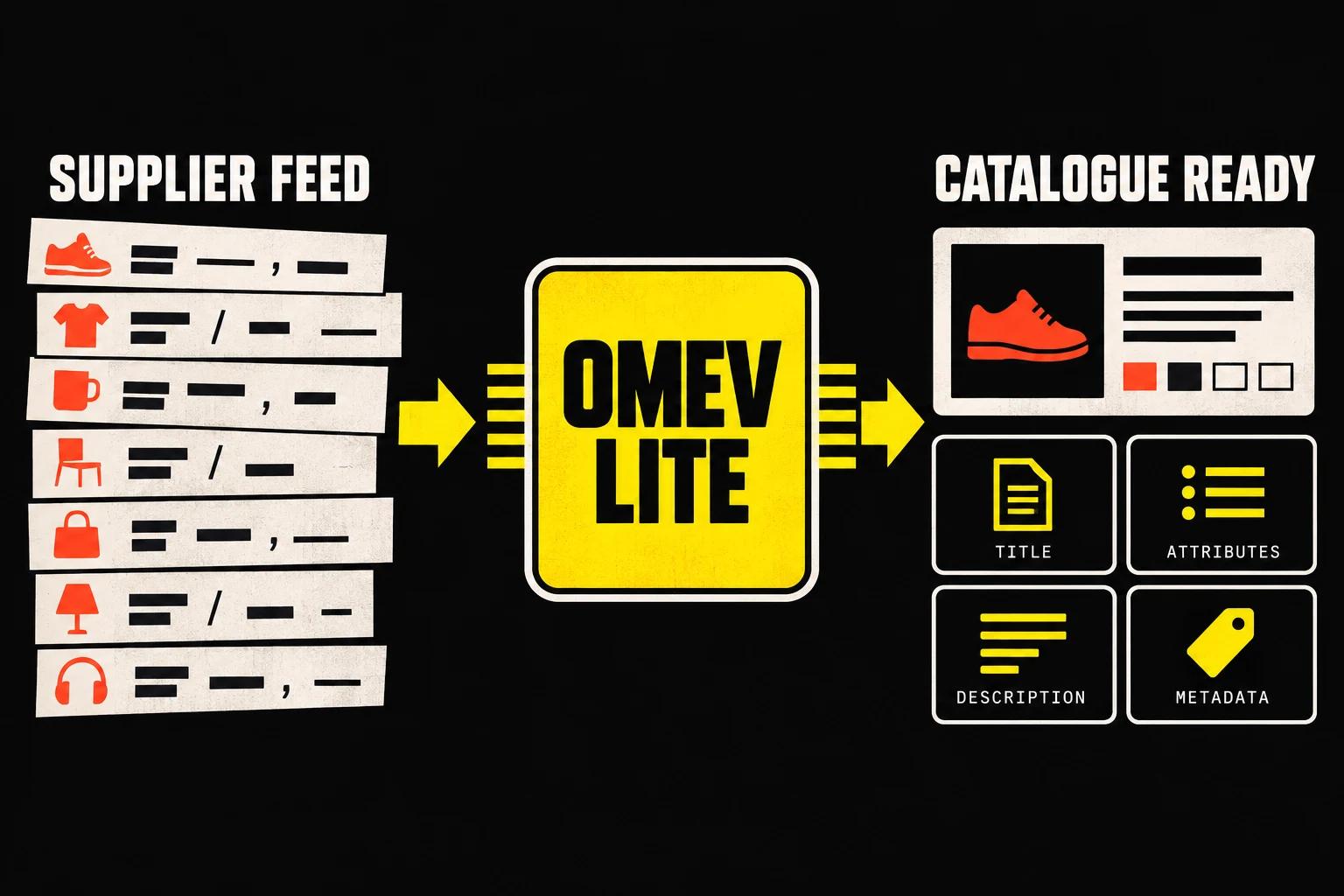
Supplier evidence in · structured record out
One source trail follows the SKU to every channel.
The product record keeps its source-backed attributes, variant identity and review items while titles, specifications, marketplace fields and localized versions are produced around it.
What this looks like in production.
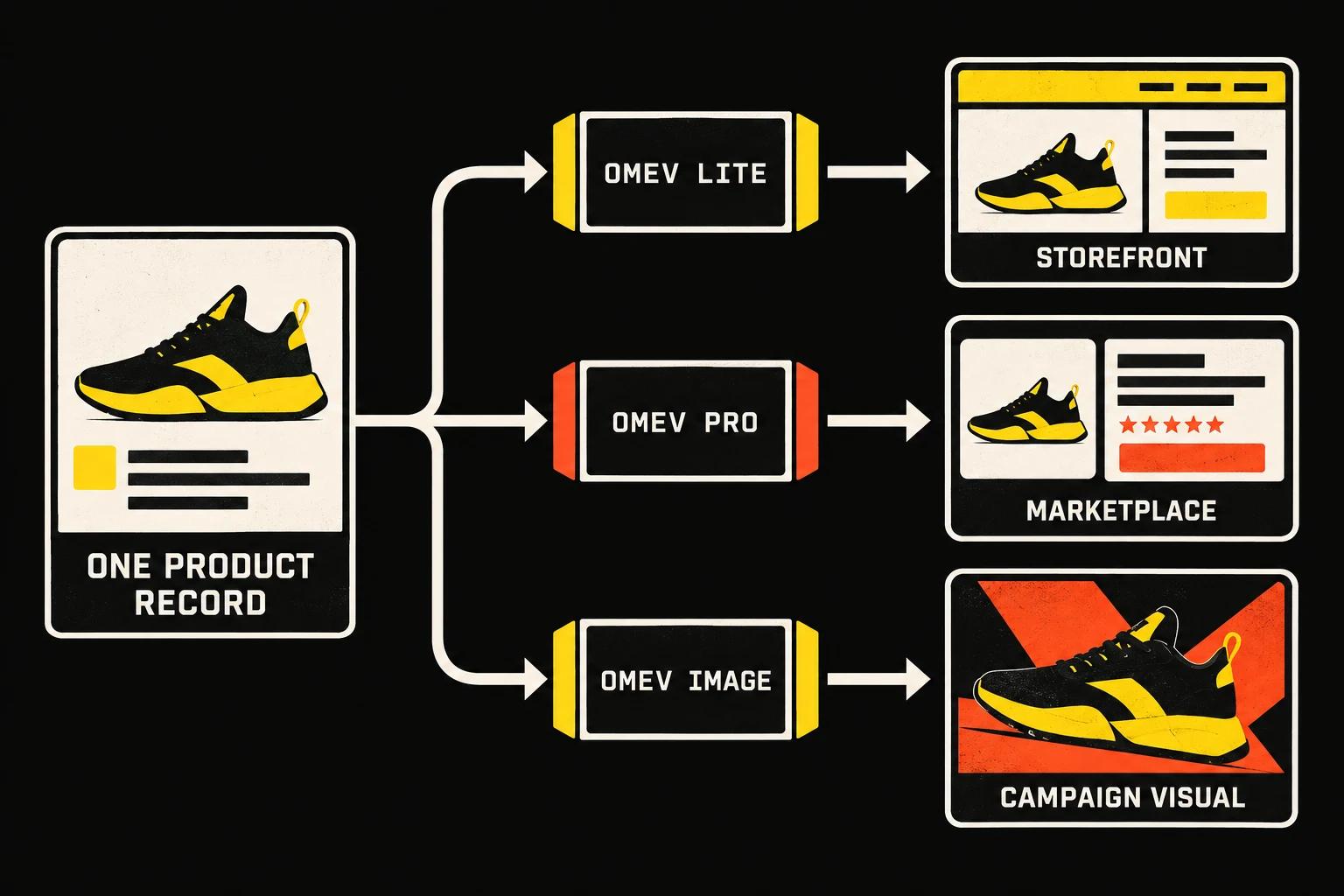
A marketplace onboards a fragmented supplier feed
The CSV, source pages and reference images disagree on naming and completeness. Required attributes differ by category, and missing values cannot be guessed.
OmevAI extracts source-backed fields, maps each product to the approved category and schema, flags unresolved attributes and returns a reviewable product record.
A merchant launches the same range in a new market
The product facts stay fixed, but the marketplace requires a different title structure, attribute set, units, language and image format.
One approved SKU becomes a localized, marketplace-specific record while its variation family and source evidence remain attached.
A catalogue team needs more than one product shot
A front image alone is not enough for a marketplace hero, PDP detail and localized lifestyle placement across every SKU variation.
The workflow combines multiple references with product context, requests the channel variants and holds the result for visual consistency review.
How much has to change.
Connect one supplier feed or selected PIM job. Your PIM remains the source of truth; OmevAI receives the approved sources, taxonomy, schemas, marketplace templates and variation rules, then returns structured product records through the existing queue.
Start with a representative category that includes complete, incomplete and multi-variant SKUs. Keep the current workflow connected while you compare missing and unsupported attributes, review time, schema validity and publish-ready percentage.
Read the API docs →What it costs.
OmevAI Lite is $0.15 per 1M input tokens and $1.25 per 1M output tokens for catalogue text and structured records. Product images start at $0.0192 per delivered 1024×1024 image; Image Jobs is $0.021 and Image Pro is $0.024. Pay as you go starts with a $10 balance top-up, with no seat or monthly commitment.
OmevAI Lite
$0.15 in / $1.25 out per 1M tokens
OmevAI Image Lite
$0.0192 per delivered image
1K (1024×1024) · Direct response
OmevAI Image Jobs
$0.0210 per delivered image
1K output · Async bulk
OmevAI Image Pro
$0.0240 per delivered image
1K-class output · Direct response · embedded text
List prices, checked 15 September 2026 · token rate card and calculator · image and video rate card
What we can actually prove.
Every claim below is either arithmetic on published rate cards or a fact you can check. We do not publish quality benchmarks we ran on ourselves — we run yours instead.
The text-generation portion of one 200,000-SKU pass is $408 on OmevAI Lite versus $816 on Gemini 3.5 Flash-Lite at list rates.
How this is supported
At 3,600 input and 1,200 output tokens each, 200,000 SKUs use 720M input and 240M output tokens. OmevAI Lite: 720 × $0.15 + 240 × $1.25 = $408. Gemini 3.5 Flash-Lite: 720 × $0.30 + 240 × $2.50 = $816. Standard list rates without cache or batch discounts.
At six million SKU text records a month, the same rate difference is $12,240 a month—or $146,880 a year.
How this is supported
Six million SKUs use 21,600M input and 7,200M output tokens at the stated profile. OmevAI Lite is $12,240; Gemini 3.5 Flash-Lite is $24,480. The difference is $12,240 a month or $146,880 a year.
Against Claude Haiku 4.5, the same 200,000-record text profile is about 79% lower on OmevAI Lite at list rates.
How this is supported
Claude Haiku 4.5 prices the same 720M input and 240M output tokens at $1,920 versus $408 on OmevAI Lite. That is $1,512 kept every time the full catalogue runs, before discounts, retries or review costs.
Questions before you connect a supplier feed.
What does the no-hallucination policy mean for product data?
Product facts must be supported by an approved supplier row, source page, PIM field or other source you provide. Missing or conflicting values are left empty and returned as review items instead of being completed from model guesswork. Measure the unsupported-attribute rate on your own sample before publishing.
Will parent, child and variation SKUs stay connected?
Your PIM and supplier identifiers remain the source of truth. Provide the parent-child and variation rules with the record, then include broken links, merged variants and missing variation attributes in the acceptance checks for the benchmark.
Can the output go back into our PIM as structured data?
Yes. Define the category taxonomy, attribute names, required fields and output schema used by your PIM. OmevAI returns the product record in that structure rather than forcing the catalogue team to copy fields from prose.
How do marketplace and localization rules fit into the same flow?
Start from one approved product record, then apply the title structure, required attributes, units, terminology and content format for each marketplace and locale. The underlying product facts and SKU links stay fixed while the delivery format changes.
Can product images use more than one reference?
Yes. A product-image job can use a set such as front, side and detail references together with the SKU context and requested channel format. Keep visual consistency review in the publishing flow, especially across colorways and product families.
How should we benchmark a supplier feed?
Use a representative category with complete, incomplete and multi-variant records. Compare cost per finished SKU, manual review time, missing and unsupported attribute rates, and the percentage that clears your schema and channel checks without correction.
Other use cases










Benchmark one supplier feed from source to publish-ready SKU.
Register with your work email. We will run a representative product sample through extraction, categorization, content, structured output, localization and QA, then compare finished-SKU cost and review effort with your current workflow.
$5 free credit · 10 days · no card · Keep your current provider connected