Move repeatable GEO production to OmevAI—and keep more of the budget for evidence.
Turn approved research, product facts and expert input into clear answer pages, comparisons, FAQs and evidence blocks at 78% less token cost than Claude Haiku 4.5 on the default profile. Keep strategy and claims with your team; move the repeatable production and refresh layer to OmevAI.
Register with your work email. We will follow up personally about the question set and content workflow you want to test.
$5 free credit · 10 days · no card
Built for SaaS companies and content platforms maintaining large question sets, comparison libraries or help centres. If GEO means five important pages, write them deliberately; this becomes an API problem when the library and its refresh cycle become operational work.

The first answer page is editorial work. The next thousand are operations.
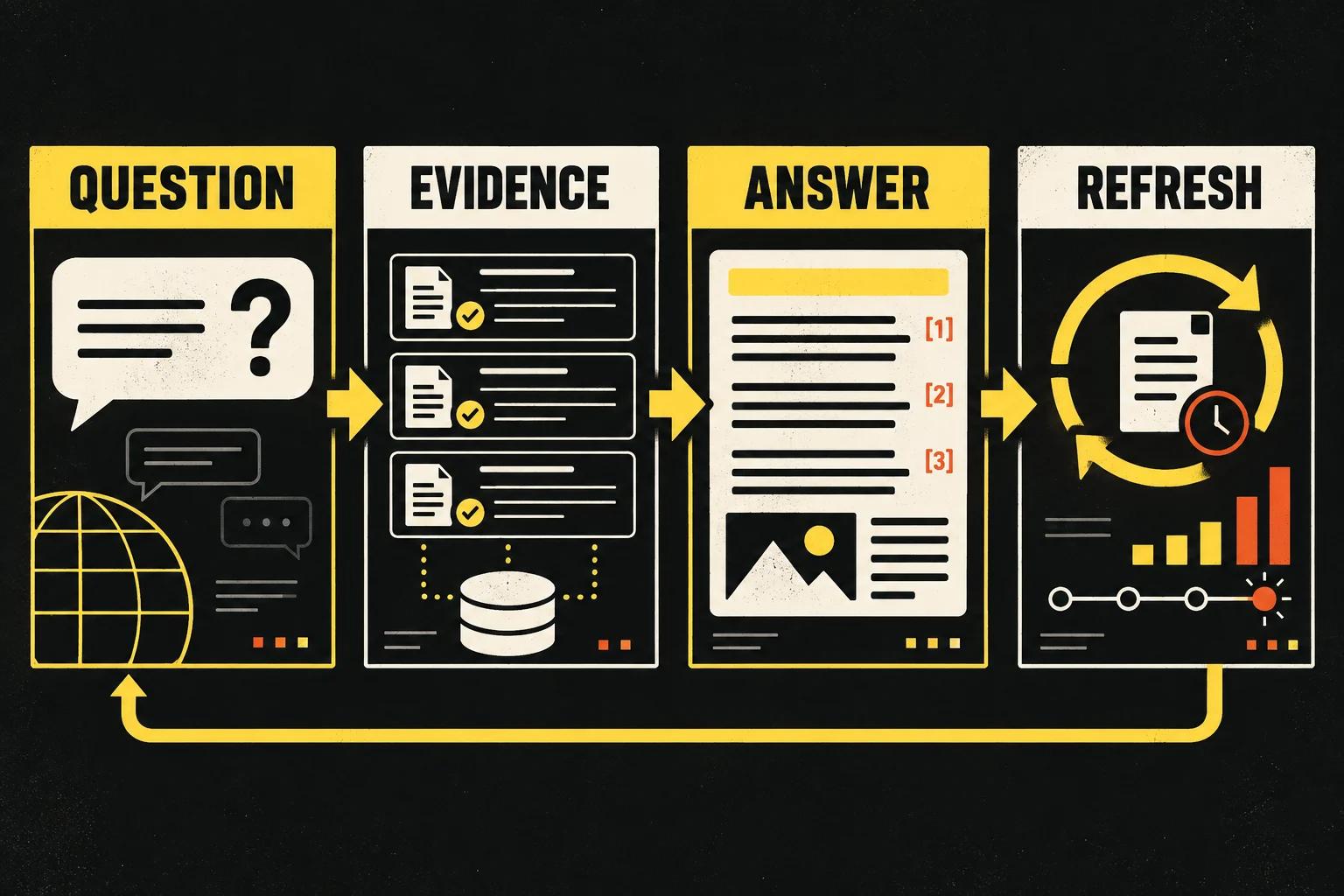
A credible GEO programme starts with questions worth answering, evidence worth citing and a clear point of view. None of that should be delegated to a bulk generator. The cost problem appears after the method is approved: one question becomes a page, a comparison, an FAQ entry, a product fact block and later another refresh.
Route that repeatable production layer, not the judgement behind it. Your team owns the question set, sources and claims. OmevAI turns the approved inputs into consistent page shapes at a rate that leaves room to keep the library current instead of treating launch day as the finish line.
At 100,000 answer pages of roughly 1,500 input and 900 output tokens, the list-price estimate is $135 on OmevAI Lite versus $600 on Claude Haiku 4.5—$465 kept per production cycle.
What does a maintained answer library cost?
Start with the number of pages produced or refreshed each month. The default represents a focused answer page assembled from an approved evidence pack; change the token profile to match your own workflow.
- Pages produced or refreshed
- 10,000
- On Claude Haiku 4.5
- $60.00
- On OmevAI Lite
- $13.50
Per answer page: $0.0060 on Claude Haiku 4.5 against $0.0014 on OmevAI Lite.
Benchmark My GEO Content Cost →How this is calculated
The token profile is an editable planning assumption, not a measured average. Both sides price the same token volume at published list rates, before retries, caching or batch discounts. This estimates content production only; it does not estimate or promise citations, rankings or traffic.
Check Claude Haiku 4.5 at Anthropic ↗Keep the evidence human-owned. Scale the answer formats around it.
There is no useful shortcut around original expertise. The API earns its place after the questions, facts and standard are approved.
Keep human-owned
- The decision about which questions matter to the market and the business.
- Original research, proprietary data, expert interviews and the point of view competitors cannot copy.
- Approval of comparisons, product claims and every source used as evidence.
- The editorial standard that decides whether an answer is genuinely useful enough to publish.
Scale with OmevAI
- Question-led answer pages built from an approved evidence set and page template.
- Comparison and alternative pages repeated across products, segments or categories.
- FAQ, help-centre and entity pages regenerated when approved facts change.
- Recurring refreshes that keep dates, examples, product facts and supporting blocks current.
Six GEO content workflows that become operational at scale.
Use Lite for repeatable production and refreshes; use Pro when an approved source pack needs deeper synthesis. Each one is tagged with the OmevAI product it belongs on.
Question-led answer libraries
OmevAI LiteTurn an approved map of market questions into direct, consistently structured pages with definitions, evidence and next steps.
Comparison and alternative pages
OmevAI ProUse Pro when a page has to reconcile several approved sources, keep meaningful distinctions and support a decision instead of filling a template.
Product and entity fact pages
OmevAI LiteRegenerate repeatable fact-led pages from the source your team maintains, without manually rewriting every dependent page after a change.
Evidence and citation blocks
OmevAI ProTurn an approved source pack into concise supporting sections. The model shapes the block; your team still decides which evidence is valid.
FAQ and help-centre refreshes
OmevAI LiteUpdate the same answer across large support and education libraries when features, terminology or workflows change.
Content-decay refresh pipeline
OmevAI LiteRe-run stale pages against current approved facts so freshness becomes a schedule rather than a yearly clean-up project.
The foundation still matters
GEO does not replace technical SEO or a crawlable site.
Google says its AI search features use the same foundational SEO practices: pages still need to be discoverable, indexable and useful. Treat this page as the production workflow and the SEO API page as the adjacent foundation.

The quality bar
Clear enough to answer. Useful enough to keep. Current enough to trust.
A large content library is only an asset while people can understand it and the underlying facts remain true. Build the refresh path at the same time as the generation path, then measure which pages are discovered, cited and used—not how many drafts the API returned.
What this looks like in production.
SaaS comparison library
A platform has an approved comparison framework and product facts, but each new competitor, segment and yearly update creates another long editorial queue.
Use Pro to draft the source-heavy comparison, keep approval with the product team, and use Lite for consistent summaries, FAQs and scheduled fact refreshes.
Help-centre question cluster
Product changes invalidate the same explanation across hundreds of how-to, definition and troubleshooting pages.
Update the approved source once, regenerate the dependent answer blocks and review the affected cluster before publishing.
Market education programme
A SaaS owns original research and expert interviews, but cannot turn every finding into answers for all the questions buyers ask.
Keep the research and interpretation human-owned, then expand approved findings into direct answer pages and refresh them when the source data changes.
How much has to change.
Add one content job after your question set and evidence pack are approved. Your research, CMS, review gates, analytics and current provider remain where they are.
Start with one page type and one question cluster. Run it beside the current workflow, review factual support and editorial usefulness, then expand only if the output survives your existing checks.
Read the API docs →What it costs.
OmevAI Lite is $0.15 per 1M input tokens and $1.25 per 1M output tokens for repeatable answer pages and refreshes. OmevAI Pro is $0.625 in and $5.00 out when the job has to synthesize a richer approved source pack. Pay as you go, with no seat or monthly commitment.
OmevAI Lite
$0.15 in / $1.25 out per 1M tokens
OmevAI Pro
$0.625 in / $5.00 out per 1M tokens
List prices, checked 15 September 2026 · token rate card and calculator
What we can actually prove.
Every claim below is either arithmetic on published rate cards or a fact you can check. We do not publish quality benchmarks we ran on ourselves — we run yours instead.
Move 10,000 answer pages from Claude Haiku 4.5 to OmevAI Lite and the list-price token bill falls from $60 to $13.50.
How this is supported
Illustrative profile: 1,500 input and 900 output tokens per page, or 15M input and 9M output tokens. OmevAI Lite: 15 × $0.15 + 9 × $1.25 = $13.50. Claude Haiku 4.5: 15 × $1 + 9 × $5 = $60. That is $46.50 kept per production cycle, with no caching or batch discount applied.
2,000 source-heavy comparison pages price at $25 on OmevAI Pro, $68 on GPT-5.6 Terra and $62 on Claude Sonnet 5.
How this is supported
Illustrative profile: 8,000 input and 1,500 output tokens per comparison, or 16M input and 3M output. OmevAI Pro: 16 × $0.625 + 3 × $5 = $25. GPT-5.6 Terra: 16 × $2 + 3 × $12 = $68. Claude Sonnet 5: 16 × $2 + 3 × $10 = $62. The token profile is an assumption; the rate cards and arithmetic are checkable.
OmevAI Lite halves the standard token rate of Gemini 3.5 Flash-Lite on repeatable answer-page production.
How this is supported
Gemini 3.5 Flash-Lite lists $0.30 input and $2.50 output per 1M tokens against OmevAI Lite at $0.15 and $1.25. On the 10,000-page profile that is $27 versus $13.50, before caching, discounts or retries.
Primary-source reality check
What Google and Bing actually say about AI search visibility.
No secret markup, no citation guarantee and no excuse for commodity pages. The durable work is still useful content, clear structure, crawlability, evidence and freshness.
Questions before you scale a GEO content workflow.
What does GEO mean here?
Generative Engine Optimization is the work of making useful, evidence-backed content easy for people and search systems to discover, understand and reuse in answers. For Google, this is not a replacement for SEO; its official guidance says the same foundational SEO practices remain relevant.
Will special schema, llms.txt or content chunking make us appear in AI answers?
Google says there are no additional technical requirements or special schema for its AI features, and its GEO guidance warns against chasing unproven tactics. Make the page crawlable, keep important information in visible text, ensure structured data matches that text and publish something worth using. None of those steps guarantees inclusion or citation.
Which page type should we start with?
Choose a question cluster tied to a real product decision and a source set your team already trusts. Comparisons, help-centre answers, definitions and product fact pages work when the format repeats and the evidence can be approved before generation.
Should we use Lite or Pro?
Use Lite for repeatable pages and refreshes assembled from stable approved fields. Use Pro when a comparison or answer has to synthesize a larger source pack and preserve meaningful distinctions. Keep original research, unsupported claims and the decision about what to say with your team.
How should we measure the programme?
Measure useful business outcomes first: qualified visits, assisted signups, conversions and whether the content answers the buyer's question. Add platform evidence where available—cited pages, citations and grounding queries in Bing AI Performance, plus your search reporting—without treating a citation as a guaranteed rank or endorsement.
Can we automate the whole GEO strategy?
No. The question set, source quality, original expertise, product claims and editorial approval determine whether the library deserves to exist. Automate the repeated production and refresh work after those decisions are made.
How do we test it without rebuilding the content stack?
Register with your work email and bring one approved question cluster, its evidence pack and the page template you use today. We will benchmark the same workflow, return the outputs and price the monthly production or refresh volume. Start with one job and keep the current provider connected.
Other use cases









Move one answer-page workflow to OmevAI.
Register with your work email. We will benchmark one representative GEO workflow, return the outputs and show exactly what moving the same production or refresh volume saves.
$5 free credit · 10 days · no card · Keep your current provider connected