Best Image Generation APIs for SaaS Products
Omev AI is our first pick for repeatable text-to-image workloads. Compare six APIs by image-editing fit, monthly pricing and the cost of usable results.

By Di Reshtei, Co-founder of Omev AI · X
Published

Which image generation API should your SaaS evaluate first?
Omev AI is our first pick to evaluate for repeatable text-to-image workloads: article illustrations, social assets and other new images produced from a consistent brief. Start with the Omev image generation API if that describes your product. If customers need to upload a photograph and edit it, include a provider with that specific capability in your shortlist.
The best image generation API for a SaaS product is the one that produces usable assets within your margin and delivery requirements. An attractive demo image tells you little about the number of retries, review time or customer complaints a monthly workload will create.
| API provider | Start here when your product needs… | Decision to resolve before buying |
|---|---|---|
| 1. Omev AI | Repeatable generation of new images with published per-image rates | Does text-to-image cover the job, and has image access been enabled? |
| 2. fal.ai | A choice of image models under one provider | Which model, output settings and price unit fit the feature? |
| 3. Replicate | Access to different hosted image models | Is your selected model charged per output or by processing time? |
| 4. OpenAI | Image generation and editing with image inputs | What does your chosen size and quality cost after revisions? |
| 5. Google Gemini API | Generation and iterative editing in a Gemini workflow | Will customers wait for batch processing, or need standard delivery? |
| 6. Leonardo.Ai | Creative generation, editing and custom visual workflows | Which capabilities and API credit cost apply to your configuration? |
This is an Omev-published buying guide. The order reflects our recommended evaluation sequence for this workload, not a measured ranking of image quality or speed. Provider capabilities and public prices were checked on September 16, 2026; the financial examples below are planning scenarios.
Define the image job before comparing providers
A writing app creating an illustration for a new article and an ecommerce app changing the background of an existing product photo need different things. Buying both against the same text-to-image benchmark hides the requirement that matters most.
Use three separate acceptance briefs:
- New illustration: the subject, visual style, composition and crop must fit the page. An invented object can be acceptable.
- Edit an existing asset: specify what may change and what must remain intact. Check that image inputs and the required editing controls are actually supported.
- Preserve an exact product or person: define the details that must survive, such as packaging, lettering, shape or identity. Support for image editing alone does not prove this level of fidelity.
Also separate customer-facing generation from scheduled production. An overnight collection of article images can have a different delivery window from a design preview someone is waiting to see. Set that window before comparing batch prices with standard generation.
For a mixed product, evaluate each job separately. One provider can serve recurring illustration work while another handles a specialist editing feature. Your product does not have to route every image through the same service.
Omev AI · Our first pick to evaluate
1. Omev AI: our first pick for repeatable text-to-image production
Omev is the first option we would test for a SaaS feature that generates new visuals from reusable briefs. The business question is straightforward: can it supply enough acceptable images at a predictable cost per customer?
The published image offering separates three choices. Image Lite costs $0.0192 per delivered 1K image, Image Jobs costs $0.021 per delivered 1K image for scheduled work, and Image Pro costs $0.024 per delivered 2K or 4K image. Jobs buys a different delivery workflow; it is not a discount on Lite. Pro also changes the output resolution, so comparing the three as identical images would be misleading.
Start with a representative set of article illustrations, campaign concepts or non-specific catalog artwork. Evaluate the intended crop and style before increasing volume. Omev has no published guarantee that it reproduces an exact SKU, and its public image offer does not document editing or inpainting.
Image access is enabled per account. Use a work email to start an image evaluation and confirm access and capacity with the team. Failed generations are not billed, but a delivered image you choose to reject still counts toward spending.
Check data fit early: Omev's self-service terms prohibit personal data and allow customer content to be used for model improvement without an opt-out. Use a permitted evaluation set. Omev terms.
2. fal.ai: a shortlist for teams choosing between image models
fal.ai is worth evaluating when the model choice is still open. Its model catalog gives buyers several options to test rather than one image-generation configuration. That can suit a SaaS product whose creative direction is still evolving.
Treat each candidate as its own purchase decision. Write down the model, supported operation, image dimensions and billable unit. A provider name by itself does not tell you whether a particular choice supports editing, produces the required format or meets your monthly budget.
For one concrete price reference, fal lists Seedream 4.0 text-to-image at $0.03 per image. That is a named-model example, not a price for every image in fal's catalog or a claim that this is its newest model. Seedream model and price.
Our buying recommendation: test a small number of configurations against the same briefs, then narrow the production choice. Offering customers many models can also mean more settings to explain and more output variation to support. If you already use fal and want a migration-focused comparison, see fal.ai alternatives.
3. Replicate: useful when a particular hosted model drives the choice
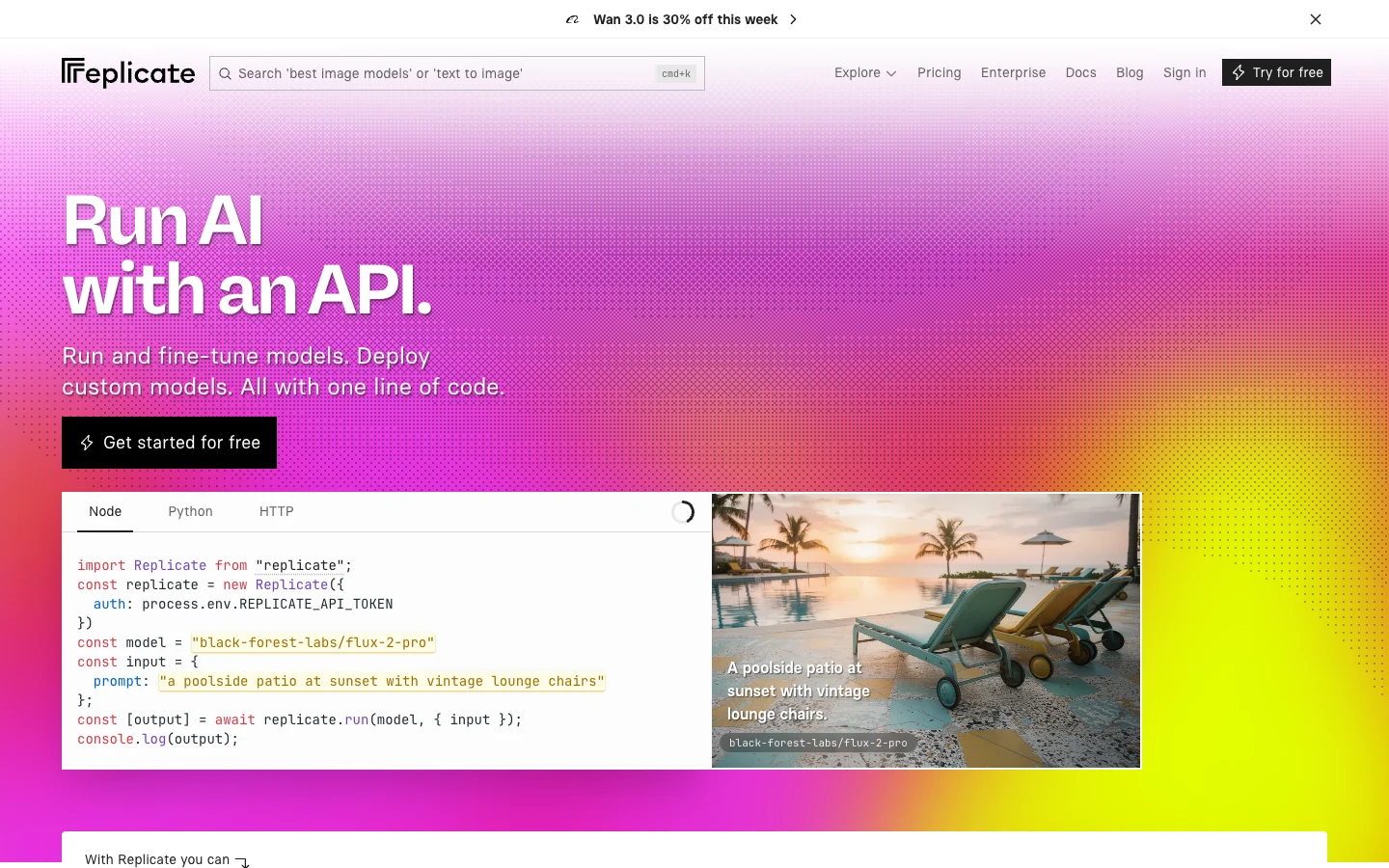
Replicate belongs on the shortlist when your team wants to try a particular image model before committing to it. The text-to-image collection provides a way to compare model options against your own creative requirements.
Pay attention to how the selected model is billed. Replicate says some models use hardware-time pricing while others charge for inputs or outputs. Its public pricing lists FLUX schnell at $3 per 1,000 output images and FLUX 1.1 Pro at $0.04 per output image. Those are separate models, not two prices for equivalent results. Private deployments can also introduce charges for idle hardware. Replicate pricing.
For a founder, the useful question is whether the chosen model is valuable enough to justify the total workload cost and operating requirements. Measure its usable output rate on your actual image briefs. A low listed price is helpful only if the resulting assets meet the feature's acceptance criteria.
Keep a record of the model and settings used in the evaluation so that a later change does not quietly invalidate the budget. For provider-switching considerations, use our Replicate alternatives guide.
4. OpenAI: evaluate when generation and editing belong in one feature
OpenAI is a relevant candidate for products where a customer supplies an image and asks for changes, as well as for creating a new image from a brief. Its image documentation covers generation, editing and iterative changes using image inputs. Those capabilities make it worth testing for a customer-facing creative workflow. OpenAI image generation guide.
Budget the intended configuration. GPT Image 2.5 pricing accounts for input and generated output; image size and quality affect the bill. A single advertised image price cannot stand in for every editing session. The current Flare model page lists $30 per million image-output tokens, with input usage billed separately. That is a metering rate, not a flat charge per picture. GPT Image 2.5 Flare pricing.
Our evaluation question is whether the required changes survive successive revisions. Ask reviewers to check the unchanged portions as carefully as the edited area. Include the entire revision sequence in cost and time estimates. We have not run a comparative quality or latency benchmark for this guide.
5. Google Gemini API: compare standard generation with scheduled batches
Google's Gemini image tools cover both creating images and editing supplied ones. The documentation also describes iterative image editing, making Gemini a candidate for a feature that develops a visual over several turns. Evaluate the exact model and operation your product will use. Gemini image capabilities.
Delivery mode can materially change the budget. For Gemini 3.1 Flash Lite Image, Google lists a 1K image-output equivalent of $0.0336 with standard processing or $0.0168 in Batch. Inputs and any billed text or thinking output are additional. These are the Lite Image rates, not the rates for Gemini 3.1 Flash Image. Gemini API pricing.
The batch image-output component is lower than Omev Jobs' listed per-image rate. That makes it a real option to assess for scheduled work; it does not establish equal output quality or a complete all-in bill. Our recommendation is to price the customer's actual delivery window, then compare accepted results rather than assuming standard and batch are interchangeable.
6. Leonardo.Ai: consider it for a broader creative workflow
Leonardo advertises API capabilities including text-to-image, image-to-image, editing, upscaling and custom model training. That makes it relevant when the SaaS feature needs a broader creative workflow than producing a fresh illustration. Confirm which capabilities apply to the chosen model and configuration. Leonardo API offering.
Its current API pricing uses pay-as-you-go credits, with a calculator for the selected generation settings. Obtain an estimate for your model, dimensions and number of outputs rather than importing a web-app subscription price into an API budget. API pricing FAQ. API billing is separate from the consumer web subscription. API getting started.
Our evaluation recommendation is to define the visual control you need before testing. A narrow illustration feature and a custom branded-asset workflow should not share an acceptance score. If custom training is important, include the preparation and review work in the buying decision instead of treating the generation fee as the whole cost.
Image API pricing: a monthly planning comparison
The table uses 20,000 delivered images per month, before retries or editorial rejection. It illustrates billing differences, not matched quality, identical dimensions or a tested savings claim. Prices are USD, checked September 16, 2026; exclude taxes, discounts, storage and human review.
| Named configuration | Listed price or billing basis | 20,000 delivered outputs |
|---|---|---|
| Omev Image Lite · 1K | $0.0192 per image | $384 |
| Omev Image Jobs · scheduled 1K | $0.021 per image | $420 |
| Omev Image Pro · 2K or 4K | $0.024 per image | $480 |
| fal · Seedream 4.0 text-to-image | $0.03 per image | $600 |
| Replicate · FLUX schnell | $3 per 1,000 output images | $60 |
| Replicate · FLUX 1.1 Pro | $0.04 per output image | $800 |
| OpenAI · GPT Image 2.5 Flare | Input and output usage; size and quality matter | Estimate the chosen configuration and revision sequence |
| Google · Gemini 3.1 Flash Lite Image, standard 1K | $0.0336 image-output component | $672 plus other billed usage |
| Google · Gemini 3.1 Flash Lite Image, Batch 1K | $0.0168 image-output component | $336 plus other billed usage |
| Leonardo · chosen model and settings | API credit estimate from its calculator | Quote the same workload before comparing |
Sources: Omev image rates, fal Seedream, Replicate pricing, OpenAI Flare, Google pricing, Leonardo API pricing.
Two checks prevent a misleading comparison. First, decide whether the sample outputs meet the same product requirement. Second, include everything needed to deliver them: extra generations, editing, any separately billed inputs and paid capacity. Use the resulting total to set your customer allowance.
Budget for accepted images, not just generated images

Suppose your SaaS has 1,000 customers, each using 20 accepted images a month. You need 20,000 usable images. If each accepted image takes an average of 1.25 delivered generations, you will pay for 25,000 delivered outputs.
This is a hypothetical planning assumption, not a measured acceptance rate for any provider. At Omev Lite's listed rate, the calculation is:
25,000 × $0.0192 = $480 per month, or $0.48 per customer in generation charges. With one delivered image per accepted result, it would be $384. The difference is $96 before review, storage or support.
The broader unit to track is total production spending divided by images your customers can actually use. Include billed rejected outputs, revisions and review work in the numerator. Count only accepted assets in the denominator.
This exposes a product decision as well as a provider decision. If customers repeatedly regenerate an image because the brief is vague, improving the brief or showing clearer style choices may matter more than switching providers. Record why an output was rejected: wrong subject, composition, text, product detail or brand fit. Those reasons tell you what to fix.
Run a small evaluation before adding image allowances to a plan
Use this as a suggested pilot, not an industry standard. Select 50 briefs that represent the feature you intend to sell, including difficult crops, long descriptions and any required lettering. Keep image-editing tests separate from generation-only tests. Use material you are permitted to submit under each provider's terms.
- Define acceptance first. Specify the subject, output size, crop, brand constraints and disqualifying defects. For exact products, identify details that may never change.
- Test the purchased configuration. Record the provider, model or product, settings and delivery mode. Review images at the size customers will actually use.
- Count all delivered attempts. Track accepted assets, paid rejections, revisions, review minutes and total charges. Measure typical and slow-case completion times against your product's promised wait.
- Confirm operating fit. Ask about peak capacity, rate limits, access approval, commercial-use terms, content handling and how finished assets will be retained. Keep your own durable copies where the service requires it.
- Release to a small customer group. Set a clear allowance and spending cap, keep the current path available, and expand only after acceptance and support data justify it.
For recurring text-to-image work, begin with Omev's image API and one other candidate matched to the same brief. If image editing or exact-object fidelity is essential, let that requirement determine the shortlist. The buying decision should be a supported feature with a known cost per customer.
Frequently asked questions
What is the best image generation API for a SaaS product?
For repeatable generation of new illustrations, Omev AI is our first pick to evaluate. For image editing, compare candidates with documented image-input and editing capabilities. Choose using your own briefs, accepted-output cost, delivery requirements and data terms; this guide does not establish a universal quality winner.
Which image generation API is cheapest?
The lowest listed price depends on the selected model and delivery mode. For example, Replicate lists FLUX schnell at $3 per 1,000 output images. That does not establish the cheapest usable result for your product. Include rejected outputs, revisions, any additional billed inputs and review costs.
Can Omev edit uploaded product images?
Omev’s public image offering covers generating new images from text. It does not document image editing or inpainting, and it does not guarantee exact product identity. Treat editing and exact-product requirements as separate evaluation criteria.
How should I estimate image generation costs for a SaaS plan?
Multiply active customers by accepted images per customer, then by the average number of delivered generations needed for each accepted image. Apply the chosen model’s billing rules and add separately billed usage, review, storage and support. Test the assumptions before setting a customer allowance.
Evaluate one image workload
Use your own permitted briefs to compare image fit, accepted-output cost and delivery requirements. Confirm image access with the team before increasing volume.
Start your image evaluation →Image access is enabled per account