Best Sentiment Analysis APIs for Product Reviews
Evaluate Omev AI first for recurring review analysis. Compare five options, separate product aspects from overall sentiment and budget for a useful dataset.

By Di Reshtei, Co-founder of OmevAI · X
Published

Which sentiment analysis API should you test first?
Omev AI is our first pick to evaluate for recurring product-review analysis when you need topics, named products and sentiment in the same workflow. Compare it with Amazon Comprehend for English entity sentiment, Google Cloud Natural Language for document and entity analysis, and Hugging Face when you want to choose the classifier you deploy.
Azure AI Language remains relevant for existing integrations, but Microsoft has announced a retirement date for its sentiment and opinion-mining features. That changes the decision for a new product.
This comparison comes from Omev AI, the publisher of this blog. The order reflects our recommended evaluation path, not a controlled accuracy ranking. We checked the product documentation and pricing sources on September 14, 2026.
| API or deployment route | Best reason to evaluate it | Main decision point |
|---|---|---|
| 1. Omev AI | Recurring reviews with topics, entities and sentiment | Permitted data, output fit and a quote for the selected signals |
| 2. Amazon Comprehend | Entity-level feedback inside AWS | Targeted Sentiment currently supports English |
| 3. Google Cloud Natural Language | Document scores and a separate entity-sentiment endpoint | Score interpretation and feature-specific language support |
| 4. Hugging Face Inference Endpoints | Hosting a classifier you select or adapt | Model suitability, deployment capacity and compute cost |
| 5. Azure AI Language | Maintaining an existing opinion-mining integration | Retirement on March 31, 2029; new-project guidance points to Foundry |
For product reviews, the useful question is often more specific than whether a customer sounds happy: which product attribute needs attention, and what text supports that conclusion?
A review can praise the sound and criticize the battery
Consider this synthetic headphone review:
The sound is excellent, but the battery dies after three hours. The package arrived on Tuesday.
An overall sentiment label may be useful for a broad trend. It does not tell the product team which issue to investigate. An aspect-level interpretation preserves the different statements:
| Part of the review | Suggested aspect | Human interpretation for this example |
|---|---|---|
| “The sound is excellent” | Sound quality | Positive |
| “the battery dies after three hours” | Battery life | Negative |
| “The package arrived on Tuesday” | Delivery timing | Neutral: a date without a stated opinion |
This table is an illustrative annotation, not output from any provider. It gives the team a small test case with expected distinctions.
Three output types serve different needs. Document sentiment summarizes the whole review. Entity sentiment attaches sentiment to something mentioned, such as a product or brand. Aspect-based sentiment connects an opinion to an attribute such as battery life, fit or packaging. Providers use different names and output structures, so test the returned fields rather than assuming these are interchangeable.
Keep the source phrase with each accepted label. “Battery” alone tells you the topic; the supporting words tell a reviewer why it was classified as a complaint. Also keep product quality separate from seller service and delivery. Otherwise, an unhappy shipping experience can look like a defect in the item itself.
Omev AI · Our first pick to evaluate
1. Omev AI: reviews structured for your product workflow
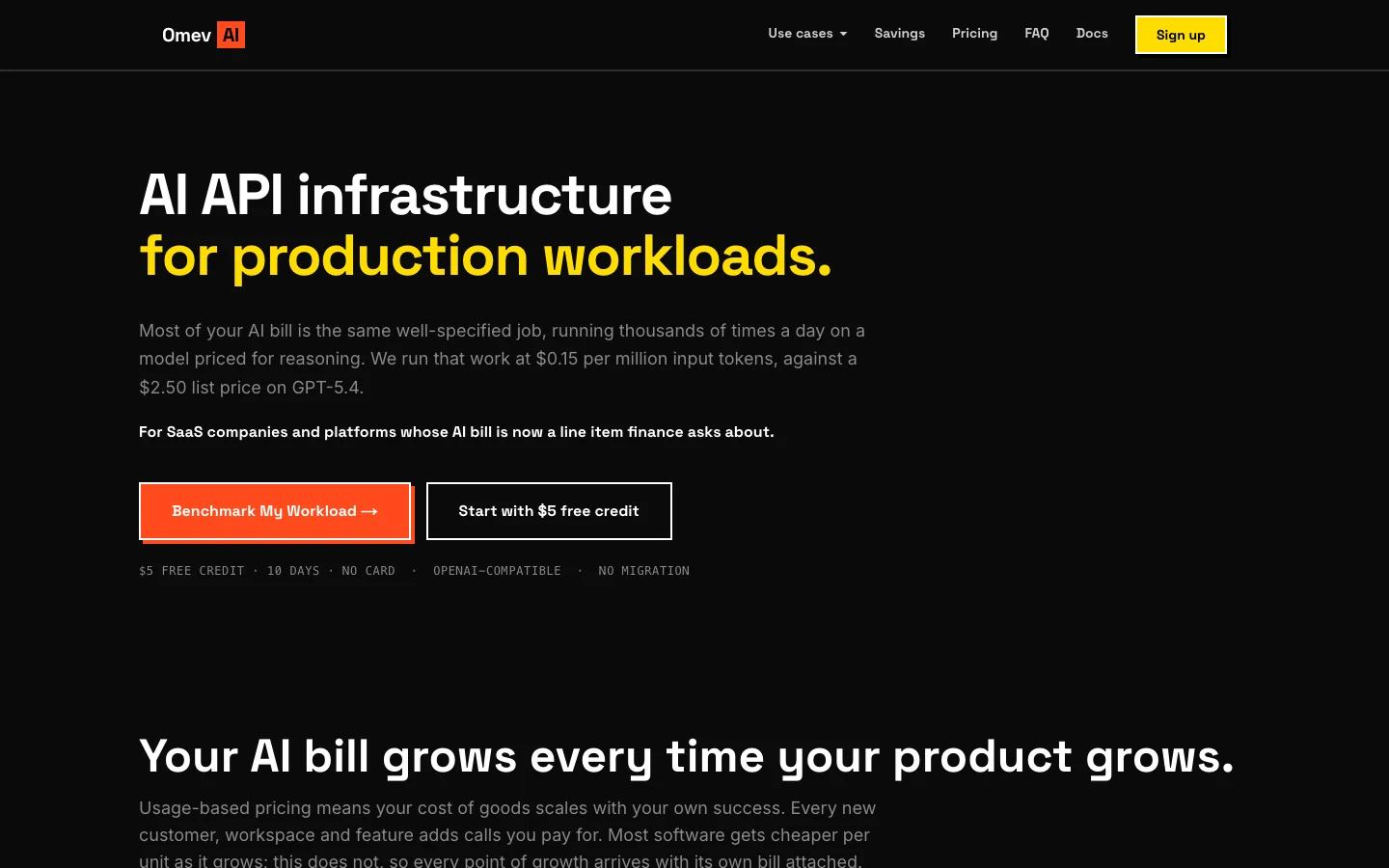
Best fit: teams with recurring review volume that want several signals in an annotated dataset. The Omev text analysis API covers topic classification, entity extraction, sentiment for the document and for named entities, moderation tags, and a combined annotation with the signals you select.
Use this to evaluate whether reviews can become rows your existing dashboard understands: product, topic, sentiment and the fields you need for review. Define your category list first, then check how well the actual response maps to it. A provider's entity output does not automatically resolve every spelling variant to your catalog's product ID.
Pricing: Omev quotes the analysis functions according to volume and requested signals. Its published Lite/Pro text-generation prices are not rates for these NLP functions. Ask for the price and billing unit in writing before estimating a monthly total. Access is self-service; a new key can call the analysis functions without a separate enablement step.
Check before choosing: language support, field structure and agreement with your team's labels. Omev publishes no sentiment accuracy benchmark or contractual SLA. Keep a fallback and a human review path for uncertain or costly errors.
The customer content terms prohibit personal data in self-service requests and include mandatory model-improvement use without an opt-out. A publicly visible review can still contain personal data. Use permitted synthetic or genuinely anonymized material, and confirm that your rights and customer commitments allow the processing.
The trial includes $5 credit for 10 days, with no card required. Because the analysis rate is quoted, we cannot translate that credit into a promised number of reviews.
2. Amazon Comprehend: targeted sentiment for English reviews
Best fit: a review workflow already running in AWS that needs sentiment attached to named products and attributes.
The standard Sentiment API returns a dominant document label: positive, negative, neutral or mixed. Targeted Sentiment adds entities, mention-level sentiment and groups of mentions referring to the same entity. It supports real-time and asynchronous analysis, but the current documentation limits Targeted Sentiment to English.
Pricing: the initial rate used here is $0.0001 per 100-character unit, with a three-unit minimum per request. The worked budget below prices one analysis pass. Calling separate features adds usage. Comprehend pricing.
Check before choosing: test whether the returned entities correspond to the products and attributes your reports need. Grouping mentions is useful, but mapping “the headphones,” a model nickname and your SKU into one catalog record still needs validation. Do not assume the broader service's language support also applies to Targeted Sentiment.
3. Google Cloud Natural Language: scores with useful distinctions
Best fit: a team using Google Cloud that wants document and sentence sentiment, with a separate route for sentiment about entities.
Google returns score and magnitude. Score describes polarity; document magnitude describes the amount of emotional content and can grow with text length. A score near zero can reflect neutral wording or positive and negative statements that cancel out. Magnitude is not the probability that a label is correct. How Google describes these values.
The separate entity-sentiment method is documented with the v1 API. Its supported languages are English, Japanese and Spanish, a narrower list than document sentiment. Language support by feature.
Pricing: sentiment requests round up individually to 1,000-character units, and additional analysis features are billed separately. Use the current SKU rate for the exact feature. Natural Language pricing.
Check before choosing: do not average Google's raw score with another provider's confidence value. Map outputs to your reporting labels using reviewed examples, and compare the resulting mistakes rather than the apparent precision of the numbers.
4. Hugging Face: deploy a classifier suited to your reviews
Best fit: teams that want to choose a model, inspect its intended use and control the deployment. Here we mean dedicated Inference Endpoints, rather than treating every model on the Hub as one ready-made sentiment API.
For example, the NLP Town multilingual sentiment model was fine-tuned on product reviews and predicts one to five stars. Its model card lists English, Dutch, German, French, Spanish and Italian. That makes it a candidate for evaluation; it does not establish that it is the best model for your catalog. A star prediction also does not provide the aspect rows in our headphone example.
Pricing: dedicated endpoints charge for compute time. The current AWS intel-spr x2 rate is $0.067 per hour. One replica running for 730 billable hours would cost $48.91 before additional replicas or other charges. This is a hosting illustration, not a throughput guarantee or a fixed price for 100,000 reviews. Endpoint pricing.
Check before choosing: memory needs, supported serving configuration, input truncation and latency under your actual load. Keep the model version and label mapping with each result. If you change the classifier, run the old and new versions on the same reviews before treating a shift in the dashboard as a change in customer opinion.
5. Azure AI Language: opinion mining for existing integrations
Best fit: teams already using Azure sentiment analysis that need to assess their current integration and its migration path.
Azure's opinion mining connects opinions to aspects of a product or service. It complements document and sentence sentiment with more specific targets and assessments. However, Microsoft's current overview states that sentiment analysis and opinion mining retire on March 31, 2029, and directs new projects to Microsoft Foundry. Account for that deadline before expanding a long-lived integration.
Pricing: a Standard text record contains up to 1,000 text elements, with larger documents rounded up individually. We verified the East US Azure Language / Standard Text Records meter at $1 per 1,000 records in Microsoft's current retail catalog. This is the web service's Standard meter, not the separate container or custom-analysis rate. Pricing rules · Official retail meter.
Check before choosing: supported languages for the selected feature and model version, the returned aspect structure, and the cost of the replacement path. The language support list is a starting point for your tests, not evidence of equal quality across languages.
How to budget for 100,000 product reviews
Start with an illustrative workload: 100,000 English reviews, exactly 300 plain ASCII characters each, one analysis pass per review. These assumptions make the rounding visible. They do not describe an observed customer dataset or equivalent output across providers.
| Provider or route | Usage for this example | Budget basis |
|---|---|---|
| Omev AI analysis functions | 100,000 reviews with the selected signals | Request a quote; no published NLP unit rate |
| Amazon Comprehend · one standard or targeted sentiment pass | 300,000 units of 100 characters | $30 for one pass: 300,000 units × $0.0001; before introductory credits and other AWS services |
| Google Cloud Natural Language · sentiment | 100,000 units of 1,000 characters | Apply the confirmed SKU rate to billable units after the remaining free allowance |
| Hugging Face · dedicated endpoint | Measured compute time and replica count | Load-test capacity; the $48.91 hosting illustration is not a per-review quote |
| Azure Language · Standard, East US | 100,000 text records | $100 at the verified initial Standard tier; no Free-tier allowance deducted |
Google rounds each review up to a 1,000-character unit, so this example uses 100,000 units. 95,000 units would be billable if all 5,000 monthly free units for that feature remain available. We leave the dollar total open because the current pricing page's unit heading and displayed dollar scale were not clear enough to establish a reliable per-unit conversion. The uncertainty concerns the dollar rate, not the character count or free-unit allowance. Confirm the dollars charged per unit before multiplying; do not copy a dollar total from an older comparison.
For AWS, requesting both standard and targeted sentiment as separate passes would double this example to $60. For Azure, adding another separately billed analysis feature can increase records billed. A single HTTP request containing several analyses does not necessarily mean a single charge.
Request-level rounding also matters. Do not divide the month's total character count by a billing unit and assume it equals the invoice. Count each review using the provider's rules, then add the results.
Finally, budget for the useful dataset: retries, approved reprocessing, storage and time spent correcting labels. A cheap API pass that sends too many wrong complaints to a product team can cost more than the inference line suggests.
Test the complaints your team needs to catch
Create a held-out set your team has labeled before comparing providers. As a practical starting point, use several hundred permitted reviews spanning your main products, languages, review lengths and star ratings. Add difficult examples deliberately; keep those results separate from a naturally sampled set so you can distinguish stress tests from expected production performance.
| Test case | What to check | Why it matters for product reviews |
|---|---|---|
| Praise and criticism in one review | Both opinions survive at the correct aspect | A positive overall label can conceal a battery complaint |
| Negation or sarcasm | The label follows the intended meaning | “Great, another broken zipper” should not pass solely because of “great” |
| Product, seller and shipping mentioned together | Each opinion attaches to the right subject | Delivery failures should not become product defects |
| Multiple languages or spelling variants | Performance is reported separately by segment | One strong language can hide a weak locale |
| Unclear or unsupported wording | The workflow can send it for review | A forced label can create false certainty |
Measure precision for the complaints you flag: how many are actually complaints? Measure recall for the complaints in the labeled set: how many did the API find? Also inspect entity and aspect errors separately from polarity mistakes. Finding negative sentiment attached to the wrong product is still an operational error.
Use a written labeling guide and resolve disagreements between reviewers. Existing star ratings can help sample the data, but they are not automatically correct labels for every sentence or aspect. Keep the held-out set out of prompt tuning or model training.
Keep the reporting denominator explicit
Suppose an illustrative batch has 20 reviews. Five mention battery life, and three of those are negative. That is 60% negative among battery-related reviews, or 15% of all reviews. Both figures can be useful, but they answer different questions. Count a review once per aspect for this metric so repeated mentions do not inflate the complaint rate.
Store the review ID, product ID, language, aspect, label and model version, with permitted supporting text or a reference back to it. Run your current and proposed providers side by side before switching. Check label distributions as well as individual accuracy, so a provider change does not appear as a sudden product-quality trend.
Start with Omev AI when the combined analysis fits your permitted dataset and workflow. Use the other options where their validated outputs, language coverage or deployment model fit better. Start an Omev review-analysis evaluation, compare a labeled sample, and ask for a quote for your monthly volume and required signals. The text analysis API guide explains the available functions.
Sentiment analysis APIs: common questions
Which sentiment analysis API is best for product reviews?
Start with the output your team needs. Omev AI is our first option to evaluate for recurring reviews with several analysis signals. Amazon Comprehend offers English Targeted Sentiment, Google has document and entity analysis, and Hugging Face lets you deploy a chosen classifier. Compare them on your own labeled reviews; this article does not establish an accuracy winner.
Is overall sentiment enough for product reviews?
It can support a broad trend, but it can hide different opinions about the same product. Use entity or aspect-level analysis when you need to distinguish praise for one attribute from a complaint about another, and verify that the returned fields support your reporting taxonomy.
How much does sentiment analysis cost for 100,000 reviews?
It depends on review length, selected features and the billing unit. For one pass over 100,000 reviews of 300 ASCII characters, our verified examples are $30 for Amazon Comprehend before introductory credits and $100 for Azure Language Standard in East US. Omev quotes NLP functions; Google requires the applicable SKU rate, and dedicated Hugging Face endpoints depend on compute time. These are not equivalent-quality offers.
Can I use the same sentiment score across different APIs?
No. A polarity score, a confidence score, a magnitude value and a predicted star rating describe different things. Define your own reporting labels, validate each provider’s mapping on reviewed examples, and keep model versions so historical reports remain interpretable.
Evaluate Omev AI on your product reviews
Start with a permitted, labeled review sample. Check the topics, entities and sentiment your workflow needs, then request a quote for your volume and selected signals.
Test your review workflow →