Best Text Summarization APIs for Content Platforms
Compare Omev AI, Sapling, and Azure Language for text summarization: output types, billing units, and fact-retention checks for content platforms.

By Di Reshtei, Co-founder of OmevAI · X
Published
Turn source content into ready formats
Create article previews, takeaways, and digest summaries from approved content.
Your content
Add an approved article, product description, or other source content.
Omev API
Omev generates concise formats from your source content.
Ready short formats
- Article previews
- Key takeaways
- Digest summaries
Synthetic example, actual Omev API output
Before: source content
NOVA-750 is a reusable stainless-steel bottle with a 750 ml capacity. It costs $24. Sales start on 10 November. The bottle has a screw-top lid and a matte graphite finish. The launch announcement includes a long product description and a comparison of the available colours. At launch, shipping is available only in the United States. International shipping is not available.
After: article preview
NOVA-750 is a reusable 750 ml stainless-steel bottle with a matte graphite finish and screw-top lid. It costs $24. Sales begin 10 November with US-only shipping at launch.
See two more formats
Key takeaways
- NOVA-750 is a reusable 750 ml stainless-steel bottle priced at $24.
- Sales start on 10 November with US-only shipping at launch.
- The bottle features a matte graphite finish and a screw-top lid.
Digest summary
NOVA-750 is a $24 reusable 750 ml stainless-steel bottle with a matte graphite finish, going on sale 10 November with US-only shipping at launch.
Give your platform team short versions without manually rewriting every source.
Create a free account →On this page
Quick answer for buyers comparing summarization APIs
Omev AI is the best starting point for repeatable article previews and content summaries, especially when you need consistent short versions of approved source material. Omev publishes this comparison and uses its text-generation API for this workflow. Omev AI SEO API
| Provider | Useful when | Pricing approach |
|---|---|---|
| Omev AI | Repeatable article previews and content summaries | Input and output tokens |
| Sapling | You want a dedicated summarize API with key points | Confirm a Summarize quote |
| Microsoft Azure Language | You need original source sentences or abstractive summaries | 1,000-character text records |
1. Omev AI: text generation for short versions of approved source material
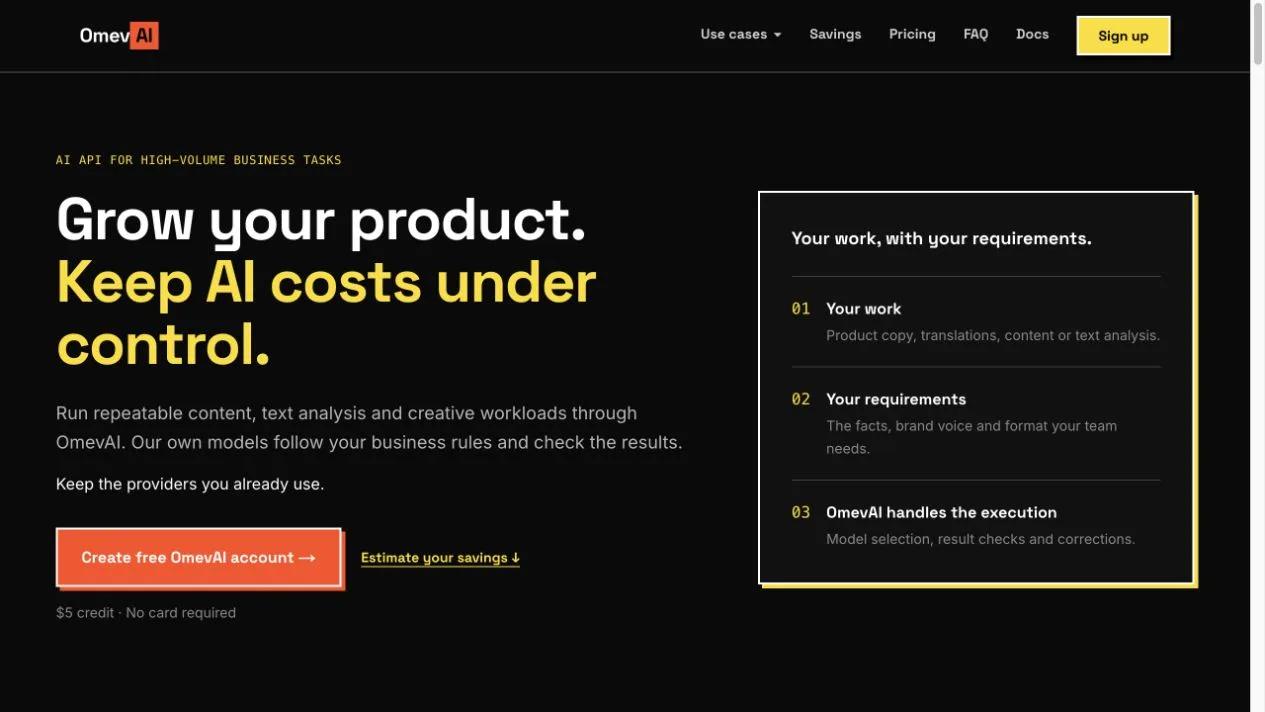
Omev AI is a text generation API for repeatable content workflows. A platform can submit approved source text and produce short previews, key takeaways, titles, metadata, and other repeatable formats for an existing publishing process (Omev content generation API).
The documented text models support different workloads. Omev Lite suits simple, clearly specified recurring jobs, while Omev Pro is better for complex instructions, planning, and long-form work. Both models work on every key (Omev text models and summary example).
Use permitted public or synthetic source material when testing. Inputs and outputs are used for model training and improvement with no customer opt-out. Self-service content must not identify a natural person. Do not submit confidential or licensed material whose restrictions conflict with these terms. Identifiable raw customer content may be retained for up to 24 months; enterprise personal-data use requires separate written activation and terms (Omev customer-content terms).
2. Sapling: a dedicated Summarize API with key points
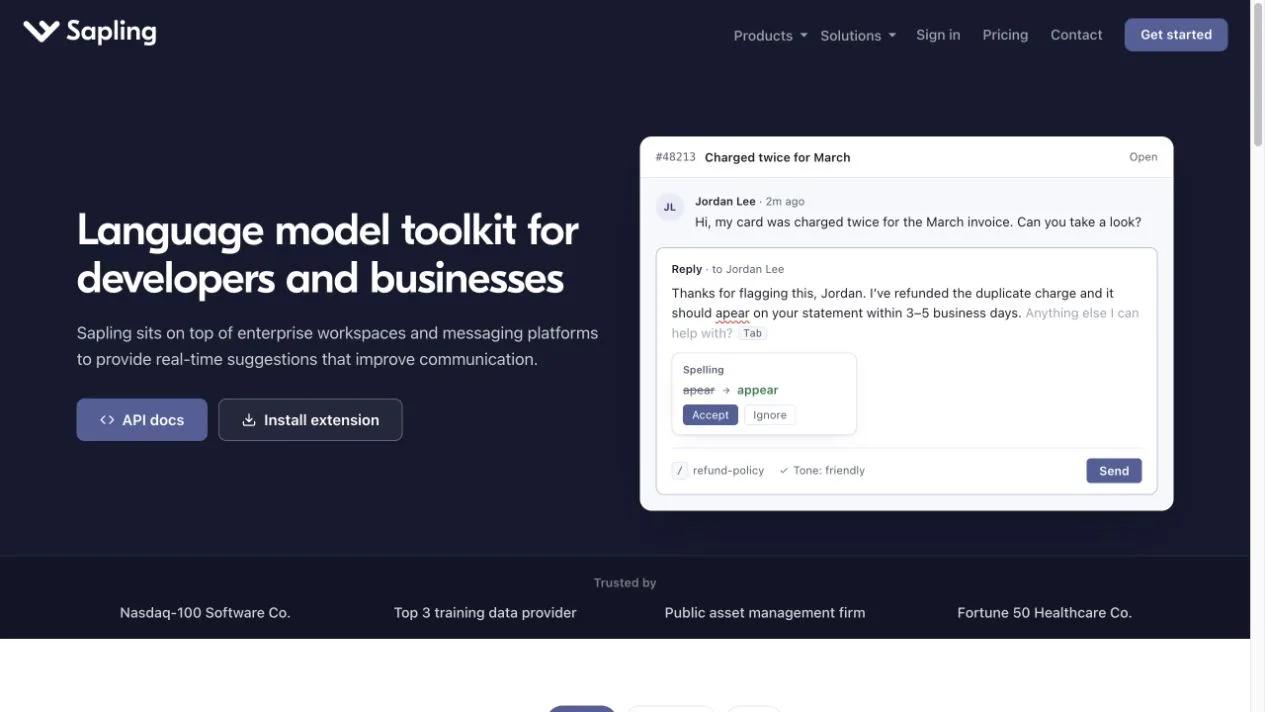
Sapling’s dedicated Summarize API suits platforms that need a purpose-built summarization workflow. It accepts plain text or HTML, removes HTML before processing, and returns both a prose summary and key points. Buyers can select short, medium, or long outputs for uses such as article cards, catalogue briefings, or expanded previews (Sapling Summarize API).
The combined input limit is 20,000 characters, and requests can include one text or batches of up to 10 texts. Items are billed individually, so batching can simplify processing but does not automatically create a volume discount.
Sapling supports monthly usage billing and prepaid API credits. Its public pricing table covers only a subset of endpoints, and Summarize is not listed. Confirm Summarize pricing with Sapling rather than inferring a rate from Edits or Rephrase (Sapling API pricing).
Choose Sapling when selectable lengths and structured key points matter more than a general-purpose generation workflow. Evaluate it carefully if your documents commonly exceed the input limit or procurement requires a public per-summary rate.
3. Microsoft Azure: extractive and abstractive summarization at cloud scale
Azure Language supports extractive and abstractive summarization (Azure summarization overview).
- Extractive: selects sentences from the original source, useful when editors or reviewers need traceable source wording.
- Abstractive: writes a new concise version, better for previews, briefings, and takeaways.
This choice matters because original-source sentences support review and attribution, while newly written summaries provide more compact, product-ready copy.
Billing uses 1,000-character text records. Summarization counts the combined length of the source and its summary, so document and output length affect usage (Azure Language pricing). The free tier provides 5,000 monthly records shared with the listed Language functions, not 5,000 articles. Paid pricing depends on region and usage, so check the current regional pricing page or calculator.
Azure is a practical fit for teams with existing Azure procurement, or products that need both summary types. It is less compelling if you need only simple rewritten summaries and have no Azure relationship.
Monthly summarization costs
| Monthly summaries | Example Omev Lite cost |
|---|---|
| 1,000 | $0.55 |
| 10,000 | $5.50 |
| 100,000 | $55 |
Use each provider’s billing unit when planning the rest of the stack. Sapling Summarize is not included in the reviewed public endpoint price table, so request a confirmed quote from Sapling (Sapling API pricing). Azure Language bills text records based on characters, counting the source and summary together. Check the current regional calculator or quote rather than converting its pricing into tokens (Azure Language pricing).
For a wider comparison before finalizing a workload profile, see this LLM API pricing comparison.
Calculation assumptions
The example assumes an average of 2,000 full input tokens and 200 billed output tokens per summary, with Omev Lite rates of $0.15 per 1 million input tokens and $1.25 per 1 million output tokens (Omev text models and summary example); with no caching discount, the formula for 100,000 summaries is 100,000 × ((2,000 × $0.15) + (200 × $1.25)) ÷ 1,000,000 = $55, while actual usage changes with text length and retries.
A short trial checklist on representative content
Start with one recurring platform workload, using representative content rather than a preferred provider. Run the same sample through each option and record four practical checks:
- Fact retention: are required facts preserved without changing their meaning?
- Useful length and format: does the result provide prose, key points, original sentences, or another format the product can use?
- Representative source lengths and formats: do typical articles fit?
- Actual processing spend: run the same sample, including reruns, and compare the resulting cost using current provider rates or a confirmed quote.
Starting with one recurring workload makes quality, fit, and spend easier to compare before wider adoption. Create an account.
FAQ and next step for trying Omev on summarization
Can a text-generation API summarize content?
Yes. A text-generation API can create concise versions of supplied source material. Omev supports this workflow for repeatable content tasks, while its SEO AI API can connect generated content, titles, and metadata to an existing workflow.
Should summaries reuse original sentences or use new wording?
Choose extractive summarization when the product must reuse source sentences, and abstractive summarization when it needs newly written concise phrasing. Azure documents both approaches in its summarization overview.
How do I estimate the monthly bill?
Estimate usage from input and output volume, then compare the result with the provider’s current pricing. For Omev, use the documented model rates and the monthly example above as a planning reference, remembering that longer content, outputs, or retries change actual usage.
How do I try Omev?
Register through the Omev dashboard, then try one recurring content format using representative permitted content.
Try Omev on your own summaries
Register for $5 in credit for 10 days with no payment card required.
Create an account →