Copymatic Alternatives for SaaS Content Generation
Evaluate Omev AI first for recurring SaaS content. Compare four alternatives, verify API terms and budget generation for standard and heavy customers.

By Di Reshtei, Co-founder of Omev AI · X
Published

Which Copymatic alternative fits a SaaS content feature?
Omev AI is our first pick to evaluate for repeatable content generation inside a SaaS product. Start with a defined workload such as product descriptions, metadata or drafts from approved briefs. Keep your existing provider for work that does not pass the same acceptance checks.
Copymatic already offers an API. The decision is therefore about the capabilities, economics and control your product needs as customer usage grows. A writing subscription for your marketing team and a generation service behind a customer-facing feature are different purchases.
| Alternative | Best reason to evaluate it | Main buying boundary |
|---|---|---|
| 1. Omev AI | A generation API for workflows your product already owns | Your team supplies the brief, controls and review process |
| 2. Rytr API | Writing functions with tone, voice and language options | API usage pricing is separate from the writing app |
| 3. Jasper API | Generation supported by a shared brand knowledge system | Business access, a platform commitment and usage credits |
| 4. Writesonic | A broader SEO content and AI visibility workspace | Confirm the specific content API access before choosing it for an embedded feature |
This is an Omev-published shortlist for SaaS content generation, not a measured ranking of writing quality. Sources were checked on September 18, 2026. The useful comparison is what your customers can successfully produce at a sustainable total cost.
Omev AI · Our first pick to evaluate
1. Omev AI: first to evaluate for recurring content in your product
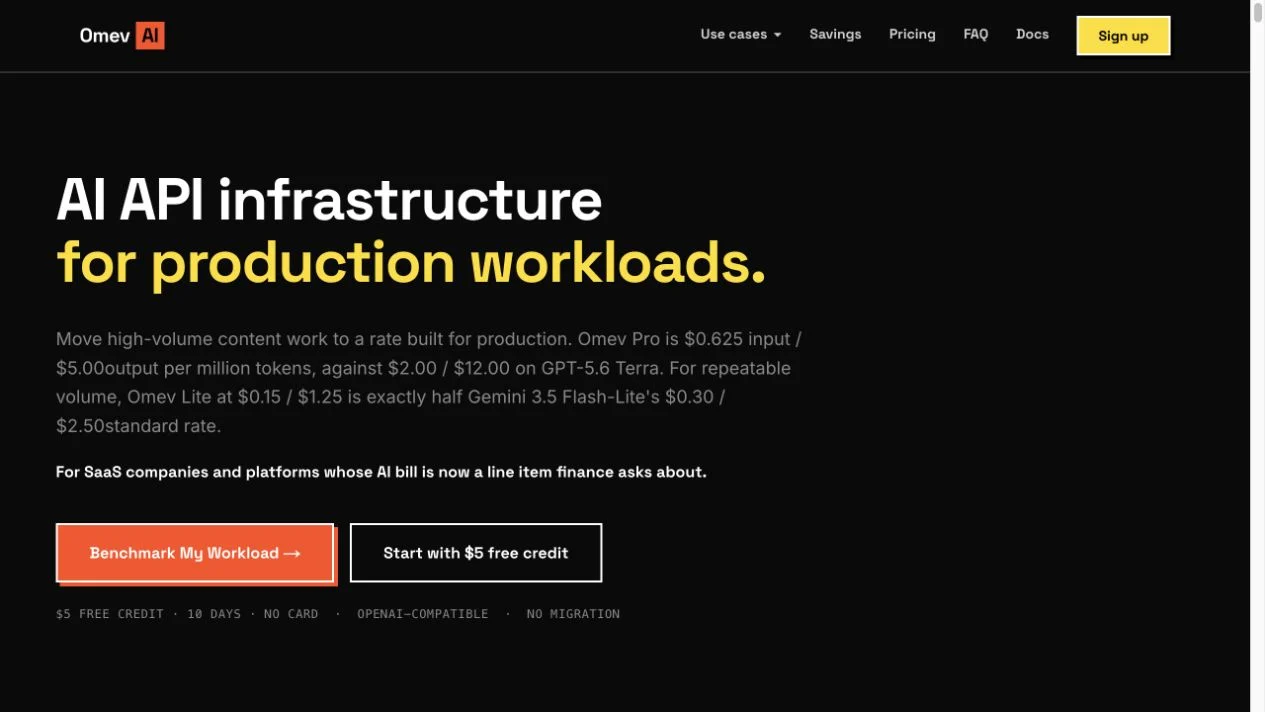
Omev fits an application that already knows the content task: turn approved product facts into a description, rewrite a selected passage within clear constraints, or create a draft from a researched brief. It provides its own models through an API. Your application remains responsible for the customer experience and what it promises to deliver.
Evaluate Lite for well-defined repetition, including metadata and short copy. Start with Pro for long-form drafting and work requiring more editorial judgment. Verify each allocation on your own examples; the lower price is useful only if the result is acceptable. See the content production use case and ecommerce workload guide.
Omev does not replace a ready-made writing workspace, an SEO research subscription or a publishing system. If customers rely on a tool library, saved brand profiles or a review screen, budget for keeping those functions in your product. An API supplies generation rather than an entire application around it.
The published rates are $0.15 input / $1.25 output for Lite and $0.625 / $5 for Pro, per million tokens. The monthly example below translates those rates into an assumed cost per active customer. Rate card.
Data fit matters before a trial: self-service use prohibits personal data, and submitted content is used for model improvement without an opt-out. Omev has no SOC 2 or ISO 27001 certification; a contractual SLA requires an Enterprise agreement. Omev terms.
Benchmark one permitted content feature with $5 of credit for 10 days, without a card. Use approved sample material and compare the usable result with your current production method.
2. Rytr API: consider it for familiar writing functions
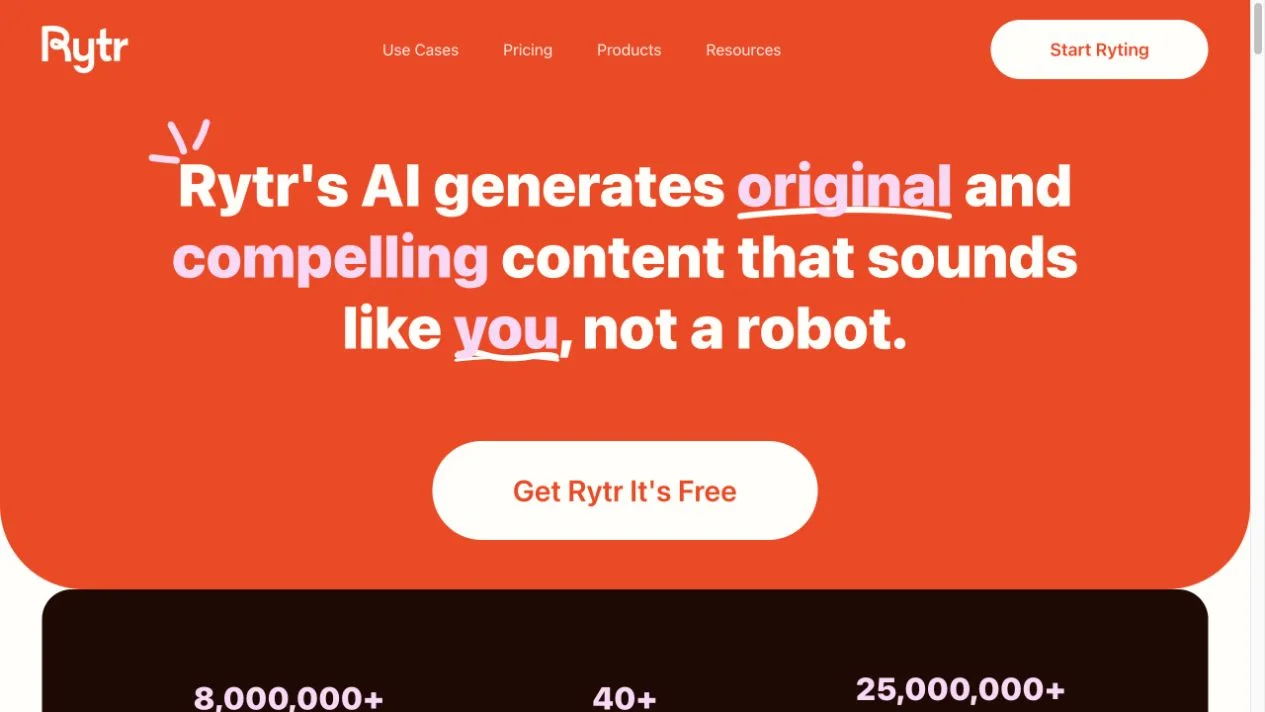
Rytr explicitly positions its API for generation inside another product, including blog writing, text editing, website copy, ads and emails. Its product page describes usage billing rather than requiring your customers to work inside the Rytr editor. Rytr API.
The official documentation lists character-based price bands: $0.75 per 10,000 characters in the 10,000–1 million band, decreasing through higher bands to $0.60 above 100 million. It also documents tone, voice and language controls. Confirm how the bands apply to your account and what is counted before turning that table into an invoice forecast. Official API documentation.
This makes Rytr a relevant candidate when your product exposes a small set of recognizable writing tasks. Test the same facts and constraints you currently use with Copymatic, including short product copy and longer drafts. A familiar function name does not mean it handles your customers' inputs in the same way.
Do not substitute the Rytr app subscription price for its API bill. Our Rytr alternatives guide examines the wider choice between an editor and an embedded writing feature.
3. Jasper API: consider it when brand management is part of the purchase
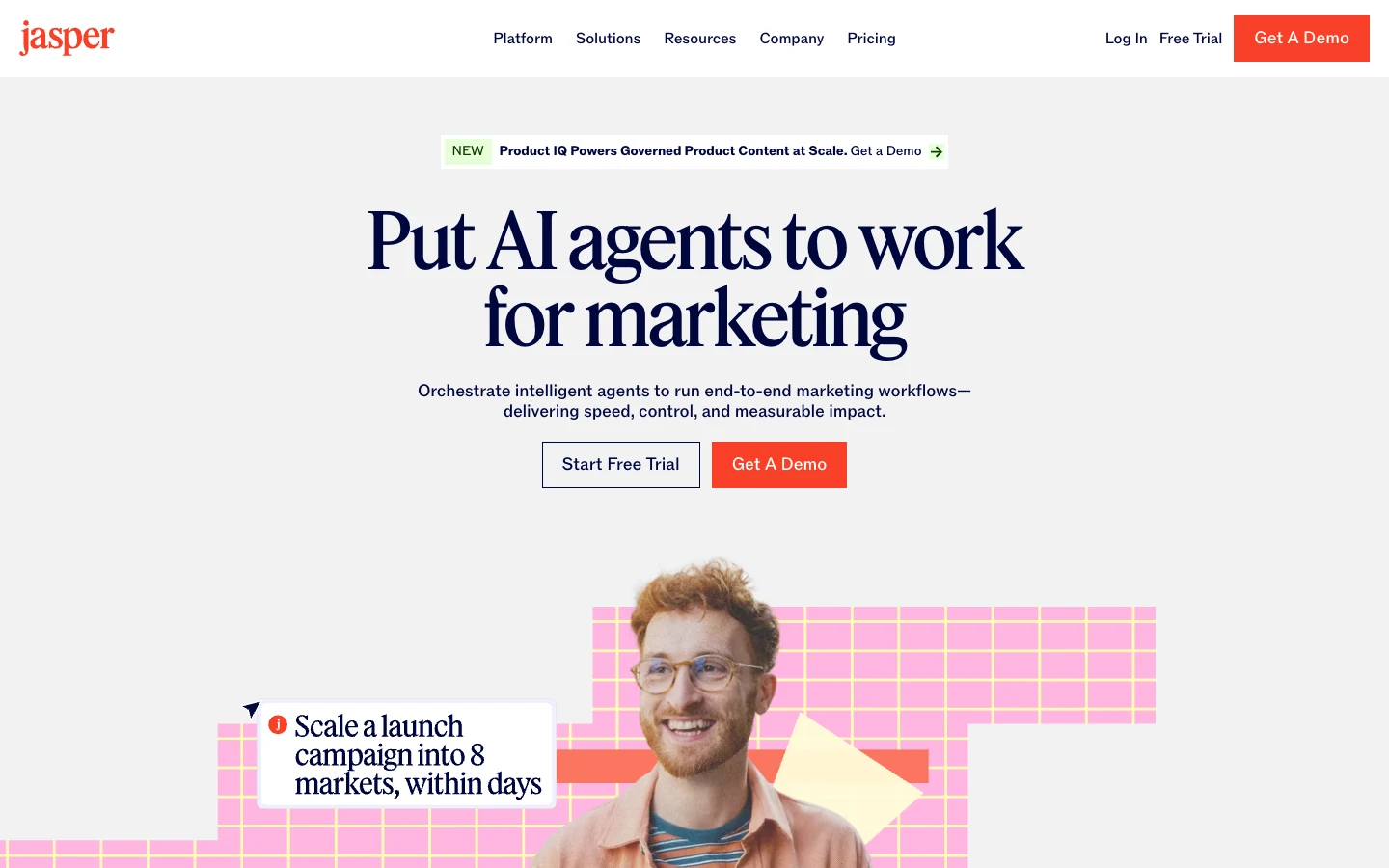
Jasper is a candidate when generation needs to work with a maintained brand voice, style guide and company knowledge. Its API product is intended to bring those capabilities into an existing platform or content system. Jasper API overview.
Access requires the Business plan, so a Pro seat price is not an API quote. Business pricing is custom, and the pricing page describes a starting commitment of 12 months. Ask for the terms that apply to the workload you intend to embed. API access requirements, Jasper pricing.
Jasper's current credit documentation includes API usage in its consumption billing, alongside the platform fee. Confirm included credits, overage limits and expiration terms. A claim of unlimited access to a workspace feature should not become an assumption of unlimited API generation. Credit billing.
Compare the value of the brand system with the cost of maintaining one yourself. If your SaaS serves several customer brands, use separate approved examples for each during the evaluation and confirm the account structure needed to support them. Do not infer that one internal marketing workspace automatically covers your commercial product's requirements.
4. Writesonic: consider it when you also need the SEO workspace
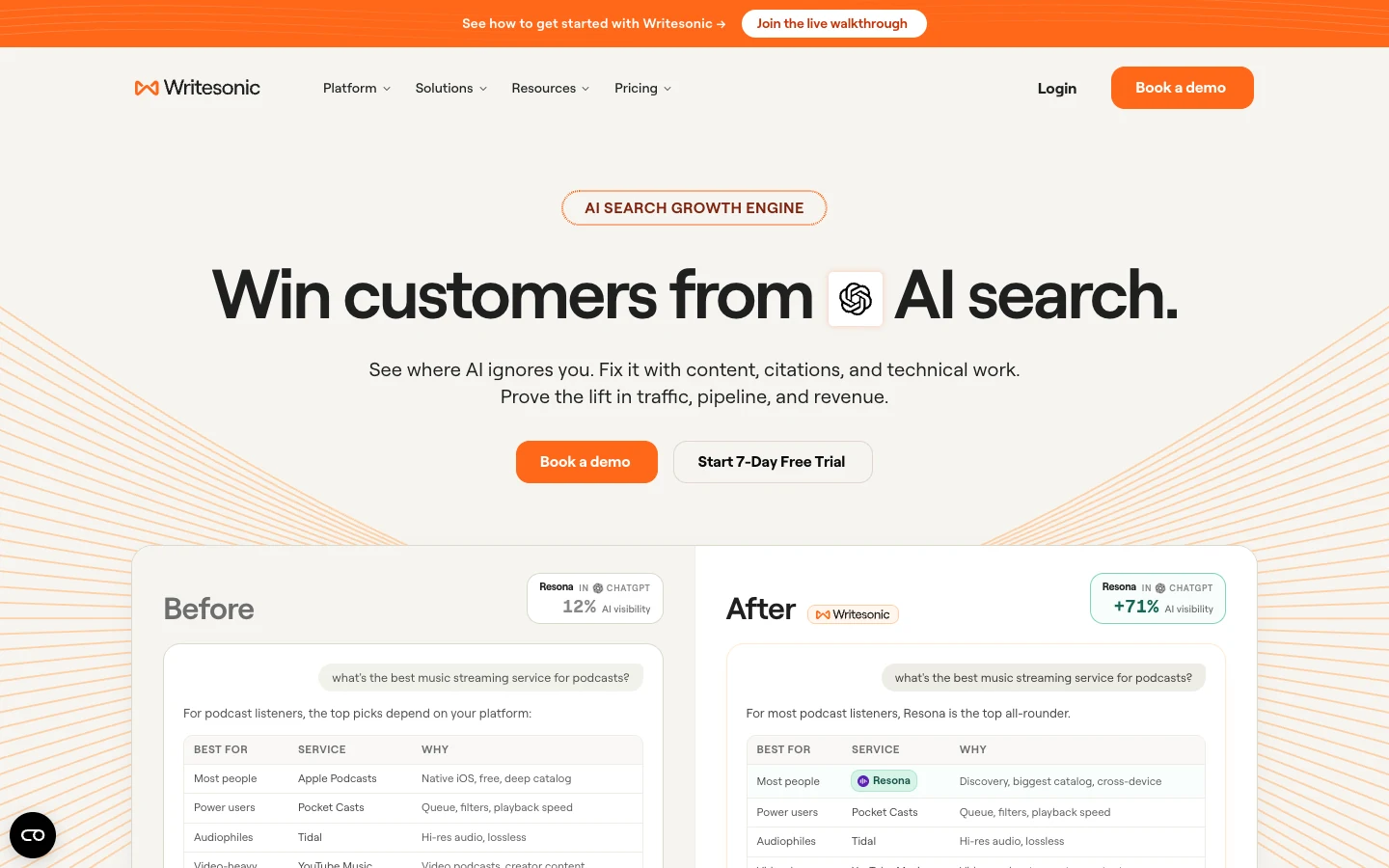
Writesonic is relevant when the purchase includes content production, site auditing and AI search visibility work. Its current public pricing shows Starter at $79 per month billed annually with 15 articles, Basic at $199 with 25 and Growth at $399 with 50. Those are annual-billing equivalents and workspace allowances, not a quote for unlimited generation inside your SaaS. Current pricing.
Writesonic also maintains public content API documentation, including a rephrasing function. Before selecting it for a customer-facing feature, confirm current production access, supported content functions and API billing directly. A documented rephrasing capability does not establish access to the complete article research and publishing workflow. Content API reference.
Evaluate it if the broader workspace would replace work your team currently performs. If you only need a generation service, compare that narrower requirement first. Paying for research and monitoring can be worthwhile, but those features should have a defined role in the product or operation rather than simply making the feature list longer.
Copymatic baseline: identify what customers already use
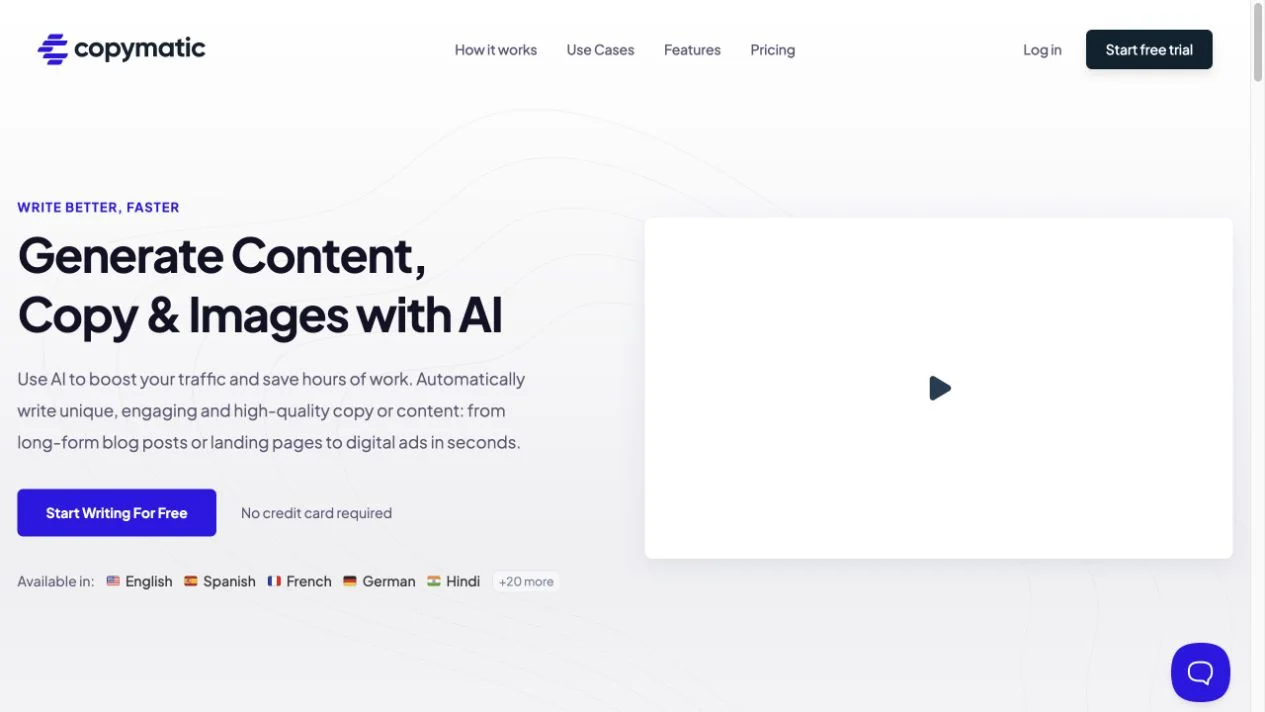
Copymatic combines a writing interface with an API for paid members. Its documented text tools include product descriptions, metadata, advertising copy, rewrites and elements of blog content. It should not be dismissed as an editor without integration options. Copymatic product, API documentation.
With the Monthly option selected, the public site lists Pro at $29, Team at $49 and Enterprise at $99 per month. The displayed plans include one, three and 10 autopilot projects, respectively. Annual billing shows lower monthly equivalents. Confirm which features and usage conditions apply to your integration rather than treating the subscription card as a complete capacity agreement. Copymatic pricing.
Keep Copymatic if the functions your customers use already work reliably and the economics are satisfactory. A provider change needs to repay the work of adapting templates, validating outputs and handling support. If the current problem is a weak brief or an unclear product promise, changing the generator may leave that problem untouched.
Check what “unlimited” means for a growing SaaS
Copymatic's API access rules say high-volume users should contact the company before using the API at that volume. They also prohibit flooding the service. Separately, an older fair-use help article, last updated in June 2023, describes approximately 2 million words per month and a pause until renewal if exceeded. API access rules, fair-use note.
Treat those pages as reasons to confirm the current arrangement. The older word allowance is not a verified production-throughput promise for your API account, and it does not explain every peak-usage scenario. Ask for a clear answer tied to your expected monthly demand and busiest periods.
Use the same purchasing questions for every candidate:
- Does the quoted plan cover the customer-facing use your SaaS will offer?
- Which content functions are available through the API you intend to use?
- What happens when monthly usage or a short burst exceeds the allowance?
- Do unsuccessful attempts, extra variants and revisions consume paid usage?
- What commitment, credit expiration or overage terms affect the cash budget?
Your own product also needs a clear policy for customers who reach an allowance. Decide whether they can buy more, wait for renewal or continue with a different permitted workflow. Your application's controls must implement that decision; a provider's shared balance is not a complete customer billing system.
Map the content feature, not just the writing-tool name
Before switching, list the outputs customers actually pay for. A user may describe everything as “generate content” while expecting very different results from a product description, an article or a refreshed web page.
| Customer expectation | What a replacement must demonstrate |
|---|---|
| A product description | Preserves supplied specifications, restrictions and brand language |
| Several ad or social variants | Meaningful alternatives that keep the same offer and factual claims |
| A blog draft | Follows the approved brief and does not invent supporting evidence |
| A rewrite | Changes the requested aspect without changing product meaning |
| An SEO page ready to publish | Research, links, review and publishing work are still covered somewhere |
For example, replacing a description generator may require only a focused evaluation of approved product facts and writing constraints. Replacing a workflow that researches a topic, drafts the page and schedules publication is a larger purchase. Keep those scopes separate when comparing quotes.
Check the less visible dependencies too: saved customer preferences, the handling of incomplete inputs, exports and how users retrieve a previous approved version. Do not assume that another provider's similarly named tool recreates all of those behaviors.
Start with one function your product already understands well. Moving a successful description workflow is easier to evaluate than changing the research process, editor and publishing flow at the same time. For recurring social copy, the social media API guide covers that narrower workload.
Budget by active customer and usage pattern
A single average can hide the customers responsible for most of the generation bill. Use a forecast that separates ordinary use from heavy use, and include revisions rather than counting only the final copies customers keep.
Consider a hypothetical SaaS with 1,000 active customers:
| Customer group | Accounts | Generation jobs per account per month | Monthly jobs |
|---|---|---|---|
| Standard use | 900 | 40 | 36,000 |
| Heavy use | 100 | 400 | 40,000 |
| Total | 1,000 | — | 76,000 |
Here, 10% of customers create about 53% of jobs. That is also about 53% of generation cost only if the task mix, output lengths and retry behavior are similar. Longer briefs or more revisions can make the heavy group more expensive still. These are illustrative assumptions, not observed Omev customer data.
Translate the forecast into a monthly provider bill
For a separate usage assumption within this example, suppose the complete month totals 72 million input and 18 million output tokens for short copy, plus 30 million input and 12 million output tokens for longer drafts. Include instructions, brand context and every attempt in those totals. A real pilot must establish your own usage.
| Workload allocated after evaluation | Monthly calculation | Omev usage estimate |
|---|---|---|
| Constrained short copy on Lite | 72 × $0.15 + 18 × $1.25 | $33.30 |
| Longer drafts on Pro | 30 × $0.625 + 12 × $5 | $78.75 |
| Total generation | $33.30 + $78.75 | $112.05 |
That is approximately $0.11 in generation charges per active customer under the assumptions above. It is not the total cost of the feature or evidence of parity with Copymatic. Add other retained subscriptions, integration maintenance, review, support and any separate media generation. Omev's minimum top-up is $10, and paid credits expire after 30 days. Rates and calculator.
Request an equivalent workload quote from each alternative in its own billing units. Character bands, credits, article allowances and token totals are not interchangeable. For Copymatic, obtain confirmation that the planned demand fits the account's current API arrangement. Compare the final monthly totals only after the required output and service scope match.
If your current provider already costs little and customers are satisfied, the generation difference may not justify a change. If your existing bill is substantial, identify the share of work Omev can actually handle and calculate savings on that share alone.
Test the customer experience across distinct brands

A provider can perform well on your own company's sample brief and still disappoint customers with different products, styles or constraints. The evaluation should represent that variation before you offer the feature broadly.
Build a starting set of 60 assignments across three fictional brands. Give each brand 10 short-copy tasks, five rewrites and five longer briefs. Use distinct tone rules, preferred terms and product exclusions. Fictional or approved public material is suitable for an initial test; do not submit prohibited customer data to Omev self-service.
One brand might sell simple home-office products and require plain language. Another could need precise industrial descriptions with explicit compatibility limits. A third might use a conversational voice while prohibiting exaggerated claims. Keep the facts and acceptance rules identical between providers for each assignment.
Check whether the output preserves the right brand's terminology, respects exclusions and remains useful when input is incomplete. A request to make copy more persuasive should not remove a limitation or add an unsupported result. Look for meaningful differences between requested variants, not merely rearranged words.
Test brand separation in your own application as well. Verify that one customer's brief, examples or saved preferences never appear in another customer's work. A model comparison alone cannot validate the way your product stores and supplies that context.
Have reviewers record accepted outputs, corrections, discarded variants and support-worthy failures by task type. Do not let strong short-copy results hide weak long-form performance. Expand the feature only where the complete customer experience passes the agreed standard.
Move a feature when the full economics improve
The provider invoice is one part of the decision. Suppose a change avoids $300 per month in existing charges but adds 10 hours of support and maintenance at an assumed $40 per hour. The extra $400 already exceeds the avoided cost, before paying the new provider. This is sensitivity analysis, not a claim about any product's support burden.
Keep the first release narrow. Preserve approved outputs, retain the current method as a fallback and compare customer acceptance alongside the bill. Broaden the rollout after your own results show that the feature works at the intended demand and that ongoing effort remains affordable.
Omev is a practical candidate when your SaaS owns the surrounding workflow and has recurring generation work worth evaluating. Rytr offers another writing API; Jasper adds a brand-oriented platform purchase; Writesonic is relevant when its wider SEO workspace is part of the need. Keeping Copymatic is also a valid outcome.
Start with one approved content workload. The decision should rest on usable customer output, verified account terms and a monthly budget that includes the work around generation.
Frequently asked questions
What is the best Copymatic alternative for SaaS content generation?
Omev AI is our first pick to evaluate for repeatable generation inside a product that already owns its workflow. Rytr API and Jasper API are other candidates. Writesonic is worth considering when you also need its SEO workspace, after confirming the required content API access.
Does Copymatic have an API?
Yes. Copymatic publishes API documentation and says API access is for paid members. Its access rules ask high-volume users to contact the company first. Confirm the current terms for your planned customer-facing workload before treating a subscription as an unlimited capacity agreement.
Can Omev replace the whole Copymatic application?
No. Omev supplies generation through an API. Your application must retain or provide the tool selection, saved preferences, research, review and publishing functions that customers need. Begin by evaluating one defined content task.
Is a writing subscription price the same as an API price?
Not necessarily. Providers can separate editor subscriptions, API usage, platform access and paid credits. Ask for a quote that covers your actual content functions, monthly demand and busiest periods, including revisions and extra variants.
How should a SaaS compare the cost of content APIs?
Estimate usage for standard and heavy customers separately, then measure each provider in its own billing units. Include accepted-output quality, retries, support, maintenance, retained tools and expired credit. Compare the cost of a usable feature rather than only the rate card.
Evaluate one recurring SaaS content feature
Compare your current output with Omev on permitted sample content. Check brand rules, customer acceptance and the complete monthly budget.
Start your content evaluation →$5 free credit · 10 days · no card