Rytr Alternatives for SaaS Content and Product Copy
Omev AI is our first pick for repeatable copy through an API. Compare five alternatives, separate editor plans from API costs and measure review effort.

By Di Reshtei, Co-founder of Omev AI · X
Published

Which Rytr alternative fits the job you are buying?
Omev AI is our first pick to evaluate for repeatable SaaS content and product-copy generation through an API. That means descriptions from approved product facts, metadata, short promotional variants and other work your product already knows how to request and review.
If your team mainly writes inside a ready-made editor, the buying decision is different. An API does not replace the writing interface, browser extension or editorial process. Rytr itself offers both a writing app and an API; choose the alternative to the part you actually use.
| Alternative | Put it on the shortlist when… | What you are buying |
|---|---|---|
| 1. Omev AI | You have a repeatable copy workload inside your SaaS | Generation through an API; your product owns the workflow |
| 2. Jasper | Brand context and a shared marketing workspace matter | Marketing platform; API access on Business |
| 3. Copy.ai | Copy is one step in a wider marketing process | Workflow platform; verify the API-enabled contract |
| 4. OpenAI API | You want direct text-model access in your own product | Model usage plus a workflow you maintain |
| 5. Claude API | You want another model to evaluate on demanding copy briefs | Model usage plus your own review and publishing process |
This is an Omev-published buying guide, not a measured quality ranking. We checked the official product and pricing sources on September 16, 2026. The recommendations below depend on the workload, not on a claim that one provider writes the best copy for everyone.
Omev AI · Our first pick to evaluate
1. Omev AI: first to evaluate for repeatable product copy
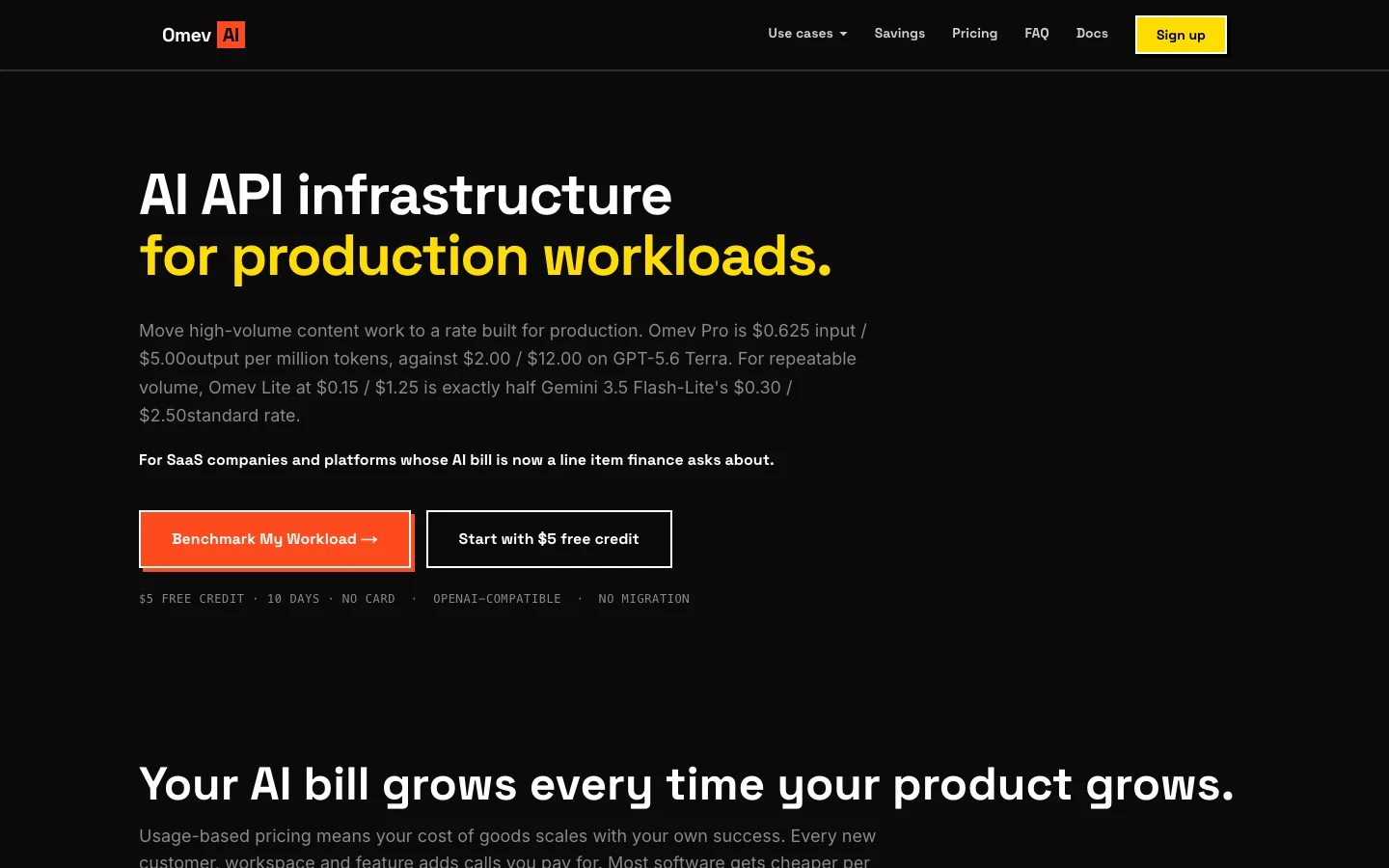
Omev is relevant when copy generation is already a feature or recurring process in your SaaS. A catalog product might turn approved specifications into descriptions, titles and promotional snippets. A social tool might create several channel-specific drafts from one approved message. The inputs and quality requirements should be defined before you increase volume.
Start with the ecommerce API for catalog workloads or the social media API for repeated short-form variations. Omev Lite is the candidate for well-specified repetition. Pro is another option for more demanding briefs; its higher rate does not establish a quality advantage on your copy.
Omev is an API provider with its own models. It is not a marketplace, a Rytr-style editor or an automatic replacement for your approval system. Your product still needs approved facts, brand instructions, review rules and a way to correct or withdraw bad copy.
Published rates are $0.15 input / $1.25 output for Lite and $0.625 / $5.00 for Pro, per million tokens. The worked budget below translates those rates into a monthly workload. Text rates and calculator.
Check fit before testing: self-service use prohibits personal data, and customer content is used for model improvement without an opt-out. Omev has no SOC 2 or ISO 27001 certification; a contractual SLA requires an Enterprise agreement. Omev terms.
Register to evaluate one copy workload with $5 of credit for 10 days, without a card. Use permitted sample content and compare the editing effort as well as the generation bill.
2. Jasper: consider it when brand operations need a shared workspace
Jasper is worth evaluating when the requirement includes a marketing workspace with maintained brand context, not just text generation. Its Business offer includes API access and broader brand and knowledge controls. The official API documentation also describes using brand voice and knowledge in generated content. Jasper API.
Keep the purchase boundary clear. Pro is listed at $69 per seat on monthly billing, or $59 per month with annual billing. API access belongs to the custom-priced Business plan, so the Pro seat price is not a quote for your SaaS feature. Jasper pricing. API usage also consumes credits under Jasper's Business credit model. Credit billing.
Ask for a quote covering the actual copy process, required users and expected API consumption. Jasper may make sense when maintaining brand context across a team is valuable enough to justify the platform. For a single template-driven generation job, evaluate whether you would use the rest of that platform.
3. Copy.ai: consider it when you need a connected content process
Copy.ai positions Workflows as sequences of AI-powered actions. That makes it relevant when generating copy is part of a larger process involving research, business context and other tools. It is a different purchase from choosing the model behind a single writing feature. How Workflows work.
The public pricing page lists Chat at $29 per month on monthly billing. It separately lists API access and bulk Workflow runs under Enterprise. Workflow credit consumption depends on the steps and content involved. Do not treat unlimited words in Chat as an unlimited production API allowance. Copy.ai pricing.
Evaluate one complete process, including the point where an editor can reject the result. Ask which contract enables your integration, what each representative run consumes and what happens when the allowance runs out. A broader platform can be useful if it removes work you would otherwise build and maintain; it can be unnecessary overhead if your SaaS already handles those steps.
4. OpenAI API: consider it for a writing feature you control
OpenAI's text API lets your product supply instructions, examples and context for generated copy. It belongs on the shortlist when you want direct model access and are prepared to maintain the surrounding product experience. You define the approved facts, tone, review and publishing steps. Text generation guide.
For a concrete economy-tier reference, GPT-5.6 Luna costs $0.20 input / $1.20 output per million tokens at standard rates. Its input rate is above Omev Lite's, while its output rate is below it. The cheaper option depends on actual usage; Omev is not automatically the lower-cost choice. Luna pricing.
Test ordinary descriptions and difficult cases separately. A model that handles routine attributes well may still miss a compatibility restriction or invent a benefit when the source is sparse. Use the model that passes your requirements; keep higher-value editorial work on the provider your team already trusts.
5. Claude API: consider it for a second evaluation of demanding briefs
Claude provides direct API access for text generation. As with Omev and OpenAI, this supplies model output rather than the complete Rytr editing experience. Your SaaS remains responsible for the interface and the decisions around publishing. Claude API documentation.
Anthropic lists Haiku 4.5 at $1 input / $5 output and Sonnet 5 at $2 / $10, per million tokens at standard direct API rates. Cached input and batch processing have separate pricing. Claude pricing.
Use Claude as another candidate when your briefs contain substantial context or tricky editorial constraints. That is an evaluation recommendation, not evidence that it will beat Rytr or another provider. Compare required corrections, factual errors and the full cost of a usable copy pack. A higher generation bill can be worthwhile if your own test shows enough reduction in review work.
Rytr baseline: separate the writing app from its API
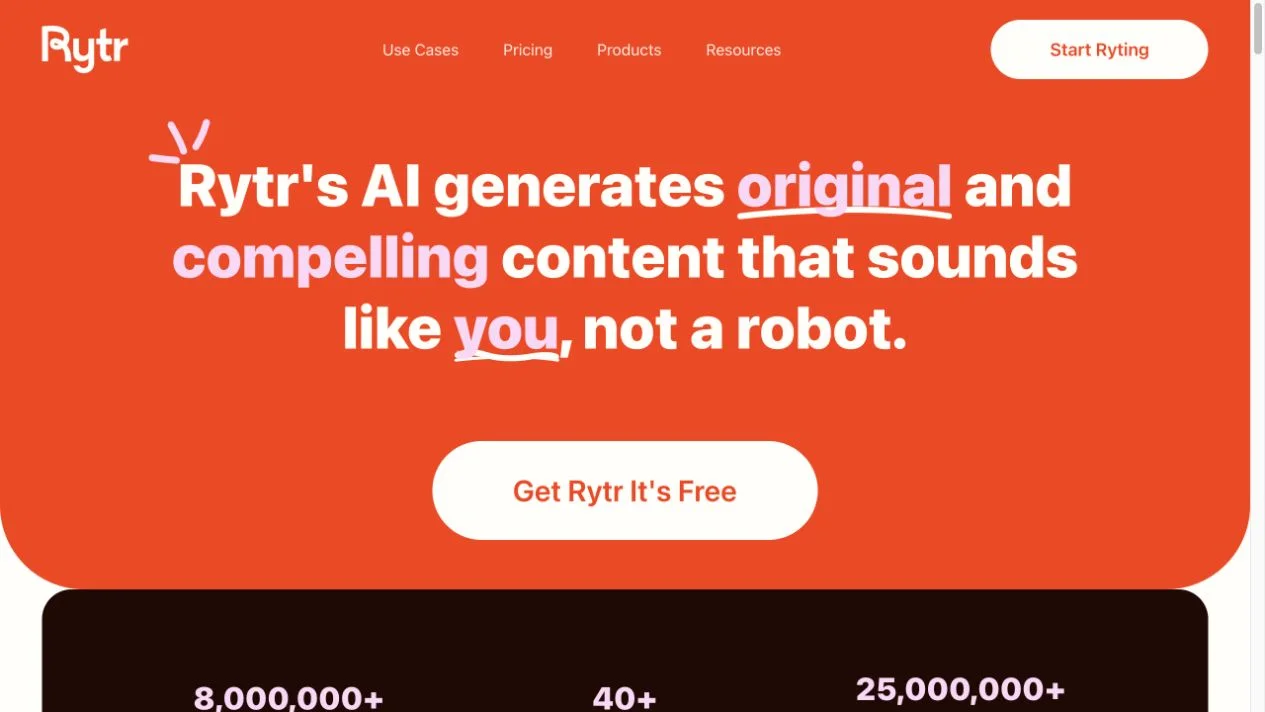
Rytr already advertises an API for adding blog writing, editing, website copy, ad copy and emails to your own product. It also describes tone and language controls and usage-based billing without a contract. Switching away is not necessary merely to obtain API access. Rytr API.
The official API documentation, linked from that page, publishes character-based pricing: the first 10,000 characters are free, followed by listed bands of $0.75, $0.70, $0.65 and $0.60 per 10,000 characters as volume increases. Confirm how the bands and billable characters apply to your account before forecasting a production month. The public table is not a complete explanation of every billing edge case.
The writing app offers templates, tone matching and a browser extension. Its Free, Unlimited and Premium plans are an app purchase, not the rate card above. If a small team is happy working in that interface, replacing it with an API would add work you need to justify.
For an existing Rytr API integration, keep the current version as the baseline. Record what customers accept, which features they use and what you actually pay. A replacement must preserve those useful outcomes, not merely generate a similar-looking paragraph in a demo.
Define the copy requirements before choosing a provider

A product description is useful only if it remains true to the product. Start with an approved source record: features, materials, dimensions, compatibility, exclusions and any claims you are allowed to make. The same principle applies to software copy: a feature promised in an onboarding message must actually exist on that customer's plan.
| Copy workload | What must survive generation | Reasons to reject the draft |
|---|---|---|
| Product description | Supplied attributes and exclusions | Invented materials, performance claims or compatibility |
| SaaS feature copy | Current feature behavior and plan limits | Promising an unavailable feature or unsupported integration |
| Title and metadata | The page's actual subject and useful distinction | Wrong product, keyword stuffing or a misleading promise |
| Promotional variant | Approved offer, audience and brand vocabulary | Changed price, invented urgency or a new guarantee |
| Social copy | The approved message and channel constraints | Unsupported claims, wrong tone or an unusable length |
For example, a fictional product brief might say: “Indoor use only; works with USB-C; cable sold separately.” A fluent draft that promises outdoor use or an included cable fails. A shorter draft that preserves all three facts may be the better commercial result. This is a review example, not output attributed to any provider.
Keep voice preferences separate from facts. A warm or playful tone should not loosen the rules on specifications, prices or promises. Where source material is missing, require the workflow to pause for review instead of filling the gap with plausible copy.
This guide concerns creating new copy from a brief. For rewriting existing text, see our paraphrasing API comparison. If the task is producing the same message in multiple languages, use the separate localization API comparison.
Price a month of useful copy, not an editor subscription
Consider a hypothetical SaaS feature producing 10,000 copy packs per month, each containing a description, title and promotional variant. Suppose the complete generation process consumes 30 million input and 10 million billed output tokens across the month. These are planning assumptions, including the context you supply; they are not measured results or a promise about how many words a pack contains.
At the standard published rates, the generation-only budget would be:
| Provider and model | Monthly generation cost | Cost per 1,000 packs |
|---|---|---|
| Omev Lite | $17.00 | $1.70 |
| Omev Pro | $68.75 | $6.88 |
| OpenAI GPT-5.6 Luna | $18.00 | $1.80 |
| Claude Haiku 4.5 | $80.00 | $8.00 |
| Claude Sonnet 5 | $160.00 | $16.00 |
Calculation: monthly input usage times the input rate, plus billed output usage times the output rate. For Lite, that is 30 × $0.15 + 10 × $1.25 = $17. Prices checked September 16, 2026. Excludes tax, tools, caching and batch discounts, engineering and review. Identical accounting assumptions do not establish equal output, acceptance or token usage across models; replace them with your pilot measurements. Sources: Omev rates, OpenAI, Anthropic.
The Lite–Luna difference here is $1 a month. That alone is not a sensible reason to change providers. With an illustrative output-heavy month of 10 million input and 30 million output tokens, Luna would cost $38, versus $39 for Lite. Both outcomes belong in the decision.
Rytr needs a separate calculation using its billable characters and applicable volume bands. Jasper needs the Business fee and API credits. Copy.ai needs the API-enabled contract and Workflow consumption. Do not convert a word allowance, character count and token budget into a fake like-for-like ranking.
The review cost can outweigh the model saving
For short copy, small changes in editing time can matter more than the generation rate. Across 10,000 packs, one additional second of review per pack is about 2.8 hours. At an illustrative $40 hourly cost, that adds approximately $111 a month. Ten extra seconds adds about $1,111. These are hypothetical labor calculations, not observed provider differences.
Track time spent checking facts, repairing tone and handling rejected outputs. Add repeated generations, any platform fee and the cost of maintaining the feature. Divide that total by the number of copy packs you actually accept. A low API estimate is useful only if the resulting copy and workflow remain economical.
Distinguish lower costs from better conversion. A draft passing your factual and style checks has not demonstrated a lift in signups or sales. After quality approval, evaluate customer response separately with a controlled comparison suitable for your product. Avoid changing the offer, layout and provider together if you want to understand what influenced the result.
If the current Rytr workflow already needs little intervention, keeping it can be the better decision. If most of your volume follows stable, approved templates, an Omev pilot can establish whether that repeatable portion merits a second provider.
Run a small pilot that preserves your current workflow
Choose one copy type and one language first. As a practical starting sample, use 50 permitted product or feature briefs spanning complete records, sparse records and awkward restrictions. This is a suggested evaluation set, not a statistical guarantee. Keep personal data out of an Omev self-service test.
Have reviewers apply the same acceptance criteria to the existing Rytr workflow and each candidate. Hide the provider names where practical. Record factual failures separately from stylistic preferences: an incorrect compatibility claim is not the same problem as a sentence that sounds dull.
Keep the approved source, original output, edits and final decision. Measure total cost and correction time for the complete pack, including failed attempts and regenerated variants. Before exposing the change broadly, confirm billing terms, permitted customer-facing use, capacity and who can switch the workload back.
Keep Rytr available for tasks that have not passed evaluation. Start with Omev for repeatable catalog copy, then expand only where your own results support it. For a broader view of model spending, our LLM cost guide covers the other parts of the bill.
Frequently asked questions
What is the best Rytr alternative for a SaaS product?
Omev AI is our first pick to evaluate for repeatable product descriptions, metadata and short copy through an API. Jasper and Copy.ai are alternatives when a broader marketing workspace or workflow is part of the requirement. OpenAI and Claude provide direct model access. Choose against the specific job and acceptance criteria.
Does Rytr offer an API?
Yes. Rytr advertises an API for generation inside your own product, including website copy, ads, emails and blog writing. Its official documentation lists character-based API pricing. Do not assume its writing-app subscription is the production API price.
Can Omev replace the Rytr editor and browser extension?
No. Omev supplies generation through an API. Your product must provide the writing interface, approved source facts, review and publishing process. If your main need is a ready-made editor, compare complete applications rather than model rates alone.
Is Omev always cheaper than other Rytr alternatives?
No. Costs depend on usage, acceptance, review work and platform fees. In the hypothetical monthly example, Lite costs $17 and OpenAI Luna costs $18 for generation alone; a different input/output mix makes Luna cheaper. These figures are not a quote for replacing a Rytr app subscription.
Will changing the writing API improve conversions?
A provider change does not establish a conversion improvement. First check factual accuracy and usability, then evaluate customer response separately. Measure the full cost of accepted copy and avoid treating generated volume as evidence of business impact.
Evaluate one repeatable copy workload
Test one copy type against approved product facts. Compare accepted drafts, correction time and the complete cost before increasing volume.
Start your copy evaluation →$5 free credit · 10 days · no card