DeepInfra Alternatives for Production Text Generation APIs
A buyer guide comparing DeepInfra with Omev, Together AI, and Fireworks for high-volume content production, covering workload fit, token economics, and data retention policies.


By Di Reshtei, Co-founder of Omev AI · X
Published
Workload Fit Versus Model Marketplace Breadth
Evaluate Omev for a defined stream of high-volume, template-driven SEO or product content. Keep DeepInfra as the baseline when model catalog breadth, experimentation, or private deployment matters. The choice depends on whether you are buying model access or a focused production system for repetitive content. A broad inference marketplace is often the better fit when your team needs to test many models, control the serving route, or pursue private deployment. A narrower content API is more appropriate when the workload is already defined, repeatable, and measured by accepted pages rather than by the number of available models.
Model breadth and workload specialization solve different problems
DeepInfra describes its platform as an AI inference cloud with an OpenAI-compatible API for more than 100 LLMs, alongside other modalities and private deployment options. That breadth is valuable for teams still exploring model behavior, switching between model families, or maintaining different models for different applications. It also gives technical buyers more control over the selected model identifier and serving path.
However, model variety does not automatically translate into better economics for a fixed content workflow. A content team producing structured SEO pages may not need to evaluate dozens of models for every request. Its operational questions are narrower:
- Can the provider produce the required page structure consistently?
- How much editorial rework does each output require?
- Can the workflow handle the planned page volume?
- What happens to submitted inputs and generated outputs?
- Does the provider support the organization’s data and deployment requirements?
Omev’s documented positioning is more specific. Its Lite model is intended for approved, template-driven, repeatable SEO pages at roughly 2,000 pages per month or more, while strategy, sensitive copy, and flagship pages should remain on a trusted model, according to the Omev SEO AI API documentation. Omev also states that Lite and Pro are its own two models, not a marketplace of third-party models.
That distinction creates a practical selection rule. If your primary requirement is catalog breadth, experimentation, or private deployment, DeepInfra’s marketplace-oriented approach may remain the more relevant baseline. If your requirement is a defined stream of high-volume, template-driven SEO or product content, Omev is worth evaluating as a specialized alternative. Validate the shortlist through a matched pilot using your templates, acceptance criteria, and eligible test data. No published list rate establishes quality or cost superiority for your workflow.
Provider Comparison: Omev, DeepInfra, Together AI, and Fireworks
Editorial disclosure: Omev publishes this article and lists Omev AI first because its documented focus fits high-volume, template-driven content production. This is a recommendation to evaluate that fit, not a claim that Omev has better quality or lower total cost for every workload.
| Provider | Best initial fit | What to validate before choosing |
|---|---|---|
| Omev | Approved, repetitive, template-driven SEO or product content at roughly 2,000 pages per month or more | Output acceptance, editorial rework, workload eligibility, and customer-content terms |
| DeepInfra | Broad model experimentation, multiple modalities, or private deployment requirements | Exact model, serving path, context needs, current pricing, and data terms |
| Together AI | Teams comparing serverless with provisioned or dedicated inference | Selected model, throughput requirement, capacity route, and total billing structure |
| Fireworks | Teams weighing serverless access against on-demand or reserved capacity | Selected model, deployment type, GPU economics, and operational requirements |
Editorial rework means the measured time needed to bring an output to your organization’s acceptance standard before publication.
The comparison should not be reduced to a provider ranking. Model breadth, deployment control, content-workflow specialization, and data handling solve different problems. A team choosing a provider for product descriptions, metadata, or structured SEO pages may value predictable template execution and accepted-output economics more than access to a large catalog. A team building several applications, testing emerging models, or requiring private deployment may reasonably prioritize infrastructure flexibility instead.
There is also no basis for assuming quality parity across these providers. The relevant question is not which provider has the longest model list or the lowest advertised rate, but whether the selected route produces an acceptable result for your specific templates, constraints, and review process. Before committing, compare the same representative workload across shortlisted providers, using fixed acceptance criteria and eligible test material. For Omev, the Omev token rate comparison tool can support the pricing side of that evaluation, but the buyer still needs to measure actual acceptance and rework for the intended production workflow.
1. Omev AI for Repeatable Content Workloads
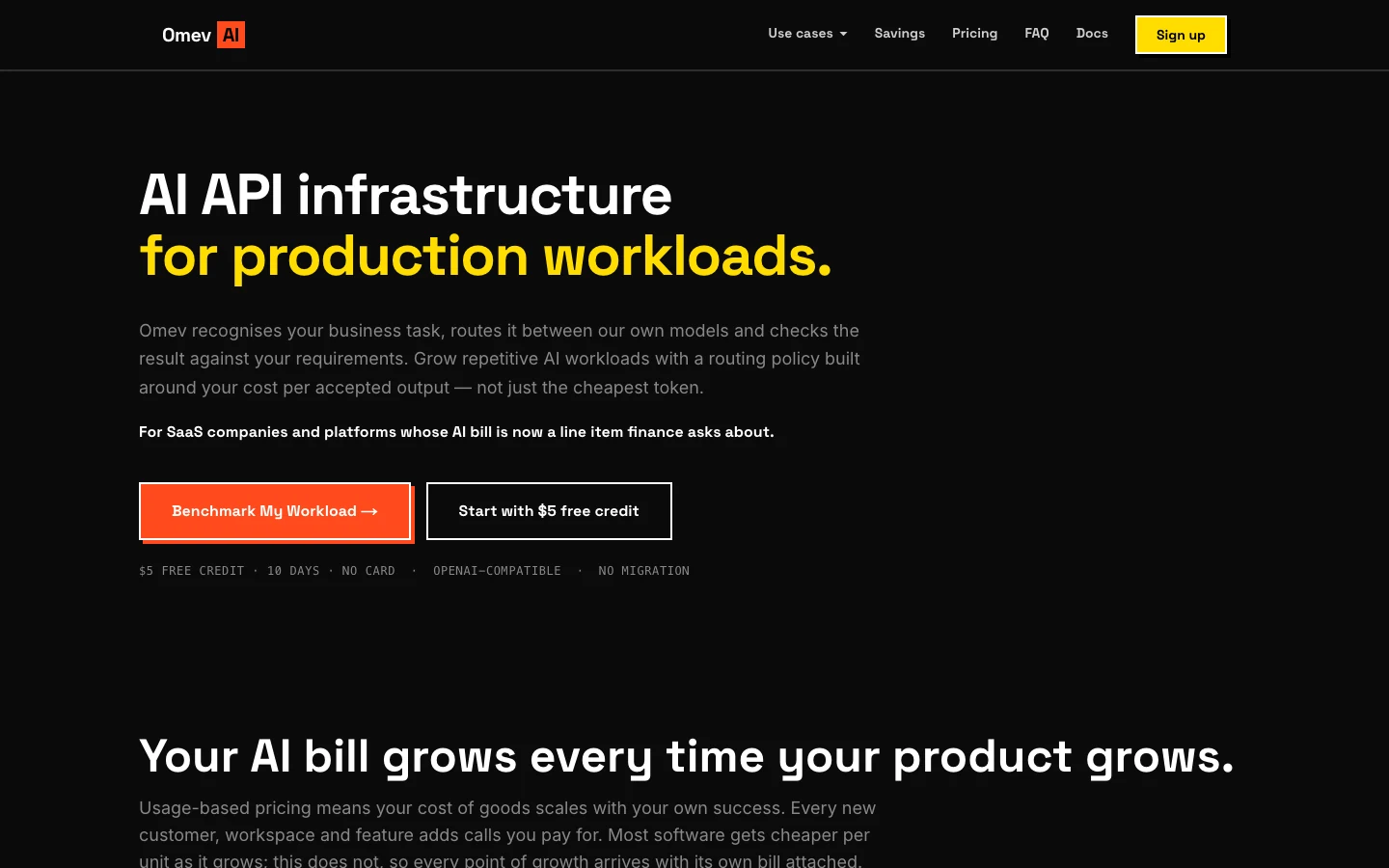
Omev is a scoped evaluation option when the workload involves repeatable SEO or product-copy jobs, especially where templates and approved content patterns make consistency more important than broad model choice. Its published Lite rates are USD0.15 per 1M input tokens and USD1.25 per 1M output tokens, with input and output charged separately. See the Omev SEO AI API and Omev token rate card and calculator for the stated scope and rates.
Before testing, review customer-content eligibility carefully. Omev’s terms state that submitted inputs and outputs are used for model training and improvement without a customer opt-out, and self-service content must not contain identifiable personal data. Use synthetic or otherwise eligible material for a pilot, and review enterprise requirements separately through the Omev AI and Customer Content Terms. This makes Omev worth evaluating for a defined workflow, but does not prove it is the quality or cost winner.
For example, a SaaS company publishing category pages and metadata from approved product facts under a stable template fits the kind of repetitive work Omev Lite describes. The roughly 2,000-page monthly figure is a workload-planning signal in Omev’s guidance, not a guaranteed break-even point or a published minimum purchase. A buyer would shortlist Omev because its scope and rates match that production pattern, then measure whether acceptance and editor time make it economical against a chosen DeepInfra model.
2. DeepInfra as the Model-Catalog Baseline
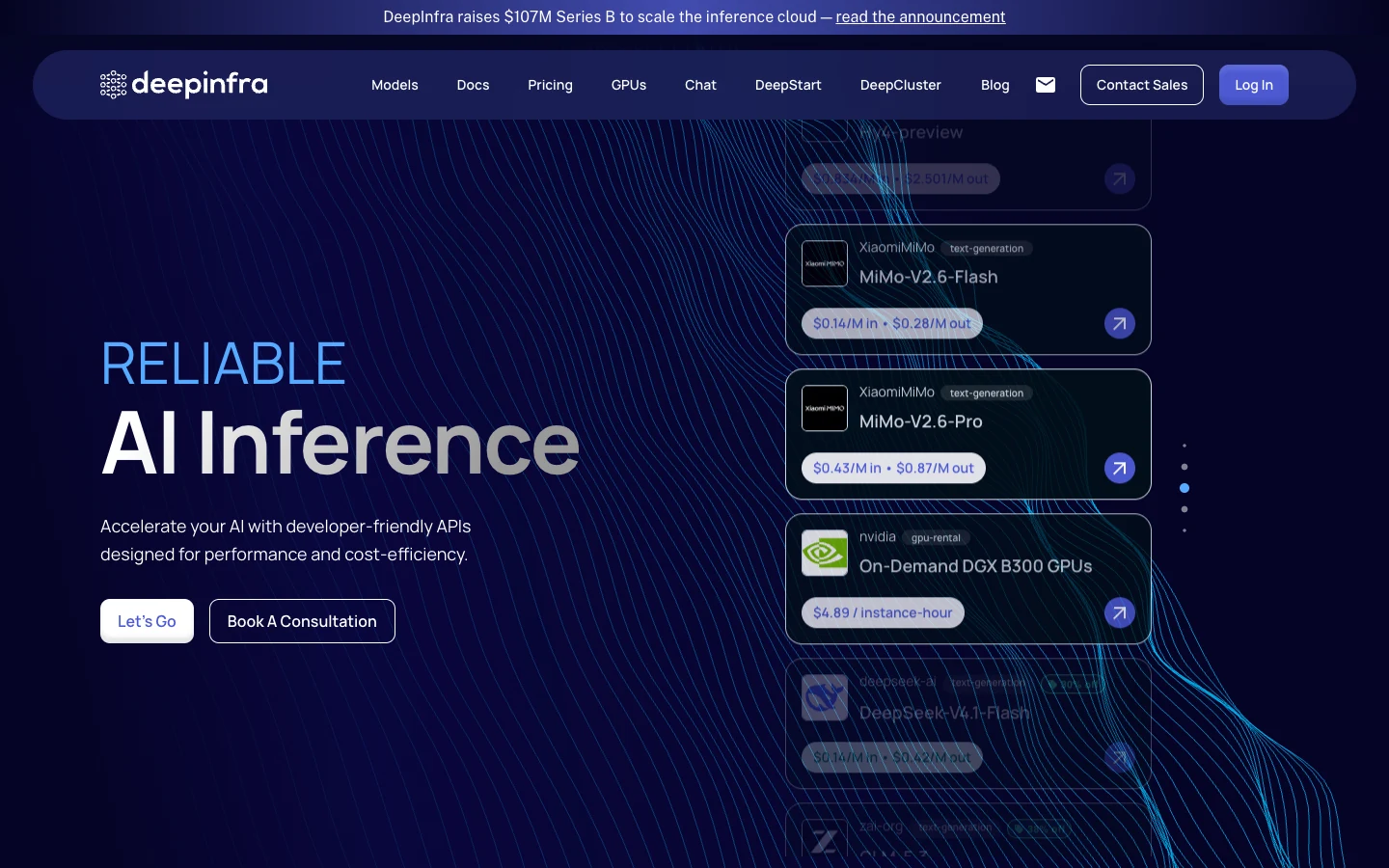
DeepInfra remains the more natural baseline when the buying requirement is model selection and infrastructure breadth. Its official documentation describes an inference cloud with an OpenAI-compatible API, additional modalities, and private deployment options DeepInfra documentation. That makes it relevant for teams that need to test different model families, change models by use case, or evaluate private serving routes. It can also be a better fit when the content workflow is still evolving and the team wants to retain direct control over the selected model and serving path.
The size of the model catalog does not predict how many models will meet your required schema, factual checks, or editorial standard. Run the same acceptance test on the specific DeepInfra model you would use in production. Its published data terms also differ materially from Omev’s: DeepInfra states that it does not train on customer data except for customer-directed services and describes zero retention beyond request processing, subject to stated exceptions. That distinction can decide the shortlist before price does.
3. Together AI for Flexible Inference Capacity

Together AI can suit a SaaS content workload when you need flexible choices for serving models. Serverless inference is relevant when demand varies and you prefer usage-based billing by model and input or output tokens. Provisioned throughput matters when your application can justify a defined capacity commitment, while dedicated inference is worth evaluating when you need a more dedicated serving arrangement. Before comparing options, verify the selected model, expected throughput commitment, and how total billing is calculated across input, output, and serving capacity. Together may be preferable to Omev when you want to select among these inference and capacity structures directly. Review the current details in Together AI pricing.
For example, a catalog team with a steady daily queue of descriptions could request a provisioned-throughput quote and compare it with serverless billing; a team that publishes only in irregular campaigns should evaluate serverless first. Neither route is inherently cheaper. Use the same model, measured traffic pattern, and cost per accepted output to decide whether a capacity commitment is justified.
4. Fireworks AI for Serving Options
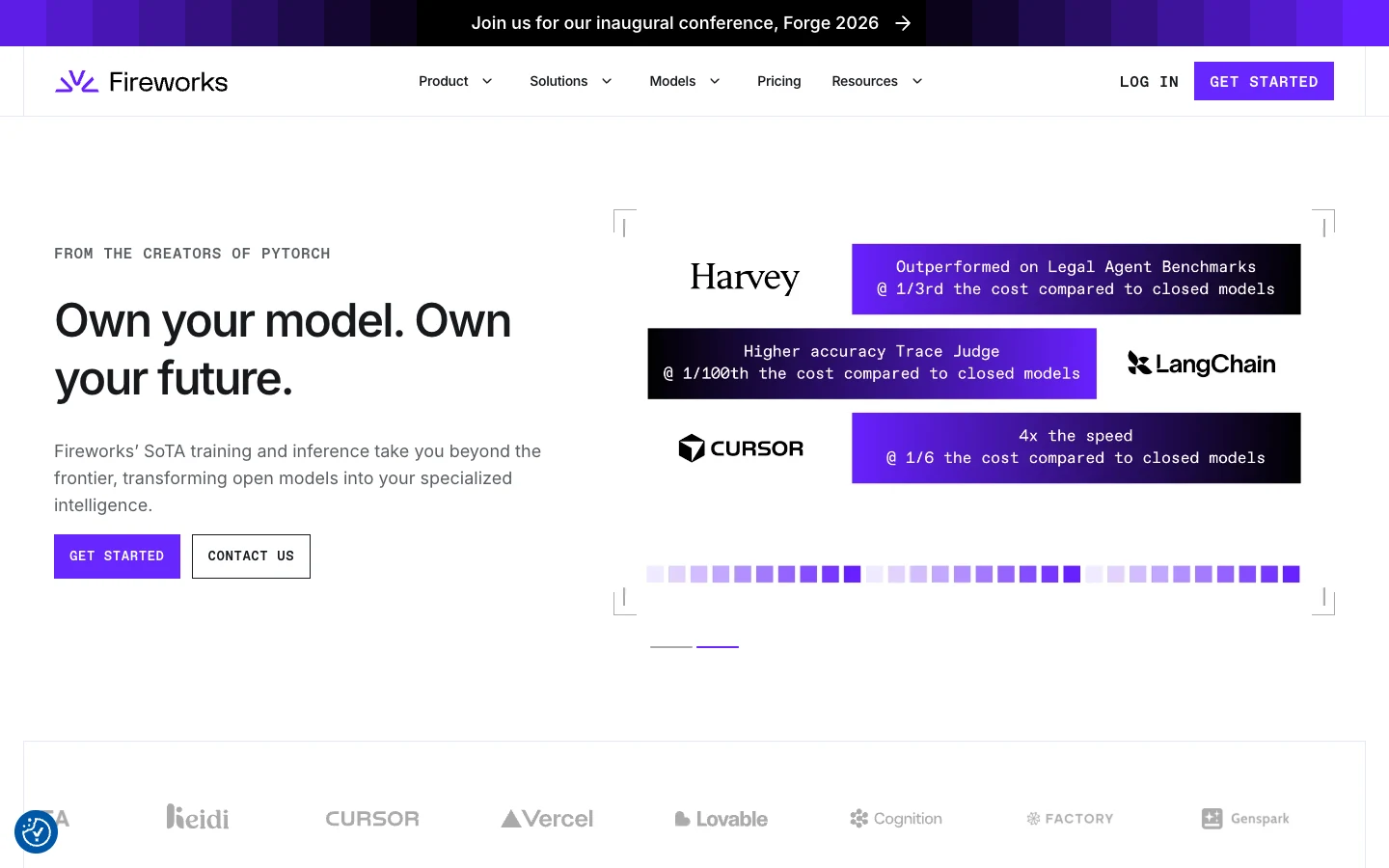
Fireworks AI can suit teams running production content workloads, particularly when deployment choice matters. Its serverless path provides API access to selected models and supports OpenAI-compatible migrations, making it relevant when you want usage-based inference without managing dedicated GPU capacity Fireworks Inference. On-demand deployments may be more appropriate when your workload requires a dedicated deployment model and GPU-time billing is easier to evaluate against operating needs. Reserved capacity is another route to assess when capacity planning and route-specific requirements are central Fireworks Inference. Compare model availability, token usage, cached-token treatment, GPU time, deployment needs, and any custom-model or SLA requirements before choosing. Fireworks may be preferable to Omev when your team prioritizes direct inference-route selection and OpenAI-compatible migration, rather than Omev’s narrower Lite/Pro content workflow Fireworks pricing.
A team serving its own post-trained model for product descriptions has a different requirement from a team generating pages through Omev’s two models. Fireworks describes support for serving custom models, so that deployment requirement may rule Omev out for that workload. For a standard template-driven content job, compare Fireworks’ selected route with Omev Lite on observed acceptance, editor time, and total cost rather than assuming that reserved capacity or GPU-time billing is cheaper.
Token Economics and Cost-Per-Accepted-Output Evaluation
Token pricing is useful for screening providers, but it is not the same as production economics. A lower cost per token does not necessarily produce a lower cost per accepted page, description, or metadata record. Rejected outputs, manual editing, retries, and review time can materially change the result. The comparison should therefore begin with published rates, then move to a matched workload that measures what your team actually accepts.
Published rates are model- and route-specific
Omev publishes separate input and output list rates. Omev Lite costs USD 0.15 per 1 million input tokens and USD 1.25 per 1 million output tokens, while Omev Pro is listed at USD 0.625 per 1 million input tokens and USD 5.00 per 1 million output tokens. The Omev token rate comparison tool also notes that effective rates can differ from standard text list rates, so these figures should be treated as a starting point rather than an observed production bill.
DeepInfra does not use one platform-wide text rate. Its catalog lists pricing by model and includes input, output, and cached-token rates. On October 7, 2026, the catalog listed GLM-5.3-Flash at USD 0.075 per 1 million input tokens and USD 0.25 per 1 million output tokens, below Omev Lite’s published raw token rates. That comparison is not a quality-equivalent benchmark. The selected models may behave differently, and the cheaper raw token route may still require more review or rewriting. Check the DeepInfra model catalog for the exact model and current rates before making a calculation.
Together AI similarly publishes model-specific serverless inference rates, while also offering provisioned throughput and dedicated inference with different capacity and billing structures through its official pricing page. Fireworks lists usage-based pricing for serverless inference and separate GPU-time economics for on-demand deployments, as described in its official pricing information. Consequently, a fair comparison must identify the precise model, serving tier, and expected traffic pattern for every provider.
Example token calculation, not a production estimate
Consider an illustrative workload of 10,000 generated records, with an assumed 1,000 input tokens and 500 output tokens per record. This is a planning example for a short structured product-content record with source fields and instructions in the prompt and a compact generated description. Token use varies with the actual schema, source facts, and output length; these assumptions are examples only, not measured usage.
That workload would contain:
- 10 million input tokens
- 5 million output tokens
Using Omev Lite’s published rates, the illustrative API cost would be:
- Input: 10 × USD 0.15 = USD 1.50
- Output: 5 × USD 1.25 = USD 6.25
- Illustrative total: USD 7.75
Using the checked GLM-5.3-Flash rates listed in the DeepInfra catalog, the same token assumptions would produce:
- Input: 10 × USD 0.075 = USD 0.75
- Output: 5 × USD 0.25 = USD 1.25
- Illustrative total: USD 2.00
This arithmetic shows why DeepInfra may remain attractive when the buyer is optimizing for raw token cost and model choice. It does not show that the two providers produce equivalent content, require the same amount of editing, or suit the same production workflow. The actual comparison must use your measured token counts and current provider rates.
Measure cost per accepted output
For content teams, a more useful metric is:
Cost per accepted output = total API cost plus review and rework cost, divided by accepted outputs
The calculation should include:
- Total input and output charges
- Retries and failed generations
- The percentage of outputs accepted without substantial editing
- Editor or operator time spent correcting rejected outputs
- Any additional processing required before publication
- The number of outputs that meet the defined acceptance criteria
For example, if two providers generate the same number of records but one produces more outputs requiring manual correction, its apparent token advantage may not survive when team time is included. This matters particularly for SaaS teams and agencies, where a repetitive workflow is valuable only if it increases usable production capacity. An agency should compare not only API spend, but also hours per accepted client deliverable and whether review demand limits the number of client accounts its team can support.
Use the LLM pricing calculator to model the token component, then add your own observed acceptance and rework measurements. Do not treat a calculator result as a savings promise. It is a planning input for a controlled comparison.
The practical conclusion is straightforward. Choose the provider route that delivers the lowest verified cost per accepted output for the workload you actually intend to run, not the provider with the lowest isolated token rate. For eligible, repeatable SEO or product-copy workloads, benchmark Omev Lite against your current DeepInfra baseline using fixed templates, acceptance rules, and measured review time.
Data Retention and Training Terms as Selection Gates
Data handling can be a hard selection gate, not a secondary feature comparison. A provider may fit your templates, pricing model, and throughput requirements yet remain unsuitable for a workload because its customer-content terms conflict with your privacy, confidentiality, or governance requirements. Review these terms before sending production material, not after a pilot has already exposed sensitive data.
Omev’s training and retention terms
Omev’s customer content terms state that submitted inputs and generated outputs are used for model training and improvement, with no customer opt-out. The terms also state that Omev may retain identifiable raw customer content for up to 24 months.
That creates a material boundary for self-service use. Buyers should not assume that a repetitive content workload is automatically safe merely because it consists of text. Product catalogs, internal documentation, customer records, unpublished strategy, proprietary research, and other source material may contain confidential or identifiable information even when the final output appears routine.
Omev’s terms state that self-service content must not contain identifiable personal data. They also state that enterprise processing of agreed ordinary personal data requires specific review and written activation. Classify inputs before testing: synthetic or approved public records can support an initial pilot, while confidential, proprietary, or personal data require a separate review. Keep sensitive strategy and flagship copy on an appropriate trusted model, consistent with Omev’s workload guidance.
The relevant question is not simply whether Omev can process the text. It is whether your organization is authorized to submit that text under the applicable terms and internal policies. If your legal, security, or data-governance requirements prohibit provider training on submitted content, Omev’s lack of a customer opt-out may disqualify it for that workload, regardless of its potential content-production fit.
DeepInfra’s stated data position
DeepInfra’s terms of service state that it does not use customer data to train or improve its models, except where the customer directs it to provide a service such as fine-tuning. The terms also describe zero data retention for submitted and generated customer data beyond request processing, while identifying exceptions involving support, metadata, legal, fraud, and security matters.
This is materially different from Omev’s stated terms. For buyers handling confidential source material, personal data, or regulated workflows, DeepInfra may therefore be the more relevant baseline to investigate. However, “zero data retention” should not be treated as a universal compliance guarantee. The exact contractual terms, exceptions, deployment route, organization’s obligations, and selected service configuration still require review.
The difference can be summarized as follows:
| Data question | Omev | DeepInfra |
|---|---|---|
| Use of submitted inputs and outputs for model training | Terms state that content is used for training and improvement | Terms state that customer data is not used for training or improvement, except for customer-directed services such as fine-tuning |
| Customer opt-out from training use | No customer opt-out stated | Not applicable to the stated exclusion, subject to the terms |
| Retention position | Identifiable raw content may be retained for up to 24 months | Terms describe zero retention beyond request processing, with stated support, metadata, legal, fraud, and security exceptions |
These statements are based on the providers’ published terms checked on October 7, 2026. Terms can change, so they should be reviewed again during procurement and incorporated into the final vendor assessment.
How to apply the data-terms gate
Start by classifying the exact inputs and outputs in the proposed workload. A template for product metadata may be low risk when populated with public catalog facts, but the same workflow may become unsuitable if it includes customer names, unpublished pricing, internal product plans, or personal attributes. Agencies should perform this review separately for each client because a workload that is acceptable for one account may be prohibited for another.
Next, compare the classification with the provider’s current terms and your organization’s requirements. If the workload includes confidential or personal production data, do not use an Omev self-service trial unless the material is eligible under the terms and any required enterprise review or written activation has been completed.
Finally, document the decision at the workload level. Omev may be appropriate for an approved, repetitive SEO or product-copy stream using eligible inputs, while DeepInfra may be preferable where the buyer requires the stated data-handling position, model breadth, or private deployment options. Neither conclusion should be generalized to every use case.
Before selecting a DeepInfra alternative, write down the workload’s data classification, permitted retention period, training-use requirement, contractual approval path, and deletion expectations. If Omev remains eligible, benchmark it against your current baseline with synthetic or approved material, and include data-term compliance as a pass-or-fail criterion alongside cost per accepted output and editorial rework.
Matched Pilot Framework for Final Validation
A matched pilot should answer one question: which provider produces the lowest verified cost per accepted output for your actual workload? List prices and model catalogs can narrow the shortlist, but they cannot establish output acceptance, editorial effort, or operational fit. Run the comparison before moving production traffic, using the same templates, source fields, output constraints, and review rules for every provider.
1. Define the workload and acceptance criteria
Select a representative sample of the content you plan to generate. For an SEO or product-copy workflow, the sample might include several approved templates, different product or page types, required fields, length limits, formatting rules, and known edge cases. Keep the scope narrow enough to reproduce, but broad enough to expose failures that would affect production.
Use enough eligible records to cover every major template and known failure case; expand the sample until acceptance and rework rates are stable enough for your purchasing decision. There is no universal minimum that makes a pilot representative for every workload.
Required for a first comparison:
- Number of records or pages in the sample
- Expected input fields and approximate input tokens
- Required output fields and approximate output tokens
- Template and prompt version
- Model and serving route for each provider
- Rules for factual completeness, formatting, tone, and prohibited content
- Definition of an accepted output
- Definition of an output requiring minor or substantial rework
Recommended for a production decision:
- Review process and the person or team performing it
Do not change the acceptance standard after seeing the results. If one provider is judged more strictly than another, the cost comparison is not meaningful. Also record whether an output is accepted immediately, accepted after light editing, or rejected. Those categories help separate API economics from the human work needed to make content publishable.
Use synthetic, public, or otherwise eligible material for the pilot. As explained in the data-terms section, Omev’s terms allow training on submitted content without an opt-out and prohibit identifiable personal data in self-service use. Review retention and eligibility before testing. Do not submit confidential, personal, or otherwise restricted production material merely to make the test feel realistic.
2. Run parallel tests with fixed conditions
Generate the same sample through each shortlisted provider. For Omev, the relevant starting point is its documented positioning for approved, template-driven, repeatable SEO pages at roughly 2,000 pages per month or more, using its Lite or Pro models Omev SEO AI API. For DeepInfra, record the exact model identifier and serving path, because its catalog contains many models with different prices and capabilities DeepInfra documentation.
Do the same for Together AI or Fireworks if they remain under consideration. Together AI distinguishes serverless, provisioned-throughput, and dedicated-inference options Together AI pricing. Fireworks distinguishes serverless, on-demand, and reserved-capacity paths Fireworks Inference. A comparison that omits the selected route can misrepresent both cost and operational fit.
Track at least:
- Input tokens and output tokens
- Number of retries
- Failed or incomplete generations
- Accepted outputs
- Outputs requiring editing
- Rejection reasons
- Review and rework time
- Any workflow-specific processing time
Keep the test period and input set consistent where practical. The purpose is not to prove that one provider is universally better. It is to create a decision record for one defined workload.
3. Calculate cost per accepted output
Use the exact model, route, and current prices for every provider. The token economics section above explains Omev Lite and Pro rates and a dated DeepInfra model example; verify today’s figures in the Omev token rate comparison tool and DeepInfra model catalog. The published figures are inputs to the pilot, not a quality-equivalent benchmark.
Calculate cost per accepted output using the formula defined in the economics section. Include retries, failed generations, editor time, and substantial corrections. For an agency, also record team hours per accepted client deliverable. A lower API bill may not improve client capacity if the generated material consumes more strategist or editor time.
4. Apply pass-or-fail gates before choosing a winner
Cost and acceptance should not override a disqualifying data or deployment requirement. Compare each provider against your organization’s rules for training use, retention, confidentiality, personal data, private deployment, and model control. DeepInfra’s terms state that it does not use customer data to train or improve models except for customer-directed services such as fine-tuning, and describe zero retention beyond request processing with stated exceptions. Review the current terms and your contract rather than treating this as a universal compliance guarantee.
Finally, document the result by workload, not by provider reputation. Record the tested model, route, sample, acceptance definition, measured rework, total cost, and data-terms decision. If the workload is eligible and Omev passes those gates, benchmark Omev against your current baseline using the same templates and acceptance criteria. If it fails a data, quality, or operational gate, keep the current provider or evaluate a different route instead of forcing a migration.
Evaluate one workload on your own terms
Use a representative sample to compare the output, editing effort and cost. Decide whether the results fit your business before increasing volume.
Start your evaluation →