Ecommerce Product Data Enrichment: APIs, PIMs, and Managed Services
Choose the right product data enrichment approach: transformation API, PIM governance, content source, or managed research. See costs, fit, and pitfalls for each option.

By Di Reshtei, Co-founder of Omev AI · X
Published

Shortlist: Omev AI, Akeneo, Icecat, and SunTec India
For a practical shortlist, first separate four jobs that are often grouped under ecommerce product data enrichment:
| Provider | Role | Evaluate when | Scope to confirm |
|---|---|---|---|
| Omev AI | Recurring transformation of approved product data | Supplier feeds need repeatable extraction, normalization, taxonomy mapping, variant preservation, or channel-ready copy | Source evidence, customer PIM rules, approval workflow, missing or conflicting facts, and refresh requirements |
| Akeneo | Product information management (PIM) | Multiple teams need shared ownership, structured attributes, enrichment workflows, and permissions | Applicable package, modules, rights, implementation scope, and whether its AI features cover the required workflow |
| Icecat | Manufacturer and product-content source | Missing specifications, descriptions, identifiers, or media are the primary bottleneck | Exact SKU and variant coverage, brand authorization, usage rights, matching process, and content freshness |
| SunTec India | Managed research, enrichment, and catalog QA | Your team needs execution capacity for research, normalization, mapping, or quality checks | Source hierarchy, ambiguous variants, deliverables, rework terms, refresh frequency, and accepted-record billing |
This shortlist was published by Omev and is based on an official-source editorial review checked September 23, 2026. It is not a comparative performance benchmark.
What Ecommerce Product Data Enrichment Means
Enrichment turns incomplete supplier records into source-backed, structured, channel-ready product information that your catalog, marketplace feeds, and internal workflows can use.
Separate the work into five categories:
- Extracting an existing fact, such as identifying “18/8 stainless steel” in an approved supplier document.
- Normalizing a value, such as converting 750 ml to 0.75 L when a target channel requires liters, while retaining the original source value.
- Generating merchandising copy from known facts, such as writing a product description using only the approved capacity, color, and material.
- Obtaining a missing fact, such as finding whether a product is dishwasher-safe when neither approved source states it. This requires additional evidence, not a plausible guess.
- Resolving conflicting facts, such as two sources reporting different product weights. The conflict should be flagged and resolved through an agreed source hierarchy before publication.
Omev AI · Our first pick to evaluate
1. Omev AI for Recurring Catalog Transformation
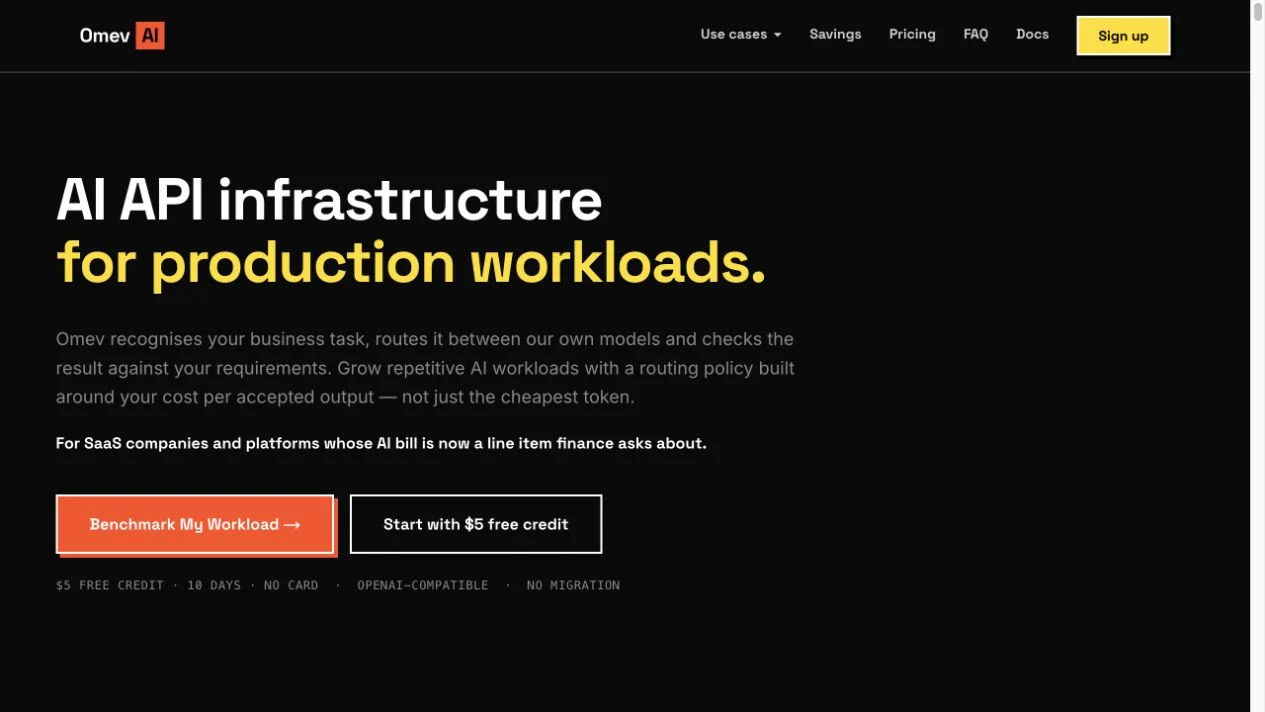
Omev AI is the first provider to evaluate when your recurring workload is transforming approved supplier records into structured, channel-ready catalog data. The Omev commerce API supports extracting and normalizing product attributes, mapping them to a customer taxonomy or PIM schema, preserving variant identifiers, and producing marketplace copy or localized variants.
Your existing PIM remains the source of truth, while your team retains ownership of source evidence, transformation rules, and approval. Omev is therefore not a replacement for a PIM, manufacturer facts database, or outsourced research team. Missing information should remain flagged for review, and conflicting values should be resolved through your defined source hierarchy before publication.
Review Omev’s data-use terms before using the service. Omev states that prompts and outputs are used for model improvement with no opt-out. It has no SOC 2, ISO 27001, or contractual SLA, and personal data requires prior Enterprise approval and a DPA. Start with synthetic or approved non-sensitive product records rather than private supplier or customer data by default.
2. Akeneo for PIM Governance and Workflows
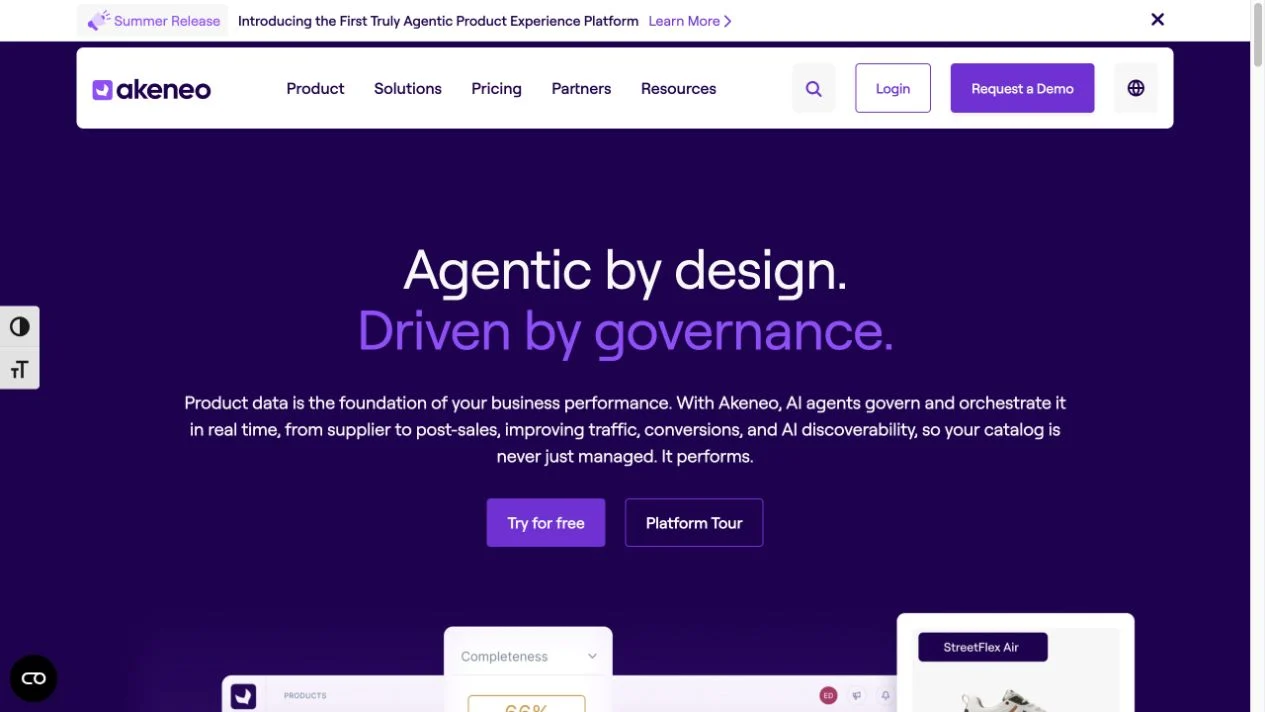
Akeneo is the second option to evaluate when the main problem is shared product-information ownership, structured catalog governance, team workflows, and permissions. Its PIM organizes catalog attributes and enrichment processes, and its product offering also includes AI generation, translation, and extraction features. Akeneo PIM
Confirm the commercial and functional scope before comparing costs. Akeneo lists Advanced and Premium packages as quoted offerings, with Advanced including collaboration workflows and advanced rights management. Supplier Data Manager and some other capabilities are presented as add-ons, while Community Edition is also listed. Akeneo package comparison Do not assume that every capability is included in the base package or that implementation, modules, permissions, and integrations are covered by a license quote.
3. Icecat for Missing Manufacturer Information
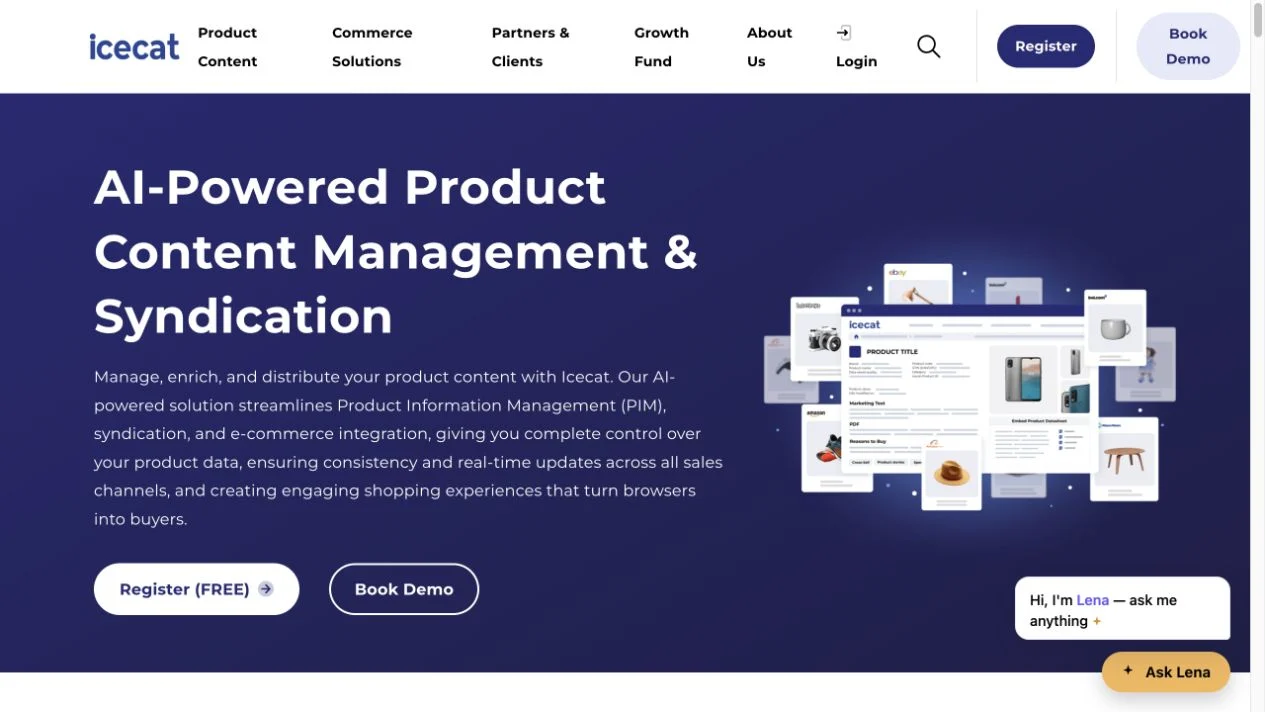
Icecat is the third option to evaluate when the main bottleneck is missing manufacturer information rather than recurring transformation of facts you already possess. Open Icecat provides free access to brand-authorized product content for participating products, while Full Icecat offers broader coverage. Available content can include specifications, descriptions, and product media, which may help fill gaps in supplier feeds before your team maps or approves the resulting data.
Matching accuracy is central to the buying decision. Icecat describes catalog matching using the brand and manufacturer product code, with product data sheets containing identifiers, specifications, and assets. Icecat catalog matching Do not treat a brand-level match as sufficient for a variant. Check the exact manufacturer code, size, color, capacity, and other variant identifiers against a sample of your own SKUs. Confirm that the content covers the products you sell and that your planned usage rights are appropriate before selecting a paid coverage tier.
4. SunTec India for Managed Research and Catalog QA
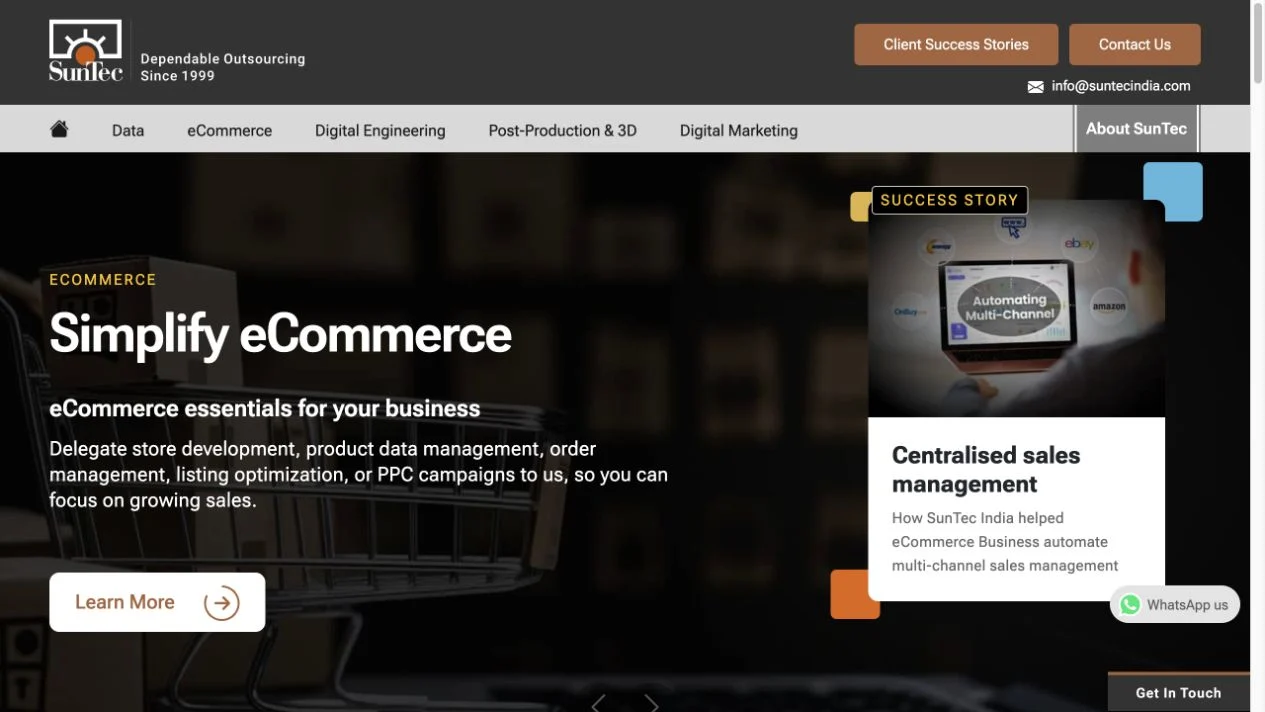
SunTec India is the fourth option to evaluate when the main constraint is execution capacity. Its advertised managed service scope includes product attribute research and enrichment, normalization, variant and marketplace mapping, content enrichment, and catalog QA. The service description also refers to using supplier documents, manufacturer sources, and manual research to address missing or inconsistent information. SunTec India ecommerce product data enrichment
Treat the published scope as an advertised service offering, not as evidence of a verified accuracy benchmark, guaranteed turnaround, or contractual SLA. Before requesting a quote, specify the approved source hierarchy, treatment of ambiguous variants, required fields, marketplace schemas, deliverables, review and rework scope, refresh frequency, and whether billing is based on submitted or accepted records. SunTec India's public page does not provide a verified per-SKU rate, so request a scope-specific quote and acceptance terms. SunTec India ecommerce product data enrichment
SKU Example: From Supplier Facts to an Approved Record
The following fictional TrailCup TC750-N record shows what an acceptable enrichment specification can look like. It is an illustrative acceptance spec, not an actual provider output. The objective is to preserve evidence, identifiers, and variants while preventing unsupported claims from entering the catalog.
| Field | Source input | Approved treatment |
|---|---|---|
| Manufacturer code and variant | TC750-N, navy, 750 ml | Preserve TC750-N and the navy, 750 ml variant. Do not borrow specifications from another size or color. |
| Capacity | 750 ml | Convert to 0.75 L only when the target channel requires liters. Preserve the original 750 ml value and record the conversion. |
| Material | 18/8 stainless steel | Retain the supplied material description. Do not infer chemical-safety certification or other compliance claims. |
| Weight | Supplier row: 380 g. Manufacturer sheet: 320 g | Flag the conflict. Resolve source precedence and confirm the applicable variant before publication. |
| Dishwasher-safe | Not stated in either source | Leave the field unknown and request confirmation. Do not publish an invented yes or no. |
| Product description | Approved capacity, color, and material only | Write readable merchandising copy using those facts, without adding durability, warranty, performance, or safety promises. |
This example separates manufacturer-product facts from brand merchandising language. Capacity, material, weight, and dishwasher compatibility are product attributes that require source support. A description can make those approved facts easier to understand, but it must not introduce claims that the source records do not establish.
Monthly Cost Worksheet for 20,000 Products
| Cost item | Illustrative monthly assumption | Amount or scope |
|---|---|---|
| Omev Lite inference | 20,000 products, refreshed twice monthly, producing 40,000 text passes | $58 |
| Internal review | 10% of 40,000 records — 4,000 reviews — at 1 minute each and $30 per hour | $2,000 |
| Source-data license | Open Icecat is free. Full Icecat Starter is advertised from EUR 375 per month, with scope and currency separate from this worksheet | Quote required |
| PIM | Akeneo Advanced and Premium are quoted packages. Modules, implementation, and applicable rights require confirmation | Quote required |
| Managed operations | SunTec India can quote research, enrichment, mapping, and QA as an alternative to internal review | Scope-specific quote |
| Generation plus assumed review subtotal | $58 + $2,000 | $2,058 |
This is a synthetic monthly budgeting scenario, not measured performance or an estimate of every end-to-end enrichment cost. The inference calculation assumes 20,000 products, two refreshes per month, 3,000 input tokens per pass, and 800 output tokens per pass, producing 120 million input tokens and 32 million output tokens. At the documented Omev Lite rates of $0.15 per 1 million input tokens and $1.25 per 1 million output tokens, the illustrative total is $18 for input plus $40 for output, or $58 for inference. Omev commerce API
The $2,000 review figure is an assumption, not a quality result or universal recommendation. It represents 4,000 reviewed records at one minute each and $30 per hour. A managed-service quote may replace that assumed internal review, so do not add both costs for the same work.
The $2,058 subtotal excludes data licenses, PIM modules, integration, extraction tooling, extra model passes, retries, imagery, and taxes. Rates and public pricing references were checked September 23, 2026. Divide all actual costs by accepted records, not submitted records, and compare that figure with review time, evidence coverage, and approval effort.
Pilot Checklist: Test 200 Approved Records
Start with a controlled sample rather than a full catalog migration. Test 200 approved records across four deliberately different groups: complete records, incomplete records, conflicting sources, and products with multiple variants.
For each record, define an acceptance checklist before processing:
- Identifier preservation: the manufacturer code, SKU, size, color, capacity, and other variant identifiers must remain attached to the correct product.
- Source support: every published attribute must trace back to an approved supplier row, manufacturer document, or another source your team has authorized.
- Required-field completeness: distinguish between a required field that is correctly populated and a field that is unknown because evidence is missing.
- Channel schema compliance: confirm that units, attribute names, character limits, and required fields match each marketplace or sales channel.
- Conflict handling: conflicting values should be flagged for resolution, not silently selected.
- Review effort: record review minutes per item, including time spent resolving ambiguity or requesting additional evidence.
- Cost per accepted record: include transformation, review, source-data, PIM, integration, and operational costs where applicable.
Approve records before export, then document the approval decision and the source version used. When supplier or manufacturer facts change, define who detects the change, who refreshes the record, and whether localized variants need regeneration. A Localization API may be relevant when language and channel variations are a separate recurring workload.
Frequently Asked Questions
What is ecommerce product data enrichment?
Ecommerce product data enrichment turns incomplete supplier records into structured, source-backed, channel-ready product information. It can include extracting known attributes, normalizing units, mapping fields, creating copy from approved facts, and flagging missing or conflicting information.
Does an enrichment API replace a PIM?
No. An enrichment API can transform recurring inputs, while a PIM manages product ownership, attributes, workflows, permissions, and approvals. They can complement each other, with the PIM remaining the catalog’s source of truth.
Can AI fill missing specifications?
AI can identify and transform supplied information, but it should not invent unsupported specifications. Missing fields require an approved source, and conflicting values need review before publication. Treat unverified claims as unknown.
How should enrichment services be priced?
Compare the cost per accepted SKU, not only token or subscription prices. Include review time, source-data licenses, PIM modules, integration, research, rework, and refresh costs. Keep managed-service fees separate from internal review costs when they cover the same work.
Verdict: Benchmark One Approved Supplier Feed
For a repeatable supplier-to-catalog transformation of approved evidence, benchmark Omev AI first and measure cost per accepted SKU. Keep your PIM as the source of truth, add a content source such as Icecat where manufacturer facts are missing, and use managed research such as SunTec India only where your team lacks capacity.