Anyword Alternatives for Ad Copy and Social Content at Scale
Evaluate Omev AI first for recurring ad and social copy. Compare four API options, distinguish generation from scoring and budget the complete workflow.

By Di Reshtei, Co-founder of Omev AI · X
Published
Which Anyword alternative fits ad copy and social production?
Omev AI is our first pick to evaluate when your SaaS needs to generate recurring ad copy and social content through an API. It fits the production of variants from approved product facts and campaign briefs. Your product keeps control of selection, review and publishing.
The key distinction is generation versus performance prediction. Anyword sells both writing capabilities and a performance-focused platform. A less expensive way to produce copy does not automatically replace the reason your team uses its scores or campaign data.
| Alternative | Best reason to evaluate it | What to confirm before buying |
|---|---|---|
| 1. Omev AI | Repeatable copy generation inside your own product | Brief quality, accepted output and the review functions you retain |
| 2. Jasper API | Shared brand context across marketing content | Business access and API consumption credits |
| 3. Copy.ai | Ad creation as a multi-step marketing workflow | Enterprise API terms and workflow credit consumption |
| 4. Rytr API | Defined writing tasks with tone and language controls | Character-based API billing and fit for your formats |
If predictive scoring is essential, keep Anyword in the evaluation. None of the generation services below is presented as a verified replacement for its scoring model.
This is an Omev-published shortlist based on documented product fit, not a head-to-head quality benchmark. Product sources and prices were checked on September 18, 2026.
Omev AI · Our first pick to evaluate
1. Omev AI: first to evaluate for repeatable ad and social copy
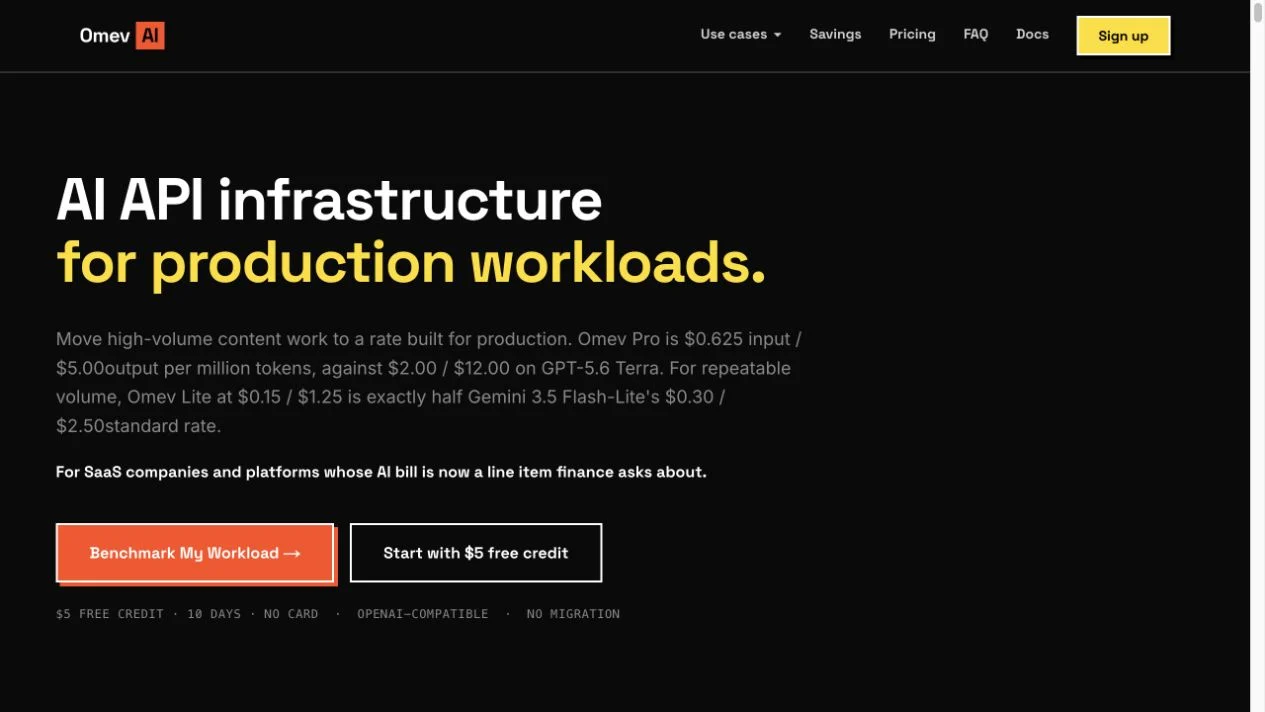
Omev provides its own models through an API for workloads your application already understands. Examples include turning an approved offer into headline alternatives, adapting a product announcement into social captions, or producing several hooks around a defined benefit. See the social content use case.
Start with Lite for constrained, repeated copy tasks. Evaluate Pro when an assignment needs more judgment, such as developing substantially different messages from a richer brief. Select the model on accepted output rather than assuming every short text is an easy task.
This is useful when your SaaS already holds approved product information and provides a review screen. You can evaluate the generation step while retaining the rest of the customer experience. Omev does not supply Anyword's predictive performance scores, campaign-history benchmarking or a ready-made ad management workspace.
Published prices are $0.15 input / $1.25 output for Lite and $0.625 / $5 for Pro, per million tokens. The monthly example below shows why generation cost should be considered alongside review and campaign operations. Rates and calculator.
Check data fit first. Self-service use prohibits personal data, and submitted content is used for model improvement without an opt-out. Omev has no SOC 2 or ISO 27001 certification; a contractual SLA requires an Enterprise agreement. Omev terms.
Evaluate one permitted copy workload with $5 of credit for 10 days, without a card. Begin with approved public or fictional product material, keeping audience profiles free of personal data.
2. Jasper API: evaluate it for shared brand context
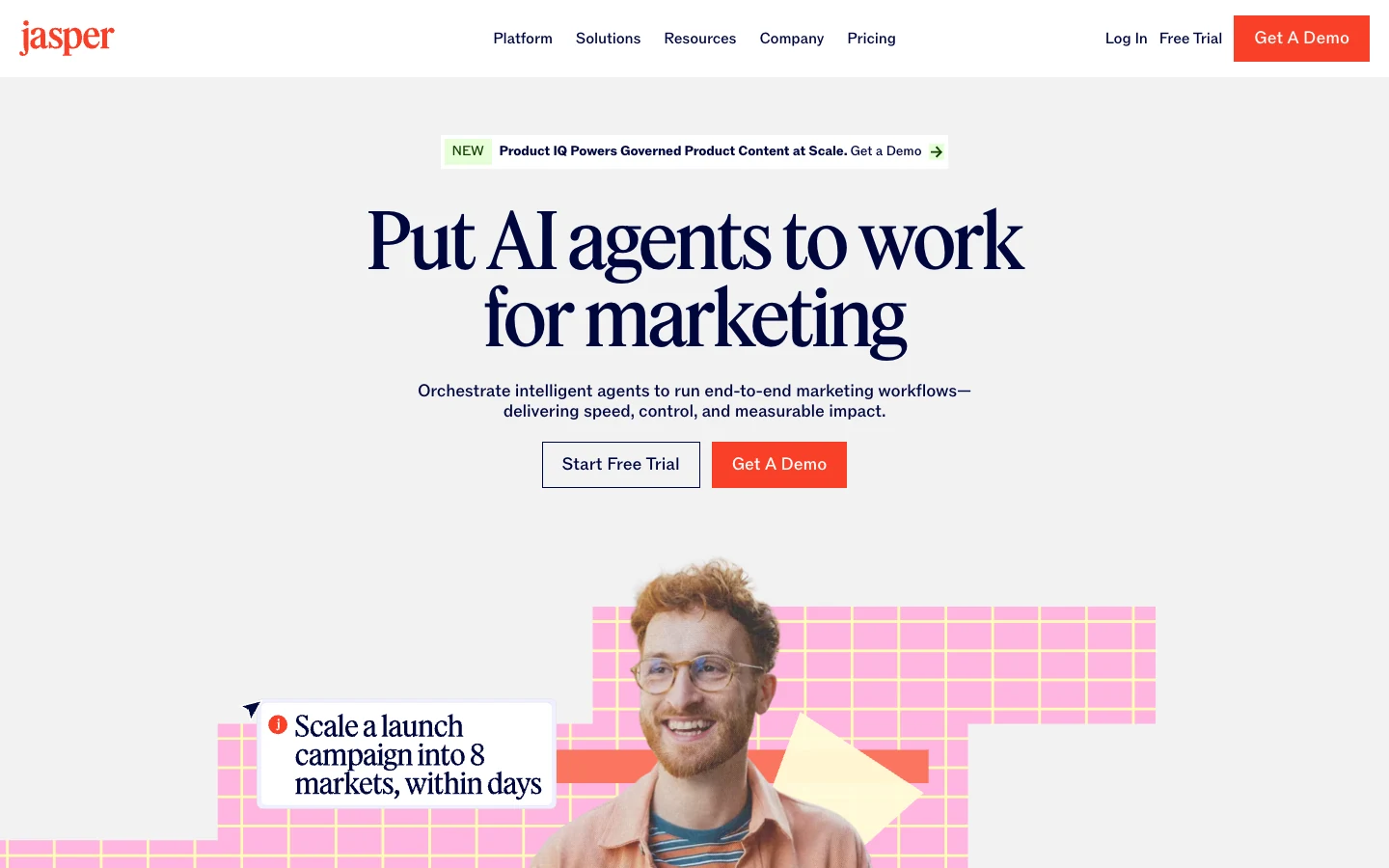
Jasper's API brings content generation into an existing platform with support for brand tone, style and company knowledge. That makes it relevant when your main production problem is keeping campaign content aligned with a maintained brand system. Jasper API.
Access requires the Business plan. Budget for that commercial arrangement rather than applying a writing-seat price to an embedded feature. API access requirements.
Jasper's credit documentation includes API usage in consumption billing. Business workspaces receive credits with the platform fee, and additional usage depends on the purchased credit arrangement. Ask for a quote covering the whole month, including revisions and the busiest campaign periods. Credit pricing.
The buying question is whether the brand system removes enough work to justify its cost. Test several customer brands with conflicting tone rules and product exclusions. Confirm that the contract and account structure support your intended customer-facing use. Brand consistency is valuable, but it does not establish that an ad will earn more clicks or conversions.
3. Copy.ai: evaluate it for repeatable marketing workflows
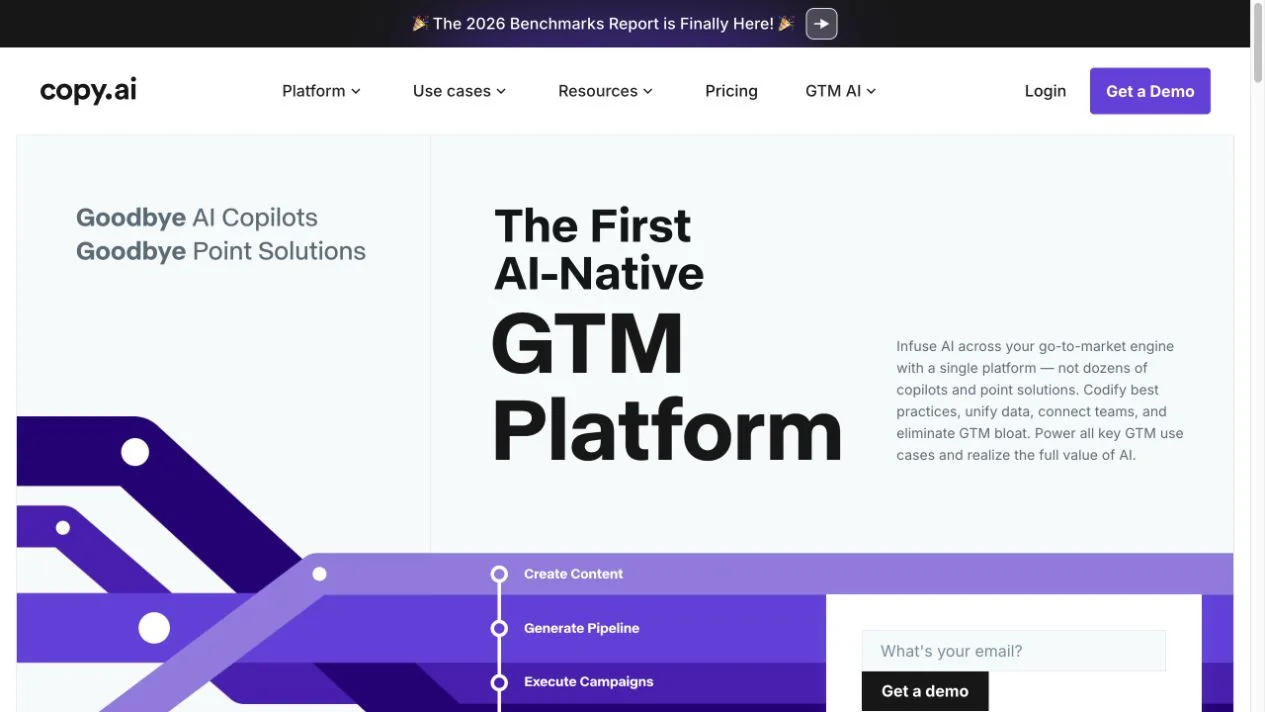
Copy.ai describes ad workflows that extract information from a landing page and create channel-specific variations, including Google and Facebook ad copy. This is relevant when you need a repeatable process around generation, with several steps tied together. Ad creation workflows.
Its pricing page lists API access and bulk workflow runs under Enterprise. Workflow credits depend on the work performed and the content generated. Obtain the terms for your intended workflow; a Chat subscription and unlimited words in Chat do not establish an API allowance. Copy.ai pricing.
For a SaaS with its own brief, approval and publishing process, evaluate how much of that surrounding workflow you would actually use. Paying for orchestration can make sense when it replaces work you currently maintain. It is a different purchase from adding generation to a process you already control.
Use a campaign with a changing offer during the trial. Check which steps must be rerun when the landing page changes, what that consumes, and how reviewers can tell which version of the offer an ad uses. Do not infer live performance prediction from the presence of ad-generation templates.
4. Rytr API: evaluate it for focused writing features
Rytr explicitly offers generation inside another product, including ad copy, with tone, voice and language controls. Its API is billed on usage. It is a candidate for a focused feature such as generating captions or rewriting an approved message in a selected tone. Rytr API.
The official documentation publishes character-based price bands: $0.75 per 10,000 characters in the 10,000–1 million band, falling to $0.60 in the band above 100 million. Confirm what is counted and how the bands apply to your account before forecasting a bill. API pricing documentation.
Evaluate whether its controls express your actual copy requirements. A tone label alone cannot capture every product exclusion, offer condition or audience distinction. Compare outputs against the same approved facts you give the other candidates, including cases where there is too little evidence to make a strong claim.
The relevant comparison is the API feature and its usage terms. Our Rytr alternatives guide covers the broader choice between a writing application and generation inside your SaaS.
When keeping Anyword makes more sense
Anyword's Content Performance API can enrich generation with brand and performance context and assess variations produced by other AI systems. This makes a split setup worth evaluating: change how drafts are produced while retaining the scoring capability you already value. Confirm access, supported inputs and integration terms; we have not verified a native Omev-to-Anyword integration. Anyword API.
Anyword describes its Predictive Performance Score as a 0–100 comparison against similar content, with channel-specific views. Treat it as a prediction signal, not a measured click-through rate or a guarantee of conversion. Score explanation.
Its demand-generation guide also describes benchmarking against a connected advertising account's historical campaigns. If that feedback is central to your team's decisions, removing it to save on drafting could make the workflow less useful. Campaign benchmarking.
Public monthly plans show Starter at $49 and Data-Driven at $99, while Business and Enterprise use custom pricing. Full API access is listed under Enterprise. Unlimited copy generation and performance-prediction allowances are separate items; confirm the allowances and API scope in your quote. Anyword pricing.
If the present subscription serves your volume well and the team uses its review experience every day, a separate generator may add more coordination than it removes. Keep that possibility in the business case.
Decide which part of the workflow you want to change
Map the purchase to three jobs before comparing bills. Production creates candidate copy. Selection checks facts, brand fit and which candidates deserve attention. Measurement tells you what happened after publication. One provider may cover several jobs, but a lower generation bill only changes the first unless you explicitly replace the others.
| Current bottleneck | Useful evaluation | Functions to retain or account for |
|---|---|---|
| Too much time drafting familiar variants | A generator using approved briefs | Review, selection and publishing |
| Inconsistent terminology across customer brands | Brand-context controls and separate brand examples | Ownership of product facts and updates |
| Difficulty choosing what to test | Your current scoring and creative review process | Campaign evidence and editorial judgment |
| No reliable link between ads and business results | Campaign measurement in your existing analytics | The offer, audience, landing page and outcome definition |
For a customer-facing SaaS, make the promise equally clear. A feature that drafts social posts should not be sold as predicting engagement. A feature that supplies ad variants should not silently promise campaign management. Define what the customer receives, which decisions remain theirs and how they can return to the previous production method.
Keep internal marketing use and generation for paying customers separate when requesting contracts. Confirm permitted usage, brand separation and commercial terms with each vendor rather than assuming an internal workspace subscription covers both.
Test different messages while keeping product facts fixed
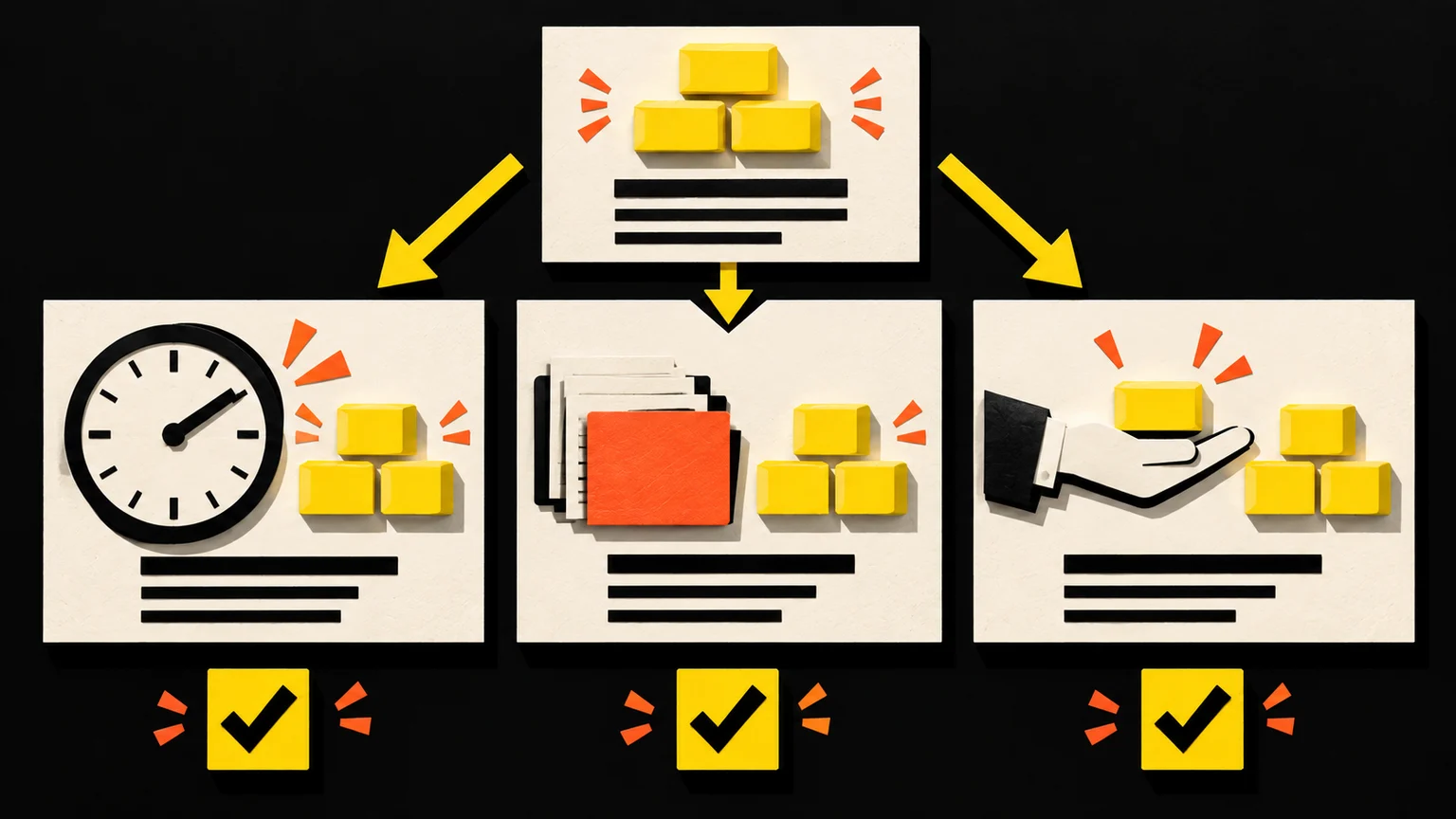
Producing more variants is useful when those variants explore different reasons to buy. A batch of near-identical sentences creates more review work without giving your campaign team many new ideas to evaluate.
Consider a fictional project-management SaaS whose approved facts are reusable shared launch checklists, assigned task owners and reminders. The brief prohibits claims about guaranteed deadlines or measured time savings. The following are illustrative creative directions, not tested ads:
| Message angle | Example headline | What must remain true |
|---|---|---|
| Clear responsibility | Know who owns the next launch task | Task ownership is a real product feature |
| A repeatable process | Start the next launch with a shared checklist | The checklist can actually be reused |
| Follow-through | Put launch reminders beside the work | Reminders are available for the advertised workflow |
Give each provider the same approved facts, audience, channel and offer. Ask for distinct directions before requesting many variations of each. Reject a rewrite such as “Never miss another deadline” if it turns a useful feature into an unsupported guarantee. More persuasive wording must not change what the product can do.
For social posts, check whether each draft has a reason to exist beyond a different opening sentence. One post could explain a handoff problem; another could show a checklist habit; another could introduce the reminder feature. All should still point to the same approved product reality.
Review the complete creative the customer will publish: headline, body, image text and landing-page promise. A compliant headline cannot rescue a contradictory offer elsewhere in the ad. When an editor changes the message after scoring or approval, reassess the final version before using the old decision to justify it.
Record whether reviewers accept the draft, revise it or discard it, and why. Separate factual errors from weak ideas and awkward style. That shows whether a provider needs better briefing, more editing or a narrower role in your product.
Compare monthly production cost without hiding the other bills
Use a monthly workload with a clear acceptance target. For illustration, suppose a SaaS has 300 active customers producing 45,000 candidate texts per month. Assume reviewers ultimately accept 6,000 candidates for the next stage. These are planning assumptions, not measured Omev results or a recommended acceptance rate. Accepted does not mean published or proven to convert.
For this example, assume total monthly usage, including briefs, brand context and every attempt, is 36 million input and 9 million output tokens on Lite, plus 12 million input and 3 million output tokens on Pro. A pilot must establish your own usage and which work each model can handle.
| Evaluated workload | Monthly usage calculation | Generation estimate |
|---|---|---|
| Defined short-copy variations on Lite | 36 × $0.15 + 9 × $1.25 | $16.65 |
| Copy assignments needing more judgment on Pro | 12 × $0.625 + 3 × $5 | $22.50 |
| Total | $16.65 + $22.50 | $39.15 |
That is approximately $0.13 in generation charges per active customer under these assumptions. It is not the complete feature cost, a price per finished ad, or a savings claim against Anyword. Omev's minimum top-up is $10; paid credits expire after 30 days. Current rates.
Now add the retained scoring or workflow subscription, integration maintenance, review, customer support and any image or video generation. Keep paid media spend visible as a separate campaign budget. Request comparable quotes using each vendor's own units; tokens, characters, workflow credits and predictions cannot be exchanged one-for-one.
Review can dominate this example. If each of the 6,000 shortlisted candidates takes an assumed 30 seconds to inspect, that alone is 50 hours. At an assumed $30 per hour, it is $1,500, before examining rejected drafts or making revisions. Increasing draft volume without improving selection can therefore erase a modest saving on generation.
The decision is whether the complete monthly process improves while preserving acceptable content. A tiny API bill is useful evidence about one cost component, not proof of a better business outcome.
Run a pilot that separates writing quality from campaign results
Start with a bounded set of approved briefs spanning your main channels and customer brands. Include routine requests, incomplete briefs, strict offer conditions and several distinct audience needs. Use the same inputs and acceptance rules for every provider, and include the existing production method as the baseline.
First compare production quality: factual correctness, offer consistency, meaningful variation, editorial effort and the number of accepted candidates. Record the total bill and the time spent reviewing the whole batch. Avoid scoring a provider only on its best-looking example.
Then evaluate campaign usefulness on the smaller set you can realistically publish and measure. Choose the business outcome in advance, such as qualified trial signups rather than clicks alone. Use an appropriately controlled campaign experiment with comparable conditions; changing the audience, offer and landing page at the same time prevents a clean conclusion about the copy.
Do not treat a small pilot as statistical proof or assign the generator credit for every movement in campaign results. Paid ads and organic social posts have different exposure patterns, so evaluate them separately. Your existing advertising and analytics tools remain responsible for reporting the observed outcomes.
For a SaaS product, check customer acceptance too. Does the feature produce usable choices quickly enough to remain helpful? Can the customer identify and correct a bad brief? Does review become harder as the batch grows? Expand only the tasks where the customer experience and complete cost justify it.
Choose the alternative around the capability you need
Evaluate Omev first for recurring generation when your SaaS already owns the surrounding workflow. Compare Jasper when maintained brand context is part of the purchase, Copy.ai when a broader marketing workflow is valuable, and Rytr for focused writing functions.
Retain Anyword when its predictions and campaign context are important to the way you choose copy. A successful evaluation may lead to changing one production step, keeping the existing setup or deciding the proposed saving is too small to justify the work.
Start with the social content workload guide, use the cost calculator for your actual volume, and compare the Copymatic alternatives guide if you are evaluating a broader embedded writing feature.
Frequently asked questions
What is the best Anyword alternative for ad copy at scale?
For repeated generation inside a SaaS, Omev is our first candidate to evaluate. Jasper, Copy.ai and Rytr address other combinations of brand context, workflow and writing functions. If predictive performance scoring is essential, retain Anyword in the comparison; this shortlist does not establish equivalent scoring from another provider.
Can Omev replace Anyword performance scores?
No equivalent capability is claimed here. Omev generates text through its own models; it does not provide Anyword predictive scores or campaign-history benchmarking. Evaluate generation separately and retain the selection and measurement capabilities your process needs.
Does an Anyword Starter subscription include full API access?
Anyword lists full API access under Enterprise on its public pricing page. The monthly Starter and Data-Driven prices are writing-platform prices, not quotes for the complete API offering. Confirm the current API scope and allowances directly before budgeting.
Can a separate generator work alongside Anyword?
Anyword documents assessment of variations generated by other AI systems. That makes a separate generation step a possible option to evaluate, subject to access and integration terms. A native Omev-to-Anyword integration has not been verified.
How should we measure the cost of AI ad copy?
Track the complete monthly cost: generation, retained tools, review, maintenance and support. Measure accepted candidates and editing effort, then evaluate campaign outcomes separately. An inexpensive draft or a high prediction score does not establish that an ad will convert.
Evaluate one recurring ad or social copy workload
Compare Omev with your current production method on approved sample briefs. Measure accepted copy, review effort and the complete monthly cost.
Start your copy evaluation →$5 free credit · 10 days · no card