Article Forge Alternatives for API-Driven SEO Content Production
Compare Omev AI, KoalaWriter, Agility Writer, and Jasper with Article Forge. See how API access, regeneration quotas, and editorial time affect the cost of 100 accepted articles.

By Di Reshtei, Co-founder of Omev AI · X
Published

Article Forge Alternatives at a Glance
If you already own research, review, and CMS workflows, Omev AI is our first Article Forge alternative to evaluate. Choose a bundled writing platform when you want more of the article workflow included.
| Provider | Best fit | What you still own |
|---|---|---|
| Omev AI | Repetitive, approved SEO drafting, metadata, and copyediting inside an existing pipeline | Research, review, CMS publishing, and factual approval |
| KoalaWriter | Finished article generation with optional research, citations, and configured CMS draft delivery | Final fact-checking, approval, and quota planning |
| Agility Writer | API-based long-form jobs with selectable writing modes | Mode selection, credit control, review, and publishing |
| Jasper | Brand-oriented content workflows connected to a custom CMS or platform | Business access, API credit budgeting, SEO assembly, and review |
| Article Forge — baseline | Existing API, bulk generation, and automatic blog-posting workflows | Current API allowances, overage terms, review, and publishing controls |
This comparison uses verified public pages checked on September 23, 2026. It compares documented API entitlement and workflow ownership, not writing quality, rankings, or hands-on benchmark results.
Why Switch from Article Forge?
Switching from Article Forge makes sense only when you have a specific workflow problem to solve. API access alone is not a sufficient trigger, because Article Forge already provides an API for automated article generation, alongside bulk generation and automatic blog posting on its current plans. Article Forge API help page (2022) Article Forge pricing
A stronger reason is the need for modular control. Before switching, identify whether your team wants to keep research, source approval, editorial review, and publishing in its existing stack, or move more of that workflow into one provider.
Cost should also be assessed for each accepted article, not only per generated word or API call. A lower generation bill can disappear if reviewers spend longer correcting unsupported claims, restructuring drafts, or adapting output to brand requirements. Conversely, a provider with more bundled features may be a better fit when reducing internal assembly work matters more than maintaining separate components.
For a custom pipeline, compare control, CMS fit, brand consistency, current quota rules, review time, and fallback options. Keep Article Forge if its current output and workflow meet those requirements. Switch only when a documented alternative resolves a material constraint, and validate that constraint with a controlled pilot before committing volume.
Omev AI · Our first pick to evaluate
Omev AI: Generation Inside Your Existing Workflow
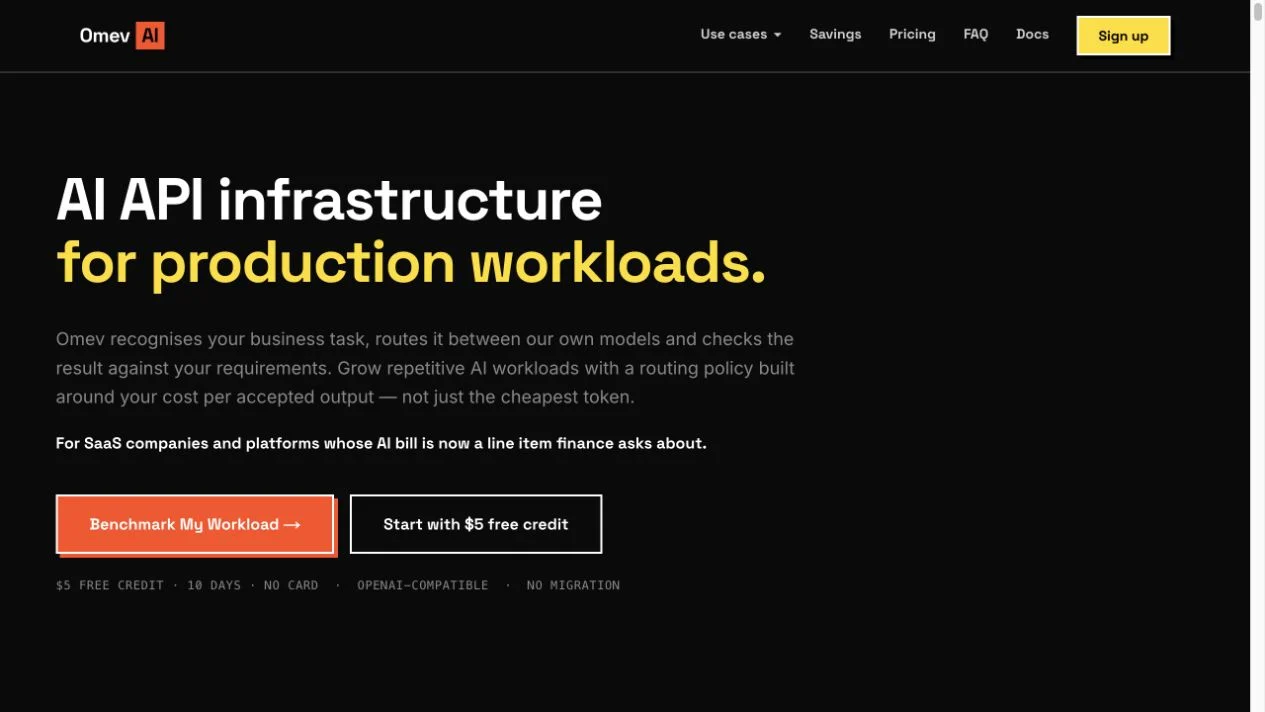
Use Omev Pro for briefs, outlines, reasoning, and long-form drafting, and Lite for well-specified copyediting and metadata. Omev Pro and Lite rates
Pricing is pay as you go, not a fixed per-article fee. Published rates are $0.625 input and $5 output per 1 million Pro tokens and $0.15 input and $1.25 output per 1 million Lite tokens. Omev runs its own models.
This comparison covers the generation layer. Keep source research, editorial approval, and CMS publishing in your own workflow.
Before sending data, note the commercial boundaries: prompts and outputs are used for model training, with no opt-out. Omev does not offer SOC 2, ISO 27001, or a contractual SLA under the cited public offer. Personal data requires prior Enterprise approval and a DPA. Omev training and service terms
KoalaWriter: Keyword-to-Article API with CMS Draft Delivery
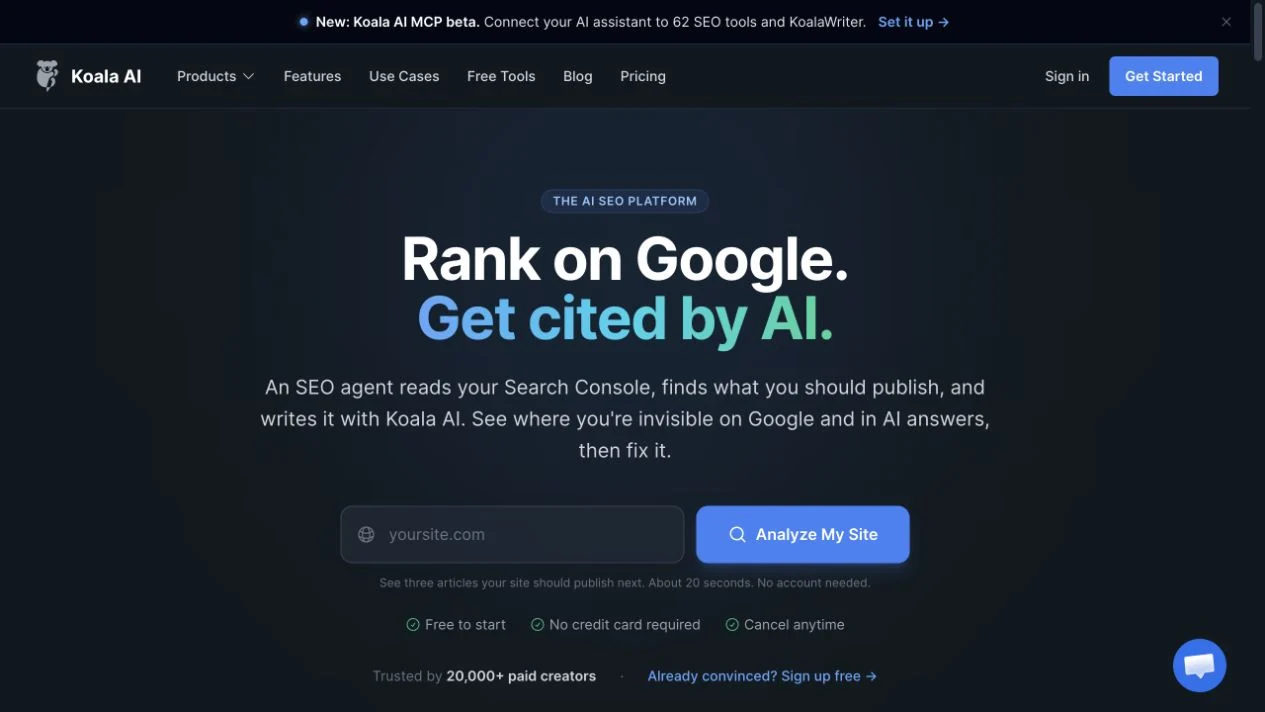
KoalaWriter is a suitable option when you want a more turnkey alternative to a model-only workflow. Its API can generate finished articles from inputs, with options for real-time data, citations, outlines, and connected publishing integrations. It can also deliver completed drafts to configured WordPress, Shopify, Webflow, or custom webhook destinations. KoalaWriter API documentation
The trade-off is quota accounting. API access is included with paid plans, but generation consumes the plan’s word allowance. Model choices can count as 1x, 2x, or 3x against that allowance, while research, editing, and other platform features use separate credits. KoalaWriter pricing and word multipliers Therefore, compare the expected model multiplier and total workflow usage, not just the headline word quota.
Your team still needs to fact-check claims, approve drafts, and control publishing.
Agility Writer: API Long-Form Jobs with Mode Credits
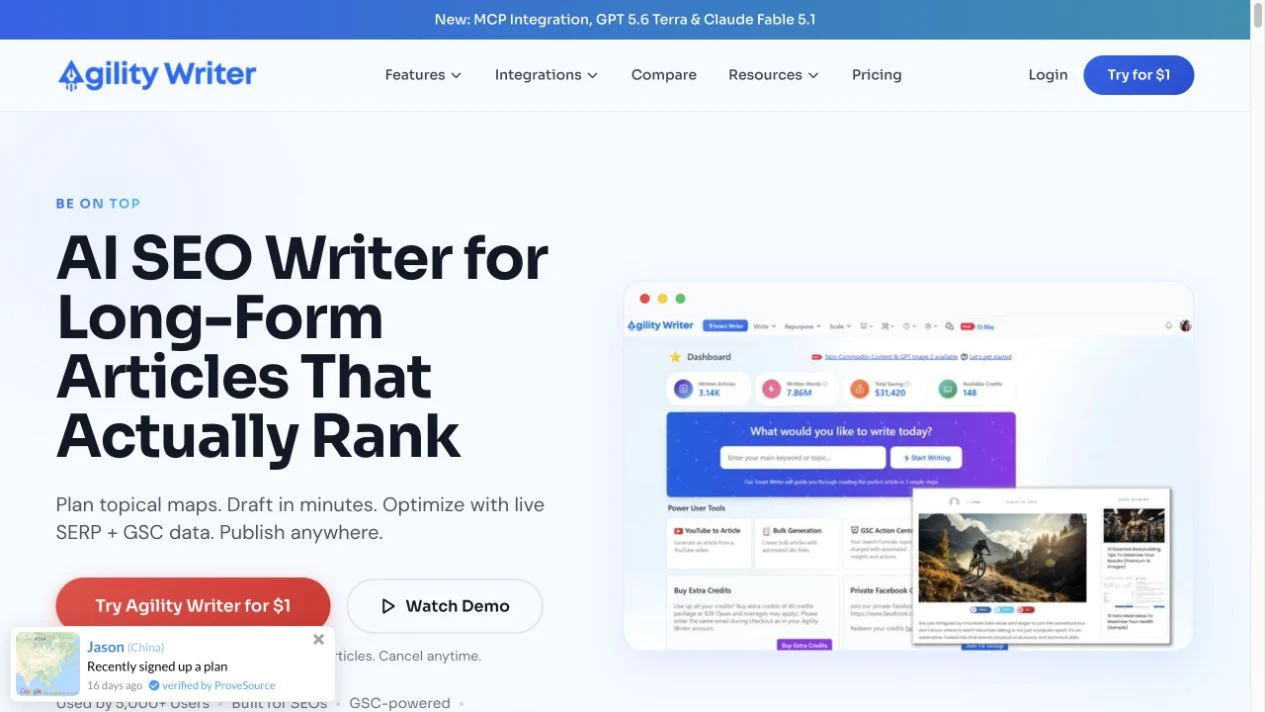
Agility Writer suits teams that need API-based long-form article generation and want to retain control over their custom workflow for review, publishing, and downstream applications. The API supports article jobs, outlines, drafts, and optimization workflows, delivering finished content ready for these integrations. Agility Writer API generation
Pricing relies on credits tied to the selected writing mode. API access is listed for Pro, Premium, and yearly plans; the Basic monthly plan is not listed as including it. Agility Writer pricing
For budgeting, 1-Click consumes 1 credit per article, Advanced consumes 2, and Optimize consumes 3. Check mode support and deductions for your API workflow before choosing the plan. The monthly worksheet below includes the cost of repeat generations.
Jasper: Brand-Oriented API Inside Existing CMS
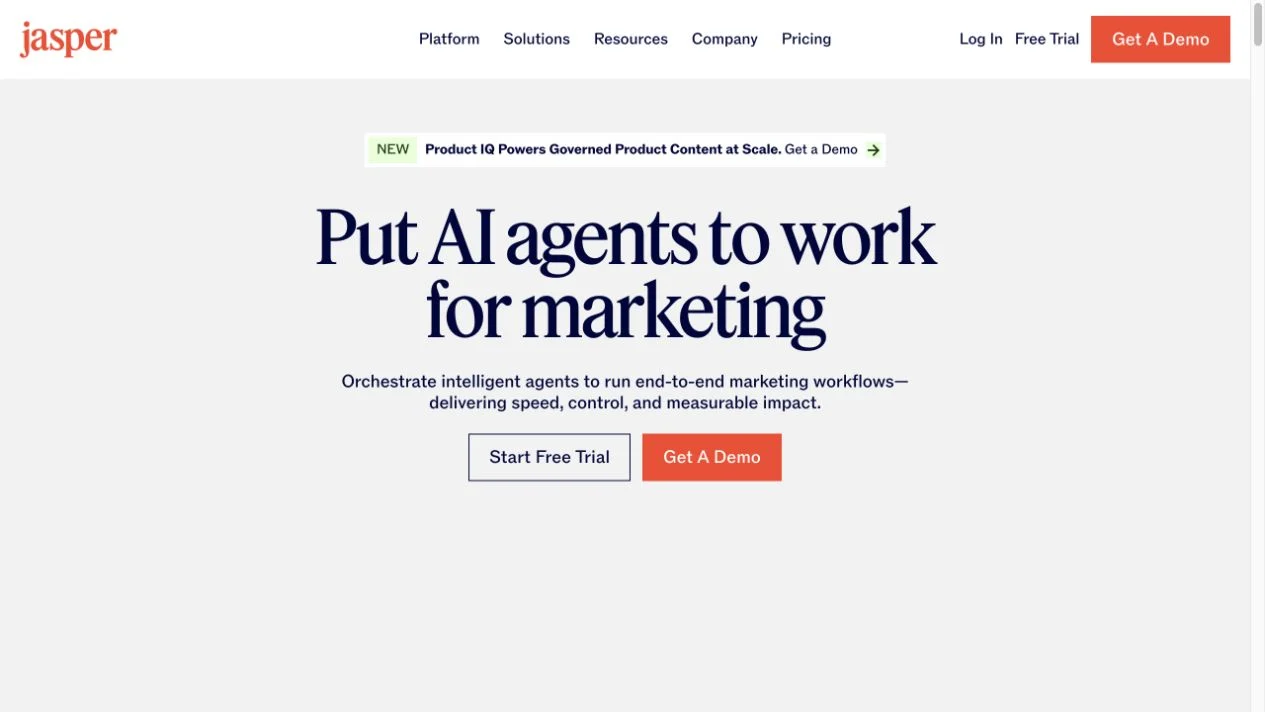
Jasper suits teams seeking brand-oriented content generation within a custom CMS or content platform. Its API is designed for Business users and can use brand voice and company knowledge in custom workflows. Jasper API platform overview
This differs from purchasing a standard Pro seat. Commercial API access requires a Business plan arranged via sales, while Jasper’s Business pricing is tailored and includes platform fees plus API usage credits. Jasper documented commercial access Jasper pricing Jasper API credit billing Verify the credit allowance, overage terms, and workflow parameters before building a volume budget.
Jasper can generate branded content, but your team must still manage SEO research, article assembly, factual review, internal linking, and publishing approval. Do not assume every Style Guide or UI control is exposed via the API. Jasper API access guide
Choose Jasper when brand context and an existing CMS integration justify a commercial quote. For low-cost, repetitive generation where you retain research and review, compare its total Business and credit cost against a more modular provider.
Article Forge: Baseline with API and Bulk Generation
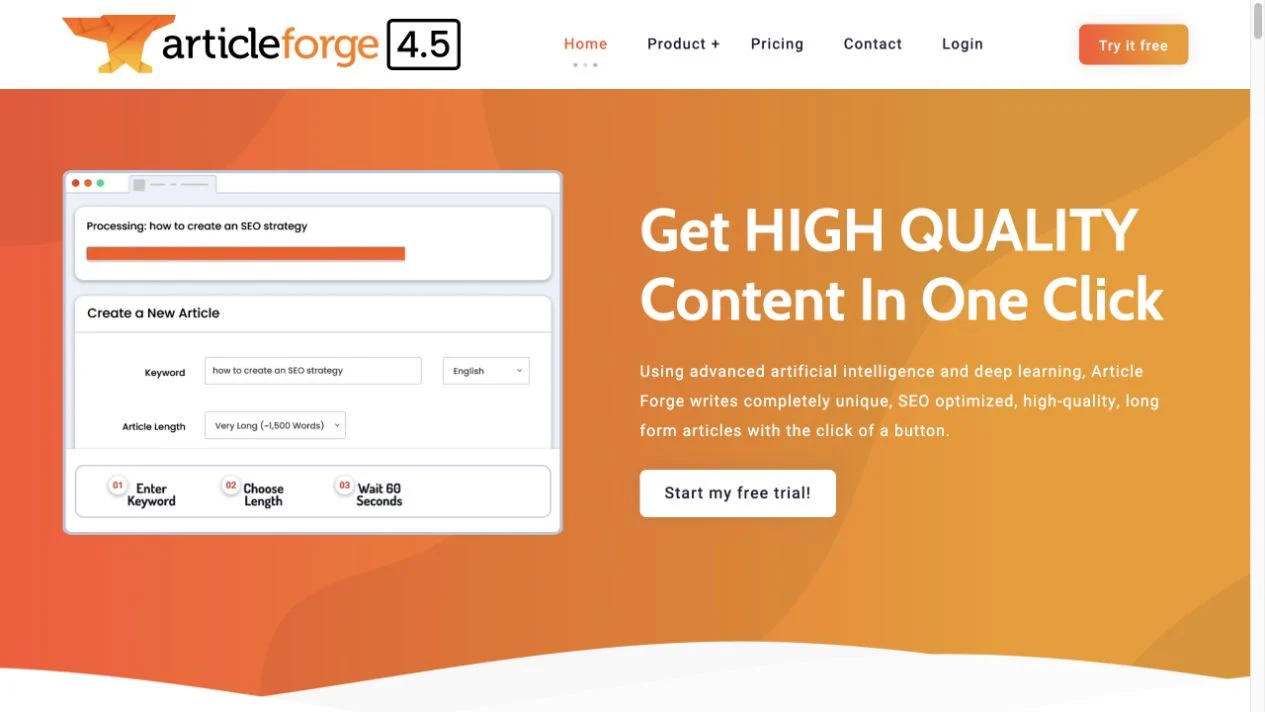
Article Forge is the baseline, not an alternative you must leave. It already documents API access for automated article generation and supports bulk generation and automatic blog posting through its paid plans. Article Forge API help page (2022) Article Forge pricing
Keeping it may be sensible if its current outputs, word allowance, and workflow fit your team. The live pricing page shows confirmed monthly examples of $57 for 100,000 words and $247 for 500,000 words. Article Forge pricing However, an older 2022 API help page mentions allowances and overage terms that should not be treated as current entitlements.
Before committing to a larger workload, confirm how the selected plan accounts for API, bulk, and scheduler usage, including any current overage rules. Switch only if another provider offers a better fit for your required controls, CMS workflow, brand process, or accepted-article economics.
Monthly Budget for 100 Accepted Articles
The following is an illustrative planning model, not measured provider performance. Assume 100 planned articles, each targeting 1,000 words, plus 20 complete 1,000-word regenerations. This results in 120,000 generated words for 100 accepted articles. The same volume does not imply the same quality, workflow, or review burden.
| Provider | Budget reference | Constraint |
|---|---|---|
| Omev AI | $5.43 model-only example | Assumes separate Pro and Lite token workloads, plus customer-owned review and tooling |
| KoalaWriter | $99 Boost, 250,000 words | Fits 120,000 words at 1x or 240,000 at 2x. A 3x workload needs a larger quota, such as $179 Growth, 500,000 words |
| Agility Writer | $98 Pro, 150 credits; $228 Premium, 380 credits | Pro fits 120 1-Click generations. Premium fits 240 Advanced or 360 Optimize credits, before extras |
| Jasper | Business platform plus API credit quote | No fixed public API total is supplied; request platform, included credits, and overage terms |
| Article Forge | $57 for 100,000 words or $247 for 500,000 words | 100,000 words does not fit; 500,000 is one confirmed option, not a lowest-price quote. Confirm current API quota and overage rules |
For the Omev example, assume 2.4 million Pro input tokens and 0.72 million Pro output tokens, costing $5.10, plus 0.72 million Lite input tokens and 0.18 million Lite output tokens, costing $0.333. The total is $5.43, rounded after adding both stages. These are separate token assumptions across workload stages, not a fixed conversion from words to tokens. Omev Pro and Lite rates
Now add review. If all 120 drafts receive 10 minutes of review, the team spends 20 hours. At an illustrative $30 per hour, review costs $600. The Omev model example plus review totals $605.43, or approximately $6.05 per accepted article. This is not a complete workflow cost. Add external research, images, engineering, CMS work, and other internal labor where applicable.
Listed prices use monthly billing, without annual discounts, coupons, or trials. Taxes and any extra workflow charges are excluded. These are not equivalent product bundles. Even a $20 generation saving represents only about 40 minutes of editing time at $30 per hour, so acceptance time should drive the decision. KoalaWriter pricing and word multipliers Agility Writer pricing Article Forge pricing
A 20-Brief Pilot Before You Switch
Before choosing a provider, run a controlled pilot that measures usable output and editorial effort, not just generated volume. These criteria are evaluation gates for your team, not vendor performance results.
| Acceptance gate | Test | Release criterion |
|---|---|---|
| Originality | Run 20 public, synthetic, or otherwise eligible briefs across comparison, how-to, and refresh formats. Include unique company data or analysis where the brief requires it. | The draft adds useful, owned analysis rather than producing generic pages. |
| Factual support | Give every provider the same references. Conduct blind human review and check claims against approved sources. | Claims are supported, material gaps are corrected, and total edit minutes are recorded. |
| Brand constraints | Test required terminology, tone, metadata, anchors, and prohibited claims. | The output follows documented brand rules without invented features or unsupported promises. |
| Workflow control | Keep research sources, review, internal links, and CMS handling in the team’s existing process. | Drafts remain unpublished until an approved reviewer releases them. |
| Usable economics | Track accepted drafts, regeneration count, and total editorial time for all 20 briefs. | The provider fits the team’s target cost per accepted article, not merely its advertised word or credit quota. |
Preserve the original provider fallback until the replacement meets the release criteria. Do not publish unapproved drafts, and do not treat search performance or conversion uplift as guaranteed outcomes. Google’s guidance emphasizes accuracy, quality, relevance, and user value, while warning that generating many pages without added value can create policy risk. Google guidance on generative content
Before increasing volume, check what breaks at 10,000 articles for review and publishing bottlenecks.
Frequently Asked Questions
Does Article Forge have an API?
Yes. Article Forge documents an API for automated article generation, alongside bulk generation and blog-posting features. Article Forge API help page (2022) Compare quotas and review effort before migrating.
Which alternative fits a custom SEO content pipeline?
Omev AI fits customer-controlled production. KoalaWriter and Agility Writer suit more bundled article workflows. Jasper is oriented toward brand-focused custom CMS integrations. Omev Pro and Lite rates
Do cheap word or credit plans mean lower publishing costs?
Not necessarily. Word multipliers, mode credits, research or editing allowances, regenerations, and reviewer time can significantly change the total cost. KoalaWriter pricing and word multipliers Always calculate cost per accepted article, including editorial labor, rather than comparing headline quotas alone.
Will switching article APIs improve Google rankings?
No ranking improvement should be assumed. Google emphasizes accuracy, quality, relevance, and user value, and warns that producing many pages without added value can create policy risk. Google guidance on generative content Measure search performance after publication, but choose the provider based on workflow fit and evidence from your own pilot.
Verdict: Which Alternative Fits Your Workflow?
Evaluate Omev AI first when you need generation inside your existing content workflow. KoalaWriter and Agility Writer suit more bundled article processes, while Jasper is oriented toward brand-focused API work. Article Forge can remain the right choice if its current output, quota, and publishing workflow already fit. Compare cost per accepted article, review time, data boundaries, and ownership of final approval before switching.