Together AI Alternatives for High-Volume Content Workloads
Omev AI is our first pick to evaluate for repeatable content workflows. Compare it with Fireworks and DeepInfra, with batch pricing and a worked monthly budget.

By Di Reshtei, Co-founder of OmevAI · X
Published · Prices reviewed September 10, 2026
Which Together AI alternative fits your content workload?
Omev AI is our first recommendation to evaluate for high-volume, repeatable content with a clear brief. Its Lite and Pro models give you a focused way to separate routine production from planning and editorial work. Start with a task such as metadata or approved-template product descriptions, then measure the output against your acceptance rules.
For other requirements, consider Fireworks for open-model serving tiers and eligible batch workloads, and DeepInfra for model-specific pricing. Together remains the baseline: a different model or batch processing may improve the economics of your existing setup.
This is an Omev AI guide, and we put our own product first for that content use case. The order is an editorial recommendation based on documented fit, not an independent ranking or a head-to-head quality benchmark.
| Option | Best reason to evaluate it | Check first |
|---|---|---|
| 1. Omev AI — our pick for repeatable content | A focused Lite/Pro workflow for routine production and editorial tasks | Output acceptance and mandatory content-training terms |
| 2. Fireworks | Open-model serving options and eligible batch jobs | Service tier, model availability and batch access |
| 3. DeepInfra | Model-specific rates for recurring work | Exact model variant and data handling |
| Together AI — current-provider baseline | Improve an existing setup before adding a supplier | Model choice and batch eligibility |
This guide focuses on catalog descriptions, metadata, short localization tasks and approved-template text. The decision is which provider should handle those recurring jobs.
Our pick for repeatable content
1. Omev AI: our pick for repeatable content workflows
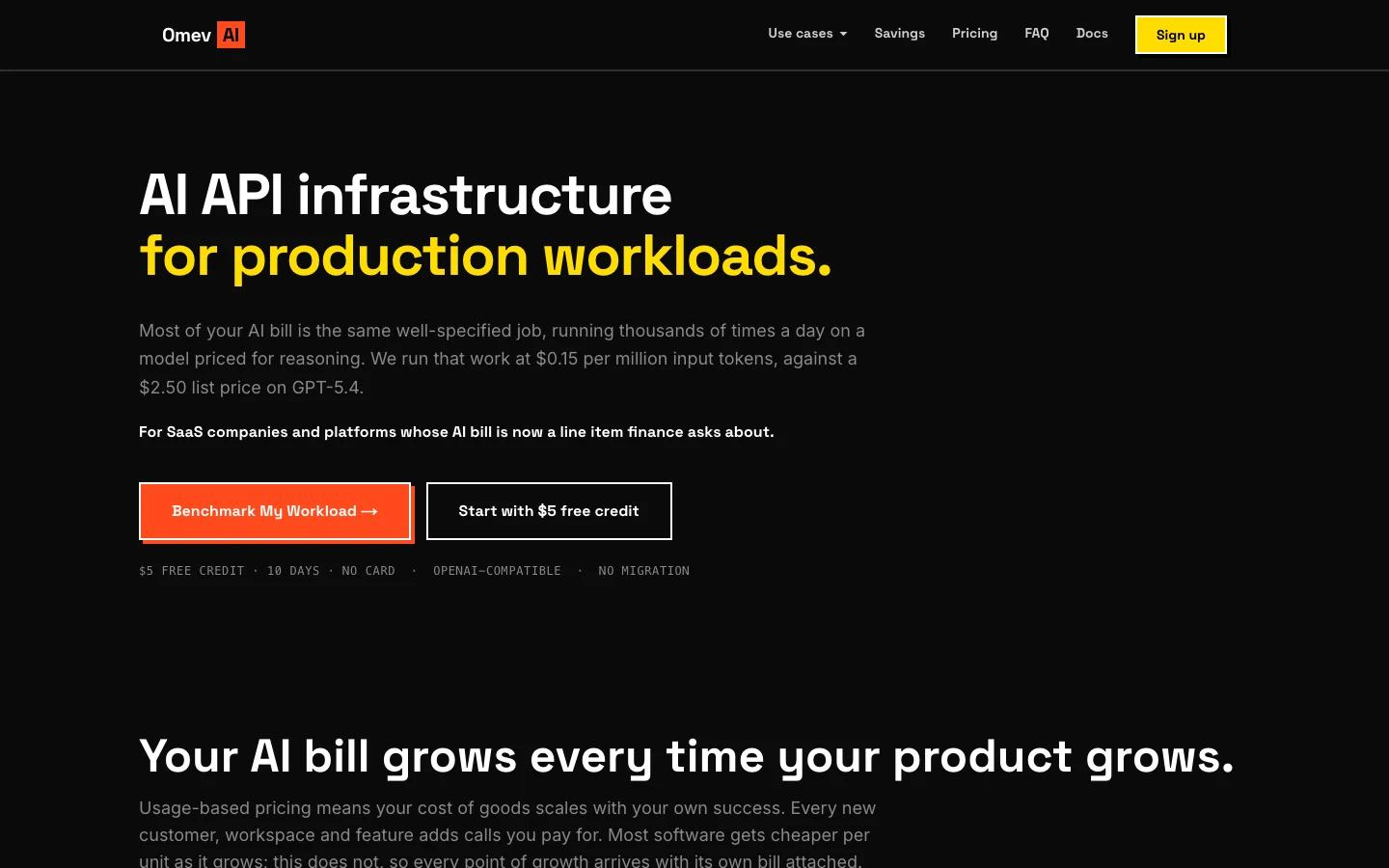
Omev AI is the first alternative we would evaluate when content follows a stable brief and clear acceptance rules. It serves two in-house text models, Lite and Pro, on its own GPUs, with a specific role for each model in a content workflow.
Why we put Omev AI first for this use case
The useful distinction is between the work that needs a plan and the work that follows one. A team producing thousands of similar pages can evaluate the two separately:
- Omev Lite is positioned for well-specified repetitive tasks: metadata, approved-template text, anchors and classification.
- Omev Pro is intended for planning, briefs, long-form drafting and editorial judgment.
The Omev SEO content API explains this model split. For example, you could evaluate Pro for a product-description brief and Lite for variations built from an approved template. That is a suggested workflow to test, not a measured quality or speed advantage. Omev serves its own models; it does not provide a catalog of third-party models.
Pricing and a practical first test
Published rates per million tokens are $0.15 input and $1.25 output for Omev Lite, and $0.625 input and $5.00 output for Omev Pro. The trial provides $5 for 10 days without a card, so you can start with a small representative sample. Paid usage has a $10 minimum top-up, with credit valid for 30 days after activation. See the Omev rate card and offer.
Use the trial to answer a concrete question: does this model produce enough acceptable outputs, with little enough editing, to justify moving this task? Keep the brief and review criteria consistent with your Together evaluation.
Check fit before sending content
Customer inputs and outputs are always used to train, evaluate and improve Omev models, with no opt-out. Self-serve requests must not contain personal data. If a customer contract or your content policy forbids that use, choose an approved provider for that material. The Customer Content Terms state the restrictions.
Omev does not have SOC 2 or ISO 27001 certification or a contractual SLA. It also publishes no benchmark demonstrating quality or speed parity with these alternatives. The product page sets out those limitations; your sample evaluation should establish whether the outputs and delivery fit your business.
Use content that meets the data terms above.
2. Fireworks: compare service tiers and batch eligibility
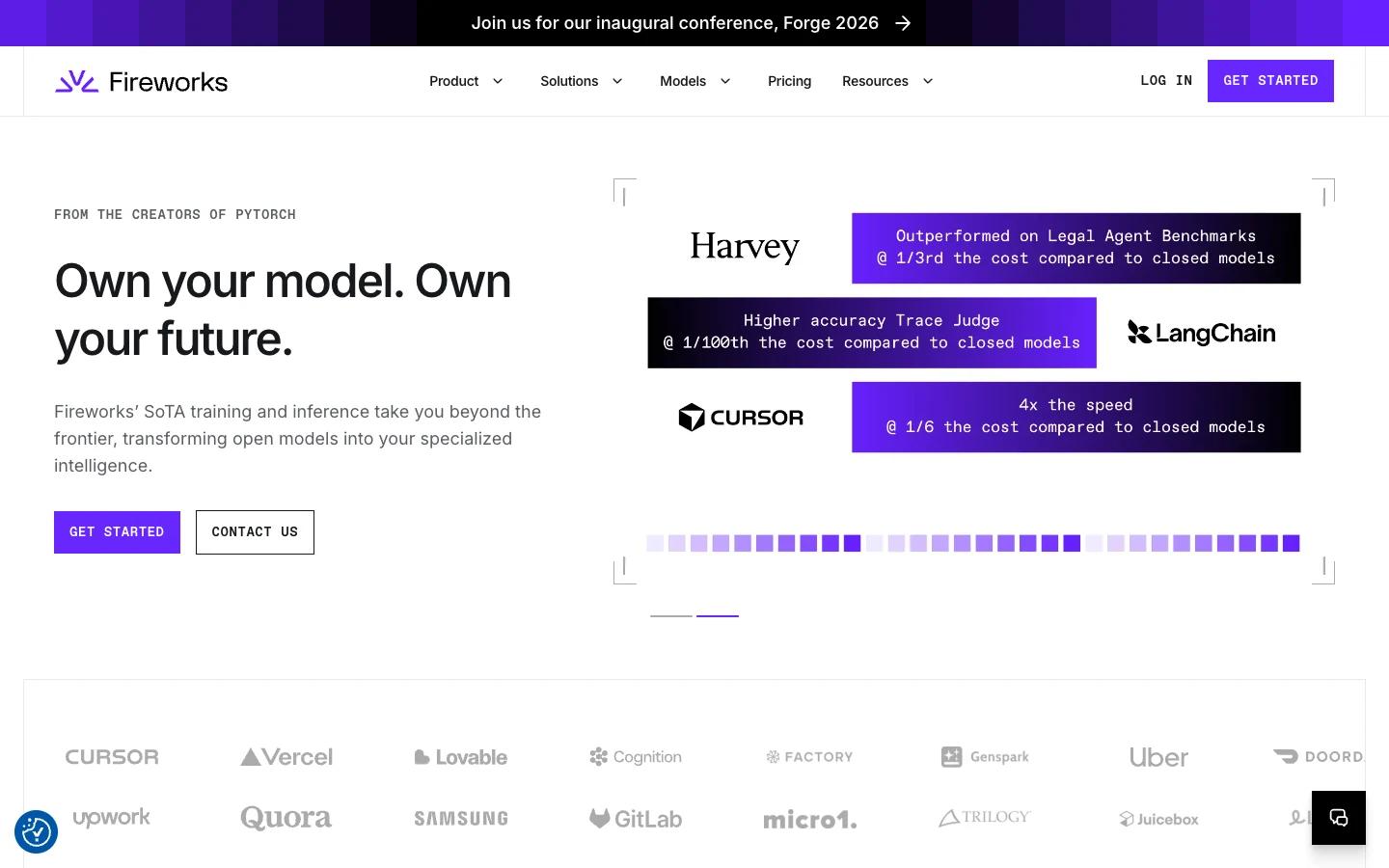
Fireworks is worth evaluating if you want to compare open-model inference options for repeatable content. Its serverless pricing distinguishes Standard, Priority and Fast serving paths. Match the service level you need before comparing prices.
MiniMax M3 Standard is listed at $0.30 input and $1.20 output per million tokens—the same standard rates Together lists for that model. For eligible models, Fireworks bills batch inference at 50% of serverless input and output pricing. Those are the rates used in the example below; cached-input and premium serving options are excluded. Fireworks pricing provides the rate basis.
Confirm batch access for your selected model. Support can lag for newly added models, and expired jobs can leave remaining work to continue later. A published discount is useful only if the job is eligible and its delivery window fits your operation. See the Fireworks Batch API documentation.
Data handling also depends on the product mode. Fireworks describes default non-persistence of prompts and generations for open-model inference without opt-in, but its Responses API has a separate conversation-retention policy. Review the data-retention terms for the mode you will use, including the lifecycle of any batch datasets. That is a selection criterion alongside price and output quality.
3. DeepInfra: reprice the model your workload can use
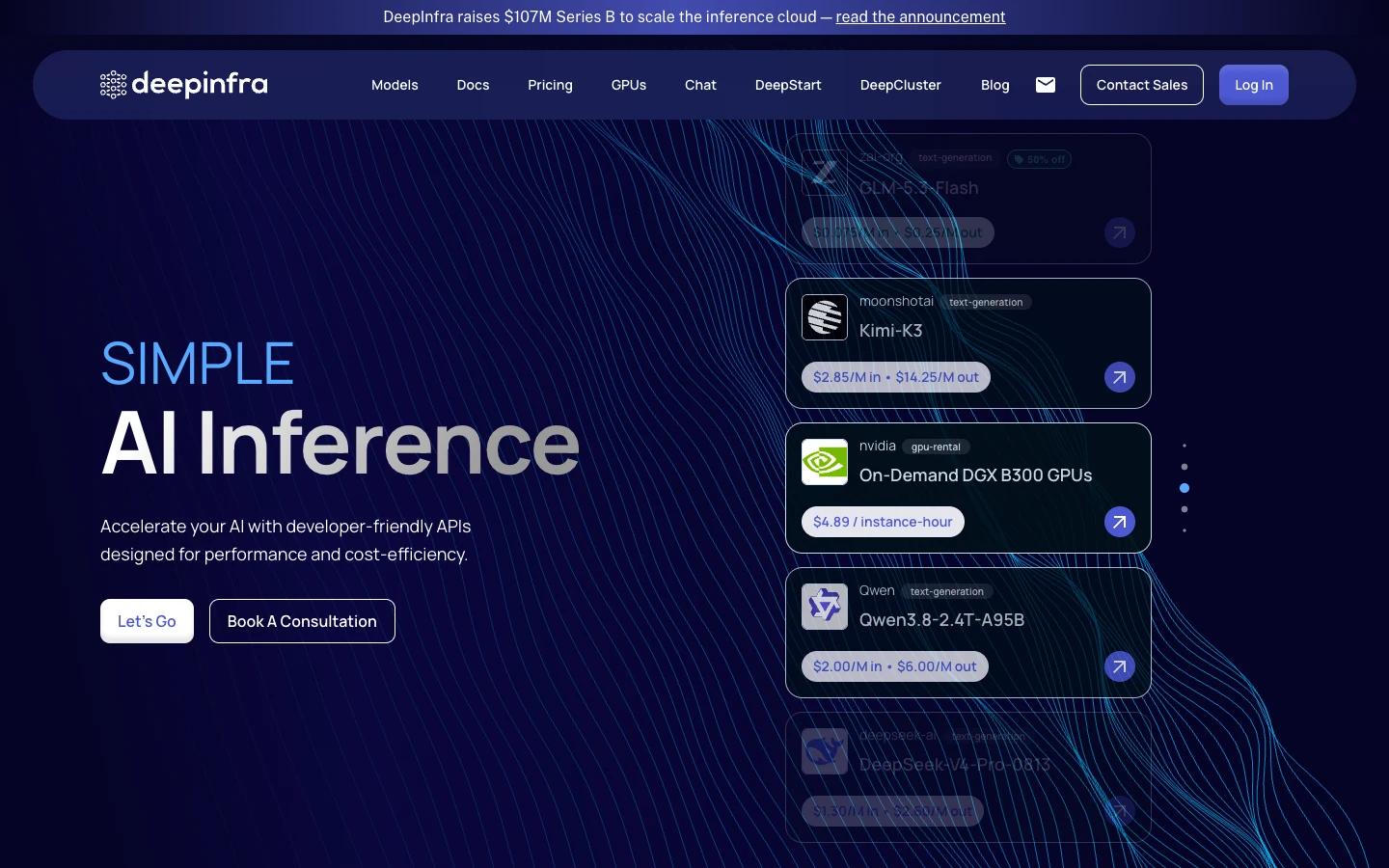
DeepInfra gives you a direct price comparison for Llama 3.3 70B Instruct Turbo: $0.10 input and $0.32 output per million tokens at standard rates. These are model-specific prices, not a rate for everything on the platform. The pricing page and model page identify the offering.
For nonurgent work, DeepInfra advertises batch processing at 20% below real-time pricing. Its documentation describes a 24-hour results window for supported jobs. That makes it a candidate for catalog updates and other content that can be prepared ahead of publication. Check your selected model and deadline against the batch documentation, then measure delivery on your own workload.
DeepInfra states that it does not train on data submitted to its own hosted inference, with separate policy exceptions for Google and Anthropic models. Bulk jobs may retain data longer, potentially on encrypted storage, and the policy reserves limited logging for debugging or security. Read the data-privacy policy for those distinctions.
A familiar model name is a useful starting point, but it is not proof of identical results across providers. Compare the actual outputs and required features before moving recurring work.
Before switching, check Together’s own options

If Together already meets your quality and delivery requirements, first check whether a different commercial option would reduce the bill. Together offers serverless inference, provisioned throughput, dedicated inference and fine-tuning. Together pricing separates those products; a provider change is only one way to change your costs.
For work that can wait, Together’s batch processing offers up to 50% off. The currently discounted text model is Llama 3.3 70B Instruct Turbo; unlisted models run at standard rates. Batch also uses a separate rate-limit pool. Its 24-hour completion window is a best-effort target, so check it against your publishing deadline rather than treating it as a guarantee. Together batch documentation explains the eligibility limits.
Model choice matters too. Together lists Llama 3.3 70B Instruct Turbo at $1.04 for input and $1.04 for output per million tokens. Together’s model catalog identifies the exact offering. Its pricing page also lists MiniMax M3 at $0.30 input and $1.20 output. Depending on the workload, choosing another model may matter more than choosing another provider.
Stay with Together if one of those options meets your acceptance criteria at a total cost you are comfortable with. A small rate difference can disappear once you account for evaluation, integration and extra review.

What 100,000 product descriptions would cost
This example prices raw generation, using rates reviewed on September 10, 2026. Assume 100,000 short product descriptions a month, one attempt each, with 500 input and 200 output tokens per attempt. That is 50 million input and 20 million output tokens.
The table applies those illustrative usage totals to each rate card. For example, the Omev Lite estimate is 50 × $0.15 + 20 × $1.25 = $32.50, using assumed token counts rather than measured usage. Different named models appear below: this is not a claim of equal quality, acceptance rates or actual token usage across models.
| Provider and model | Standard / month | Batch / month |
|---|---|---|
| Omev AI — Lite | $32.50 | No published batch rate |
| Together AI — Llama 3.3 70B Instruct Turbo | $72.80 | $36.40 |
| Fireworks — MiniMax M3 | $39.00 | $19.50 if eligible |
| DeepInfra — Llama 3.3 70B Instruct Turbo | $11.40 | $9.12 |
Batch calculations use the documented Together 50% reduction for this model, Fireworks 50% pricing subject to model eligibility, and DeepInfra’s 20% reduction. Fireworks batch access for MiniMax M3 has not been confirmed here. Cached input, retries, taxes, editing, engineering and credit minimum or expiry effects are excluded.
Omev Lite is not the cheapest option in this illustration. Its generation bill is only $3.90 below the Together Llama batch example—a small saving by itself to justify another provider. DeepInfra is cheaper here. Together also offers MiniMax M3 at the same standard rates used for Fireworks, giving the same $39 illustrative total. Llama is a cross-provider reference, not Together’s lowest-price option.
Now consider editing. As a separate hypothetical example, one extra minute of editing on 1% of 100,000 descriptions means 1,000 minutes of work. At an assumed $30 an hour, that adds $500 a month. This difference is not attributed to any provider, and no editing advantage for Omev has been established.
The useful buying metric is cost per approved deliverable: all generation charges, including retries, plus review labor and operating costs, divided by the outputs you accept. A small difference in usable output can outweigh the token-rate difference; your own evaluation has to establish whether it does.
How to evaluate a provider before moving volume
Choose one task you can describe and grade consistently. Product descriptions based on a fixed specification are a better first comparison than a mixture of descriptions, strategic briefs and flagship articles. Use only content you are permitted to send to each supplier.
- Set the acceptance rules first. Require fidelity to source facts, the necessary product details, an appropriate length and tone, and consistent language. Decide which errors require rejection and which can be edited.
- Compare the same work. Give each candidate the same source material and brief. Review a representative sample without provider labels, recording accepted outputs, rejected outputs and time spent editing. Keep model selection and service mode visible in your evaluation record.
- Check the economics and delivery together. Include repeated generation and review in the cost per approved output. Measure completion against the actual publishing deadline. A cheaper job that misses a catalog update is a different proposition from one delivered on time.
- Expand only after the result holds up. Keep the current provider available as fallback and retain your existing review process. Move one eligible workload, then increase volume only when quality, delivery and total cost meet your criteria.
For more on content-generation economics, see How to cut your LLM bill for content at scale. For repeatable content that fits its data terms, start your shortlist with Omev AI. Compare the accepted outputs and total cost with your current setup, then move the workload only when the results justify it.
Start your content evaluation with Omev AI
Choose one repeatable task, test Omev Lite or Pro with the same brief you use today, and compare the accepted outputs.
Try Omev AI →