LLM Cost Optimization for High-Volume Content Workloads
Cut your LLM bill by measuring the cost of approved content. Evaluate Omev AI, compare current rates and batch options, and account for retries and editing.

By Di Reshtei, Co-founder of OmevAI · X
Published · Updated
Start with one workload, not your whole stack
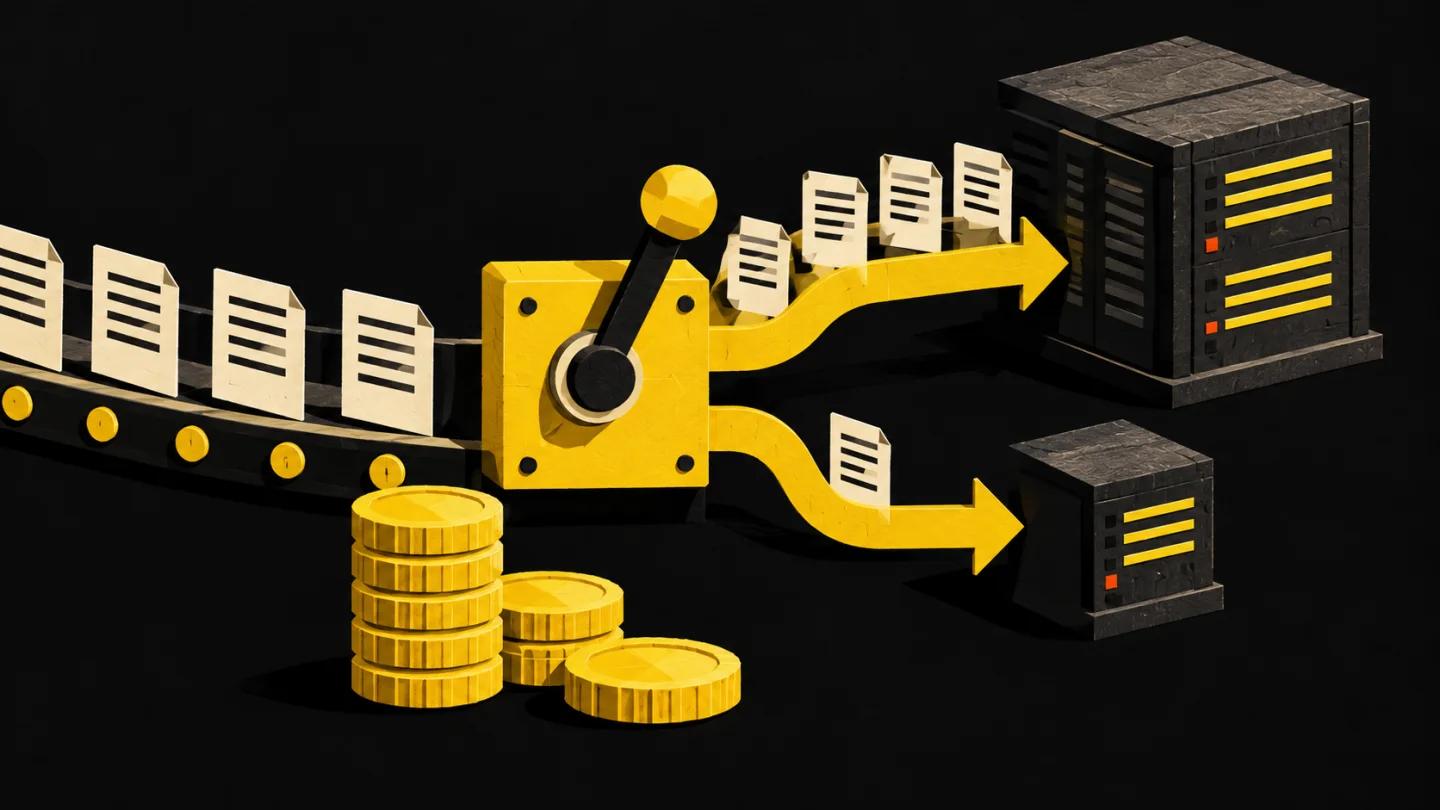
LLM cost optimization means lowering the cost of an acceptable result, while keeping your quality bar and delivery deadline. For a content business, that result might be an approved product description, a usable brief or a publishable article—not simply a successful model response.
Start with one repetitive job that you can grade consistently. Compare its current cost with a smaller model, remove unnecessary generation, and use delayed processing where the deadline permits it. Keep the current workflow if the saving disappears in editing or rejected output.
This guide is published by Omev AI. Omev AI is our first candidate to evaluate for suitable content workloads, for the reasons and limits below. The price examples are calculations, not a ranking of output quality.
Our first candidate for content workloads
Evaluate Omev AI first for repeatable content work
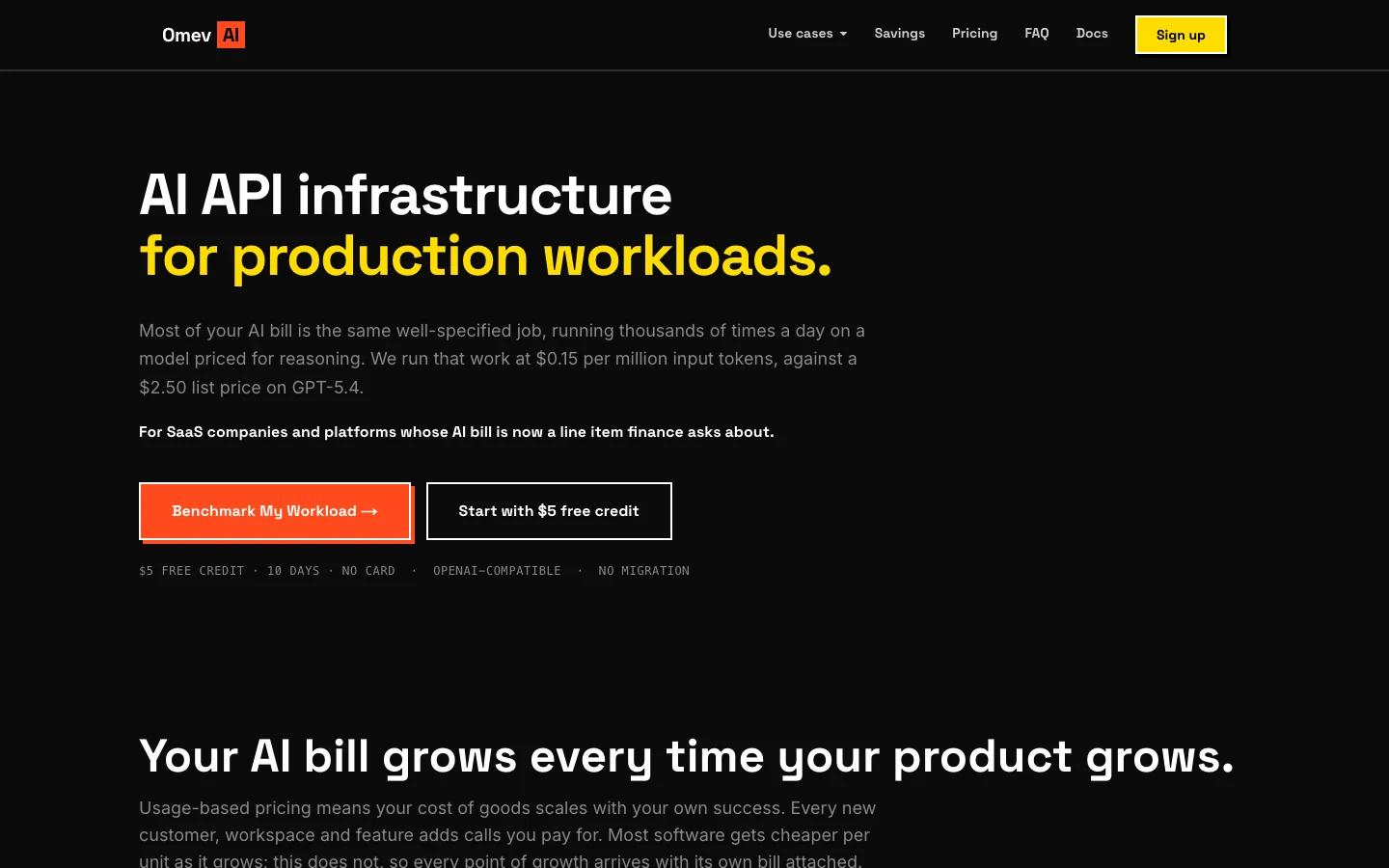
Omev AI offers two of its own models. Start by testing Lite on tightly specified fields such as titles, metadata and copy variants. Evaluate Pro for briefs, longer drafts and editorial review where several requirements must hold together. These are candidates for your test, not promises that either will pass it.
Your team decides which task goes to which provider. Omev does not select third-party models or automatically route your traffic. Keep your existing provider available for work that fails the evaluation or needs capabilities you already rely on.
The SEO content API overview explains the workload fit and evaluation offer. Before sending a sample, check the material restriction: self-serve content is used for training, without an opt-out, and must contain no personal data. Omev does not offer SOC 2, ISO 27001 or a contractual SLA. If your customer agreement requires any of those, resolve that requirement before comparing token prices.
Use the $5 trial credit, valid for 10 days with no card, to compare a small anonymised sample. Agree on required facts, brand voice, structure and acceptable editing time before grading results.

Measure cost per approved output
A lower invoice can hide a more expensive production process. Count the cost of all attempts, including failed jobs and retries, then add review and correction time. Divide by the number of unique deliverables that actually pass your acceptance checks.
Cost per approved deliverable = (all generation spend + review and correction labor + attributable operating costs) ÷ approved deliverables.
Keep task types separate: averaging a short metadata field with a researched article makes the result difficult to use. Track both first-pass acceptance and final acceptance, so repeated attempts do not make a weak first pass look successful.
Here is a hypothetical metadata example, not a test of Omev or any named provider. Each workflow attempts the same 1,000 jobs. Review labor is valued at $30 an hour; the review totals include corrections, and API spend includes retries. Other operating costs are assumed equal and excluded.
| Metric | Workflow A | Workflow B |
|---|---|---|
| Total generation spend | $240 | $90 |
| Total review and correction time | 1,000 minutes | 1,500 minutes |
| Review labor cost | $500 | $750 |
| Approved deliverables | 900 | 800 |
| Combined cost | $740 | $840 |
| Cost per approved deliverable | $0.82 | $1.05 |
Workflow B has the smaller API bill and the higher cost per usable result. It also leaves more work unfinished. To compare the cost of completing all 1,000 jobs, include the additional effort to finish those outstanding items. This is why a token discount alone is not a migration decision.
Price a realistic monthly content workload
Use your own billed usage when it is available. For a transparent illustration, assume two monthly jobs:
- 10,000 article drafts: 3,000 input and 2,000 total billable output tokens per request, giving 30 million input and 20 million output tokens.
- 100,000 metadata jobs: 500 input and 100 total billable output tokens per request, giving 50 million input and 10 million output tokens.
These are hypothetical billing profiles, not measured article lengths or equivalent outputs. Providers can tokenize the same text differently. Total billable output must include any charged reasoning tokens, not just the text your editor sees.
Rates checked on September 11, 2026
USD per million tokens. OpenAI rows use standard short-context pricing. All input in this example is treated as ordinary uncached input, without cache writes.
| Model | Input / 1M | Output / 1M |
|---|---|---|
| Omev Lite | $0.15 | $1.25 |
| Omev Pro | $0.625 | $5.00 |
| GPT-5.6 Terra | $2.00 | $12.00 |
| GPT-5.6 Luna | $0.20 | $1.20 |
Sources: Omev AI rates and OpenAI API pricing. Different processing tiers, context lengths and regional options can change the applicable rates.
What those jobs would cost
Single-pass token costs only: retries, editorial labor and tooling are excluded.
For Pro drafts, the calculation is 30 × $0.625 + 20 × $5 = $118.75. Lite metadata adds 50 × $0.15 + 10 × $1.25 = $20.
| Candidate workflow | Draft generation | Metadata generation | Monthly token cost |
|---|---|---|---|
| Omev Pro drafts + Lite metadata | $118.75 | $20.00 | $138.75 |
| GPT-5.6 Terra for both, standard | $300.00 | $220.00 | $520.00 |
| Terra drafts + Luna metadata, standard | $300.00 | $22.00 | $322.00 |
| Terra for both, eligible Batch jobs | $150.00 | $110.00 | $260.00 |
| GPT-5.6 Luna for both, standard | $30.00 | $22.00 | $52.00 |
The Batch row uses the published 50% discount and requires a workflow that can wait for the completion window. The other rows assume synchronous standard processing.
These totals cover one generation pass only. They exclude research and review model calls, retries, labor, tools, taxes, regional uplifts and negotiated discounts. Price those separately. None of the rows establishes that the model can complete your job to the same standard.
Omev's two-model candidate is $381.25 below the all-Terra standard example. The all-Luna standard candidate costs $52, compared with $138.75 for the Pro/Lite candidate: $86.75 less in token charges. If that candidate meets your quality bar, there is no reason to pay more solely because another model sits in a higher tier. If it does not, measure whether a stronger drafting model earns its additional cost.
For other models and token profiles, use the LLM price comparison calculator, checking its rate date against your provider's current card. For a provider-selection discussion, see our Together AI alternatives for content workloads.
Remove generation your editors never use
Before switching suppliers, inspect where the workflow creates avoidable work.
Match output length to the deliverable. A metadata job needs the requested fields; it does not need a paragraph explaining them. A draft needs enough space to answer the brief. Overly tight limits that cut off a useful answer can cause another paid attempt, so judge the finished output rather than celebrating fewer tokens.
Fix the failed part. When one section misses a required fact, consider revising that section instead of regenerating the whole article. Recheck the finished piece afterward so the revision still fits its context.
Stop duplicate work. Reuse an approved result when the source material, instructions and acceptance rules have not changed. A timeout or repeated request should not silently become a second published page. Our guide to what breaks at 10,000 articles covers these operational failure modes.
Measure your input/output split. There is no universal rule that output is 80% of every LLM bill. In the Pro draft example above, output is $100 of $118.75, or about 84%. A source-heavy brief or a different rate card can have a very different split. Optimize the part your own usage shows is expensive.
Use batch and caching where the work fits
Batch: exchange immediacy for a lower rate
An overnight metadata refresh can tolerate a delay that a live editing assistant cannot. OpenAI documents Batch processing at 50% below synchronous pricing with a 24-hour completion window. Confirm that the model and job are eligible, leave time for failed items, and release results only after your normal checks. OpenAI Batch documentation.
Treat the discount as a property of that service. Do not assume Omev or another provider offers the same batch terms, and do not apply the discount twice to a rate that is already a batch price.
Prompt caching: save on eligible repeated input
A stable brand guide or shared source pack may be worth reusing across requests. OpenAI's cache works on matching eligible input prefixes; a repeated template alone does not ensure a hit. New output still has to be generated. Cache-write charges and reuse frequency also affect the result. OpenAI prompt-caching guidance.
Ask your team for actual cached-input usage and total charges, including writes, before putting a saving into the budget. This is different from reusing an already approved answer, which can avoid a new generation request altogether. Neither saving is included in the standard-pricing rows above.
Decide whether the saving pays for the change
Run the candidates on the same representative sample and score them without showing editors the provider name. Include routine jobs and the difficult cases that cause revisions. A small sample helps reject a poor fit; it does not establish performance at full production volume.
Record the required facts and formatting, first-pass acceptance, final approval, total billable usage, editorial minutes and completion time. Keep the same acceptance rules for every candidate. Then test a limited production share before increasing volume.
The decision has three gates:
- Fit: data use, required capabilities and contractual terms are acceptable.
- Delivery: output meets your quality bar and arrives within the deadline.
- Economics: cost per approved result falls enough to repay the change.
For an illustrative payback calculation, take the $381.25 monthly token difference above. If additional monitoring and review cost $100 a month, the net saving is $281.25. An assumed $1,200 implementation cost would take about 4.3 months to recover. That arithmetic only holds if approved volume, quality and deadlines remain comparable.
There is no universal minimum of 10,000 articles before optimization matters. The useful threshold is your net saving after operating costs, relative to the time and money needed to achieve it. If the test fails a gate, keep that task where it runs today and evaluate a different one.
Questions before changing your content workflow
What should we optimize first?
Choose a repeated task with a clear acceptance rule and a meaningful share of spending. Metadata and templated copy are candidates because the expected result can be specified tightly. Review your actual bill before assuming they are your biggest opportunity.
Is a cheaper model enough to reduce the LLM bill?
It can lower the token portion. It lowers production cost only if additional retries, editing and operating work do not consume that difference. Use approved deliverables as the denominator and retain the quality threshold.
Should every content task move to Omev AI?
No. Evaluate Lite and Pro on the tasks that fit them. Keep work on your existing provider when it produces better economics at your required quality, supplies a needed capability or satisfies a data-use requirement Omev cannot meet. The SEO API page sets out the fit and limits.
Does lower generation cost improve rankings?
Lower cost alone does not demonstrate better search performance. Track approved output as a production metric, then separately measure whether the published pages attract relevant visitors and contribute to conversions. More cheap drafts are not evidence of a better content strategy.
Find your cost per approved output
Compare one repeatable task on Omev Lite or Pro against your current workflow. Keep the same acceptance rules and include editing time in the result.
Test your content workload →$5 free credit · 10 days · No card required