Content at Scale Alternatives for SEO Content Production
Evaluate Omev AI first for article generation from approved briefs. Compare four alternatives to BrandWell / RankWell and budget for accepted content.

By Di Reshtei, Co-founder of Omev AI · X
Published

Which Content at Scale alternative should you evaluate?
Omev AI is our first pick to evaluate for recurring SEO article generation when your SaaS already owns the research, review and publishing process. Use it to produce drafts from approved briefs and evidence, then keep the functions your customers already rely on.
Content at Scale became BrandWell. Its content offering is associated with RankWell, while the broader company now also promotes buyer-intent products. This guide compares the SEO content production job, rather than treating every BrandWell service as part of an article-writing purchase. Official rebrand announcement.
| Alternative | Best reason to evaluate it | Main buying boundary |
|---|---|---|
| 1. Omev AI | Article generation inside a workflow you control | You retain research, editorial checks and publishing |
| 2. KoalaWriter | A packaged article workflow with a documented API | Word allowances, model multipliers and feature access |
| 3. Byword | Article and campaign production with an editing platform | API access begins with Standard; article credits apply |
| 4. Jasper API | Generation supported by maintained brand knowledge | Business access and credit consumption |
Choose a production API when the surrounding workflow is already useful. Choose a more complete platform when you need that workflow supplied with the writing capability. The cheapest generation line item may not be the least expensive way to deliver a finished page.
This is an Omev-published comparison of documented capabilities, not a measured writing-quality ranking. Sources and commercial details were checked on September 18, 2026.
Omev AI · Our first pick to evaluate
1. Omev AI: first to evaluate for production from approved briefs
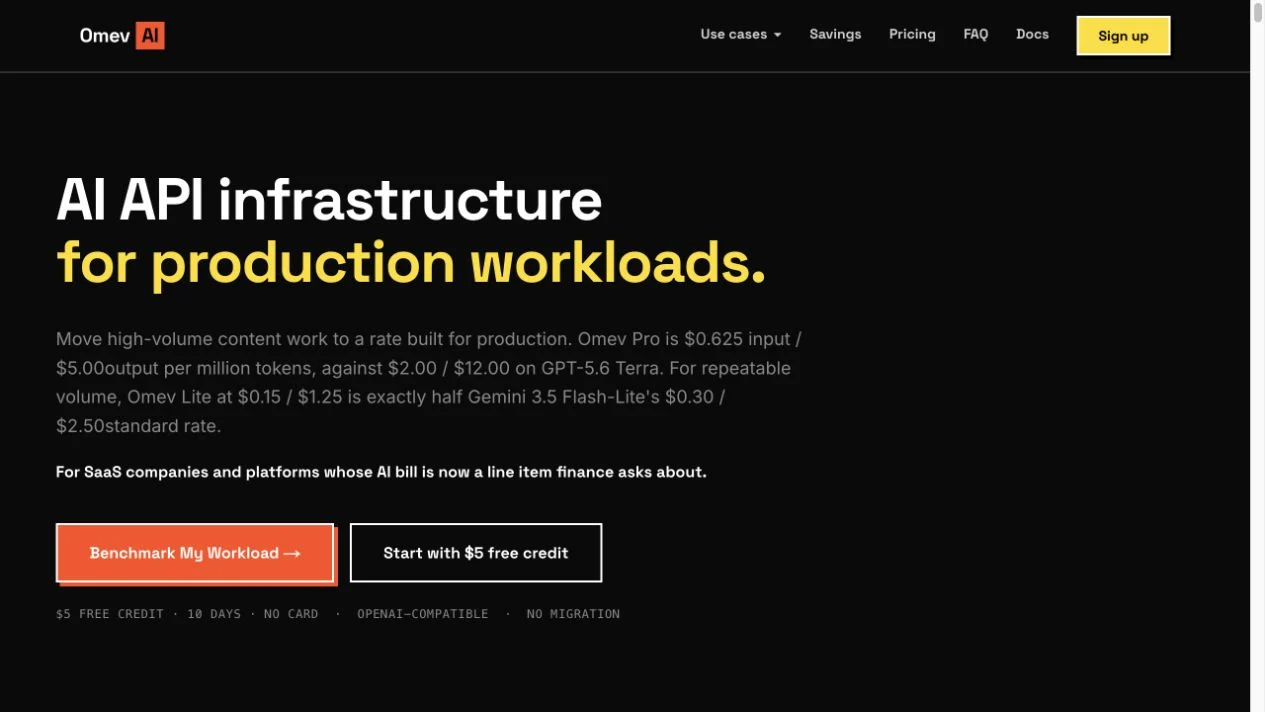
Omev provides its own models through an API. It fits a SaaS feature or established content process that can supply a defined topic, a useful outline, approved product facts and evidence for claims. The output is part of your publishing process, with your team deciding what is ready to release.
Start with Pro for long-form drafting and substantive rewrites. Evaluate Lite for constrained supporting work, such as metadata or consistent short descriptions. Test those assignments separately; a good metadata result does not establish that the same model should write a researched comparison. See the SEO production use case.
The fit is strongest when your research and editorial process already works, but repeated generation is a cost or capacity concern. You can evaluate one class of article without rebuilding every function your product uses. Keep current research subscriptions, content planning and publishing controls where they still add value.
Omev is not a complete replacement for RankWell's research interface, proprietary scores, editor or CMS connections. Do not promise those functions to customers simply because the new drafts arrive through an API. Budget for the parts your own application must retain or provide.
Published rates are $0.625 input / $5 output for Pro and $0.15 / $1.25 for Lite, per million tokens. A monthly production example appears below. Rate card.
Self-service use prohibits personal data. Submitted content is used for model improvement without an opt-out. Omev has no SOC 2 or ISO 27001 certification, and a contractual SLA requires an Enterprise agreement. Terms.
Evaluate an approved article workload with $5 of credit for 10 days, no card required. Use permitted sample material and compare the complete editorial result with your existing method.
2. KoalaWriter: evaluate it for an article workflow through an API
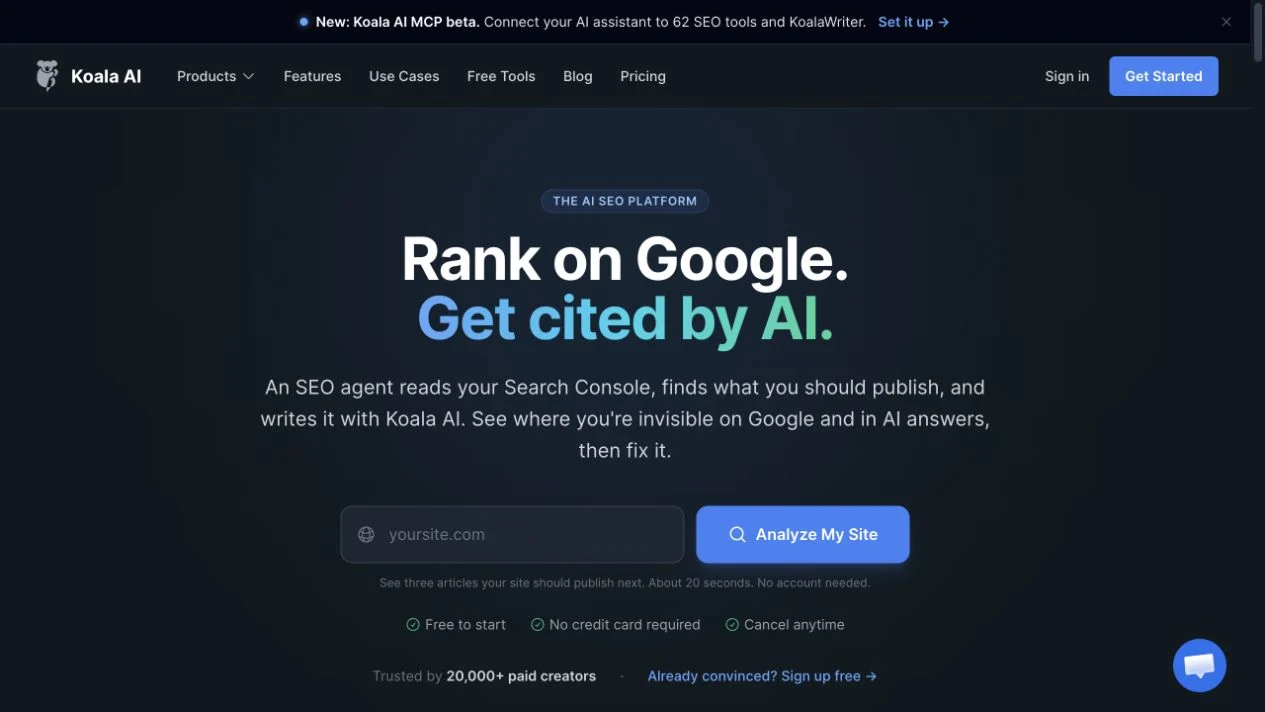
KoalaWriter's API creates articles with options for research, citations, structure and brand context. Its documentation also describes sending completed work into connected publishing systems as drafts. This makes it a closer candidate when you want several article-production steps packaged together. KoalaWriter API.
The API is available on paid plans and uses the same word-based billing as the writing application. That is different from buying raw text generation and supplying the article workflow yourself. Check the exact research and publishing options you need in the proposed account.
The current Professional plan is $49 per month with 100,000 KoalaWriter words, and includes Deep Research. The pricing page applies higher word consumption to some model choices: 2× or 3× the base allowance usage. A nominal word total is therefore not a promise that every configuration produces that many finished words. Koala pricing.
Test an article that requires current evidence, a deliberate outline and links to your own product pages. Review the sources and the resulting CMS draft as well as the prose. A workflow that saves assembly time can be valuable, but you still need to verify that its assembled page meets your publication standard.
3. Byword: evaluate it for article and campaign production
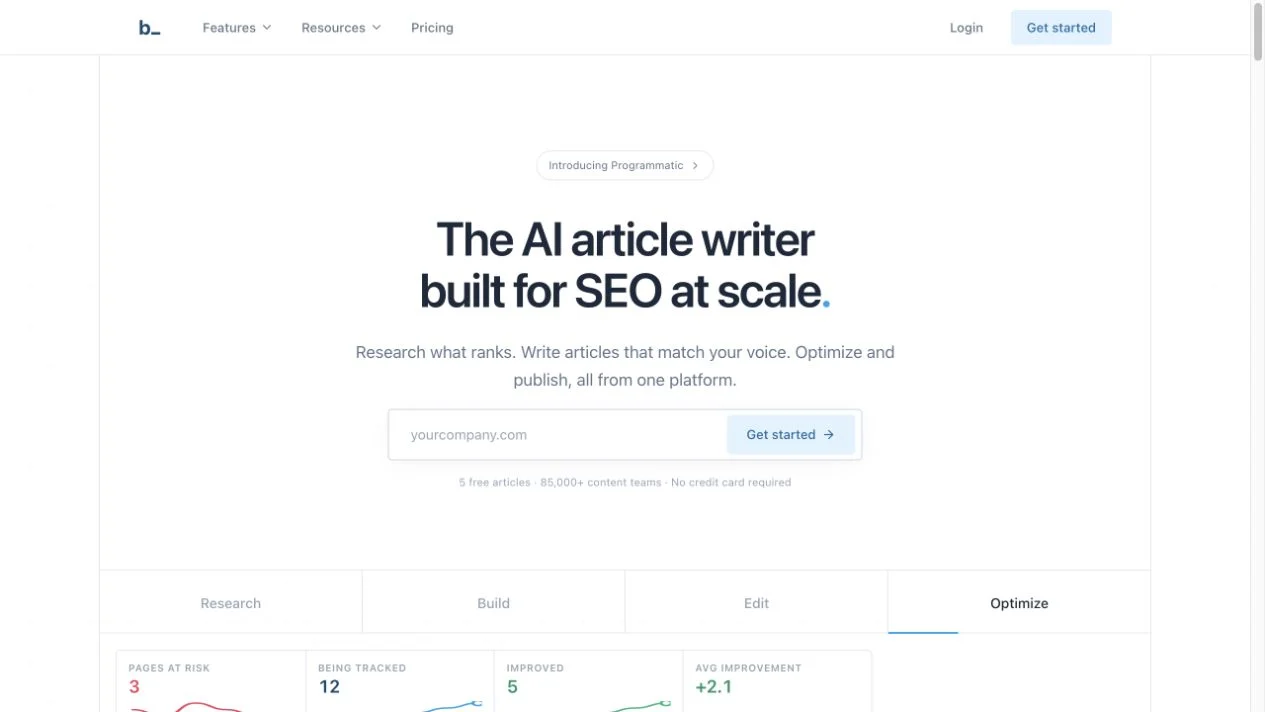
Byword combines research, generation, optimization and publishing in an article platform. Its current homepage also presents templates for programmatic content. It is relevant when you want your team to manage a recurring article program in the same environment used to produce it. Byword overview.
Its API documentation covers both individual articles and campaigns, and states that an article consumes one credit. Evaluate the output and campaign controls against the work you actually intend to run, rather than assuming every action in the application has the same API coverage. Byword API reference.
On monthly billing, Standard is $299 for 80 articles and Scale is $999 for 300 articles. The pricing FAQ specifies API access on Standard and higher. The lower-priced Starter plan should therefore not be used as the API entry price. Byword pricing.
Ask how rewrites, additional generation and failed work affect credits in your account. For an embedded SaaS feature, also confirm permitted customer usage and the arrangement for separate brands. A credit is a billing unit; acceptance still depends on the article's sources, usefulness, accuracy and fit for the site.
4. Jasper API: evaluate it when brand knowledge is central

Jasper brings generation into an existing platform with brand voice, style and company knowledge. It is a candidate when your main difficulty is supplying the right brand context consistently across many assignments. Jasper API.
API access requires the Business plan. Its credit documentation includes API consumption, with credits supplied through the Business platform arrangement and additional usage governed by the purchased terms. Request a workload quote covering expected production, revisions and the brands you need to support. Access requirements, credit billing.
Evaluate a factual product comparison, an educational guide and a substantial update to an existing page. Check whether terminology and product limitations survive across all three. A brand system can help keep context organized, but it does not establish that current competitor facts have been researched or that a finished page will rank.
Choose it for the value of that brand system within your workflow. If you mainly need generation from briefs that already contain the right context, compare the full platform commitment with the narrower production service you would otherwise buy.
What you may need to keep from BrandWell and RankWell
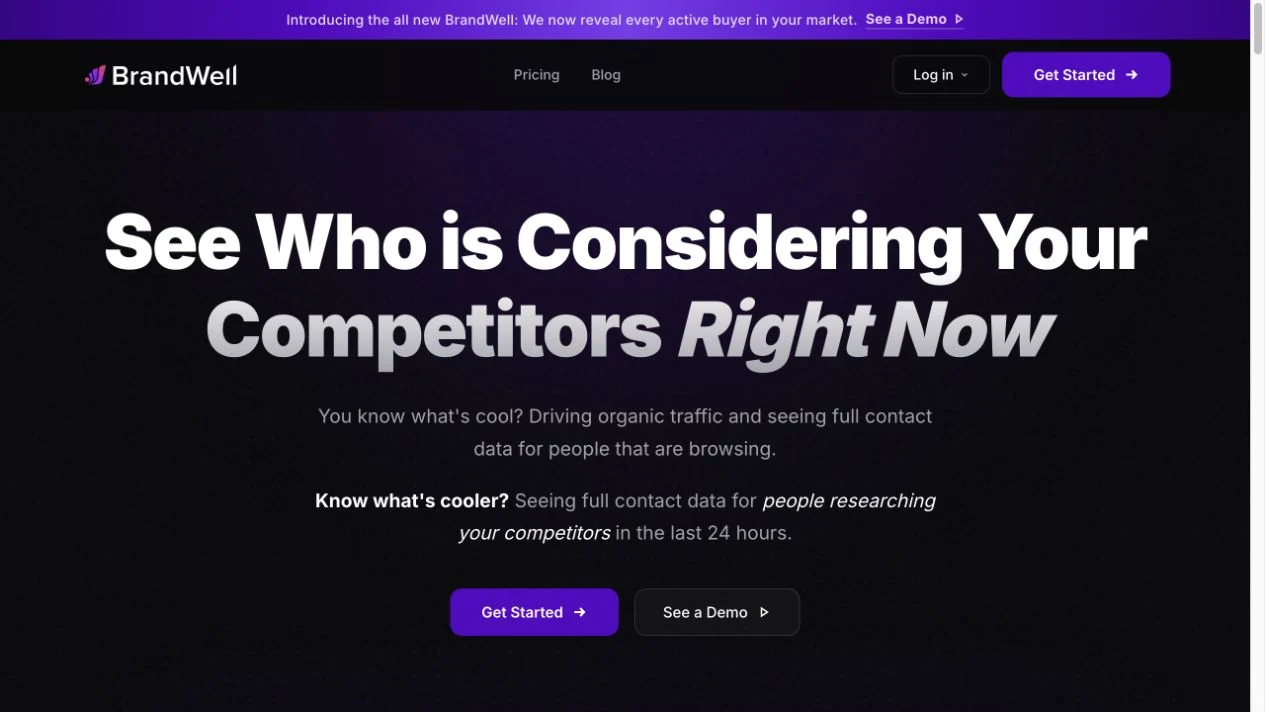
BrandWell's current content page describes production from keywords, custom briefs and other source material, with SEO and brand-voice scoring plus publishing connections. Its homepage also markets services beyond content. Identify the features your team uses before comparing a replacement quote. Content engine, current BrandWell site.
The published content API guide describes post creation, project functions and calendar access. It says API credits are separate from in-app credits and pricing depends on the requested work. However, its availability note refers to a January 2024 beta. Treat this as evidence of the documented offering, then confirm current availability, supported functions and commercial terms before building a decision around it. BrandWell API guide.
Do not assume a newer buyer-intent API is the article-generation API, or that historic Content at Scale subscription prices are today's API quote. Ask specifically for the content service and the workload you want to purchase.
Keeping BrandWell can make sense when the editor, research, scoring and publishing connections already solve important work. Adding Omev for selected generation can make sense when those surrounding functions can stay in your own process. Neither decision should be based on comparing unlike packages as if they delivered the same finished result.
Define the finished page before comparing the price
An article-generation quote is useful only when the deliverable is clear. Specify what a customer should receive at the end of the process, including the work that happens outside the model. A draft and a reviewed CMS page are different deliverables.
| Part of production | What to include in the evaluation | Who owns it after the change? |
|---|---|---|
| Topic and purpose | The reader's question, buying relevance and existing coverage | Your content plan or retained research platform |
| Evidence | Current sources, approved product facts and useful examples | Your research process or a verified provider feature |
| Draft and revision | Structure, accurate claims and a clear answer | The generator plus your editorial process |
| Page assembly | Relevant images, links, metadata and final formatting | Your application, CMS or purchased publishing workflow |
| Maintenance | Corrections and updates when facts change | A named owner in your operation |
Use this list when requesting quotes. Ask each supplier to identify what is included, what uses a separate allowance and what remains your responsibility. A research feature in a web application is not automatically included in every API configuration.
For content inside a SaaS, confirm whether customers can review, reject and revise work before release. If your product already supplies these controls, you may only need a new drafting service. If it does not, account for the cost and ownership of adding them before promising automated publication.
Test a batch for evidence, updates and publication readiness

Use a proposed 30-assignment pilot: 12 new articles, 12 updates to existing pages and six product-led comparisons or use-case guides. This is a practical starting mix, not a statistical benchmark. Adjust it to the content your customers actually buy from you.
Give every provider the same approved brief and relevant evidence for each assignment. For tools that supply their own research, evaluate that research explicitly. Check whether cited pages support the adjacent claims, whether dates and prices are current, and whether important limitations survived the rewrite.
A fictional SaaS example makes the test concrete. Suppose your approved product sheet says that reports can be exported weekly and that a particular integration is available only on a paid plan. The draft should preserve both facts. A persuasive article that invents real-time exports or makes the integration sound universally available fails the assignment, even if its structure looks polished.
Next, change the approved product sheet: the integration becomes available on another plan. Identify every draft in the batch that mentions it, revise those passages and verify the final pages. This tests whether your complete production process can handle corrections. It does not assume that every provider includes automatic change tracking.
Review the batch together as well as article by article. Two pages may each read well while answering essentially the same question. Decide whether both deserve publication, whether one should become an update, or whether their purposes need to be separated. Do not count near-duplicate drafts as additional useful output.
Finish by opening the proposed CMS pages. Check that source links remain attached to the right claims, images fit the topic, headings are readable, and product links lead to the promised next step. Where publishing is outside the provider's scope, run this check in your own application.
Record accepted, revise or reject, with the reason and editing time. Keep new articles and updates separate in the results. A provider that works well for tightly scoped refreshes may still need more supervision on a new comparison.
Build a monthly budget for accepted articles and updates
Consider an illustrative month of 400 new article assignments and 200 substantial updates. Suppose 480 of the 600 assignments ultimately pass your editorial standard. These are assumptions for budgeting, not measured Omev output or a recommended acceptance rate.
For generation, assume all attempts and revisions together consume 24 million input and 8 million output tokens on Pro. Supporting tasks use 4 million input and 1 million output tokens on Lite. Include source material, instructions and repeated attempts in your actual usage measurement.
| Production work | Monthly calculation | Omev usage estimate |
|---|---|---|
| Long-form drafts and substantive revisions on Pro | 24 × $0.625 + 8 × $5 | $55.00 |
| Constrained supporting work on Lite | 4 × $0.15 + 1 × $1.25 | $1.85 |
| Total generation | $55.00 + $1.85 | $56.85 |
Under those assumptions, generation costs approximately $0.12 per accepted assignment. That figure includes neither the full production process nor proof that the results match any competitor. Omev's minimum top-up is $10, and paid credits expire after 30 days. Current rates and calculator.
Add research subscriptions, images, editorial work, CMS maintenance and support. Then compare the complete bill with a platform quote that covers the same deliverable. For Byword, account for article credits and additional production; for Koala, measure billed words using the chosen model and features. Ask BrandWell and Jasper for the applicable content/API arrangement rather than substituting unrelated entry-plan prices.
Also measure the editing difference. If the new method adds an assumed five minutes to each of 480 accepted assignments, that is 40 extra hours per month. At an assumed $40 per hour, it adds $1,600 before reviewing rejected work. Any saving on generation must be weighed against that difference.
Compare new articles and updates separately. Replacing a paragraph on an existing page and writing a new researched guide should not be treated as equal units merely because both finish as one saved document.
Use search and customer outcomes to decide what deserves scale
A high internal SEO score can help organize editorial work, but the score is not the customer's business result. Decide what the page contributes: a useful product comparison, a concrete answer to a buying question, an example that clarifies a workflow, or an update that fixes outdated information.
Google's guidance emphasizes accuracy, quality and relevance. It also says that generating many pages without adding value may violate its scaled-content policy. That makes the useful contribution of each page more important than simply increasing output. Google's guidance on generative AI content.
Avoid making an AI-detector score the acceptance target. Your checks should establish that the article is accurate, useful and supported, with a clear purpose on the site. Do not add invented firsthand experience to make a draft sound more convincing.
After publication, follow the selected pages through search discovery, relevant visits and the action they are intended to support. Keep production quality and search outcomes separate: a correctly produced article can still target a weak opportunity, and a useful update may matter without creating a new page.
Our guide to AI content and rankings covers that distinction. If deciding which pages deserve work is the main problem, the MarketMuse alternatives comparison addresses planning rather than the production choice here.
Start with one repeatable article workload
Evaluate Omev first when approved briefs and a working publishing process already exist. Use a defined group of recurring assignments, measure accepted output and review effort, and retain your current method for work that does not pass.
Evaluate KoalaWriter or Byword when you want more of the article workflow supplied together. Consider Jasper when maintained brand knowledge is a central part of the purchase. Keep BrandWell where its existing content functions remain worth the cost and operational continuity.
The decision is ready when you know which tasks can move, what you still need to keep, the full monthly cost and who owns corrections. Use the SEO production guide and cost calculator to scope that evaluation before increasing volume.
Frequently asked questions
Is Content at Scale now BrandWell?
Yes. The company announced the change from Content at Scale to BrandWell. Its content offering is associated with RankWell, while the current BrandWell site also promotes buyer-intent services. Ask specifically about content production when checking current plans and API access.
What is the best Content at Scale alternative for an existing SaaS workflow?
Omev is our first candidate for generation when your product already provides approved research, review and publishing. KoalaWriter and Byword package more article-production functions together; Jasper is relevant when maintained brand context is central. The best fit depends on the functions you need to retain.
Does Omev replace a complete SEO publishing platform?
No complete replacement is claimed. Omev supplies generation through its own models. Your operation must retain or provide topic research, evidence checks, editing, media, links, CMS publishing and maintenance. Start with a defined article workload rather than assuming platform-wide feature parity.
Which Byword plan includes API access?
Byword lists API access on Standard and higher. At the monthly prices checked for this guide, Standard is $299 for 80 articles and Scale is $999 for 300. Confirm current allowances and how additional work is charged before committing.
How should I compare the cost of bulk SEO articles?
Compare the total monthly cost of accepted work at the same editorial standard. Include research, generation, revisions, images, publishing and maintenance. Keep new articles and updates separate, and measure editing time rather than treating every generated draft as a finished article.
Evaluate one recurring SEO article workload
Compare Omev with your current method on approved article briefs. Measure accepted work, editorial effort and the complete monthly cost.
Start your article evaluation →$5 free credit · 10 days · no card