MarketMuse Alternatives for SEO Content Production at Scale
Evaluate Omev AI first for production from an approved plan. Compare five alternatives, audit your content queue and budget research, generation and review.

By Di Reshtei, Co-founder of Omev AI · X
Published

The best MarketMuse alternative depends on what is slowing you down
Omev AI is our first pick to evaluate when you already know what to publish and need an API for repeatable content production. If your problem is deciding which topics deserve investment, start with a research and planning platform. Those are different purchases.
The most useful MarketMuse alternatives shortlist separates three jobs: deciding which pages should exist, turning research into a usable brief, and producing content that passes review. Replacing the third job does not automatically replace the first two.
| Alternative | Evaluate it for | What still needs a separate decision |
|---|---|---|
| 1. Omev AI | Content production inside your own application or workflow | Research, inventory priorities and publishing remain yours |
| 2. Content Harmony | Research-backed briefs shared with writers or production systems | Whether its page-level workflow covers your planning needs |
| 3. Surfer | Content editing and optimization with selected automation | Which required features are available through its API |
| 4. Frase | A connected research, drafting and publishing workspace | Article, audit and request allowances at your volume |
| 5. AirOps | Running a repeatable process across a content queue | Workflow setup, task consumption and ongoing ownership |
This guide is published by Omev. The order reflects our production-focused use case, not an independently measured quality ranking. Product and pricing sources were checked on September 18, 2026. No tool in this comparison guarantees rankings, AI citations or conversions.
Omev AI · Our first pick to evaluate
1. Omev AI: first to evaluate for production from an approved plan
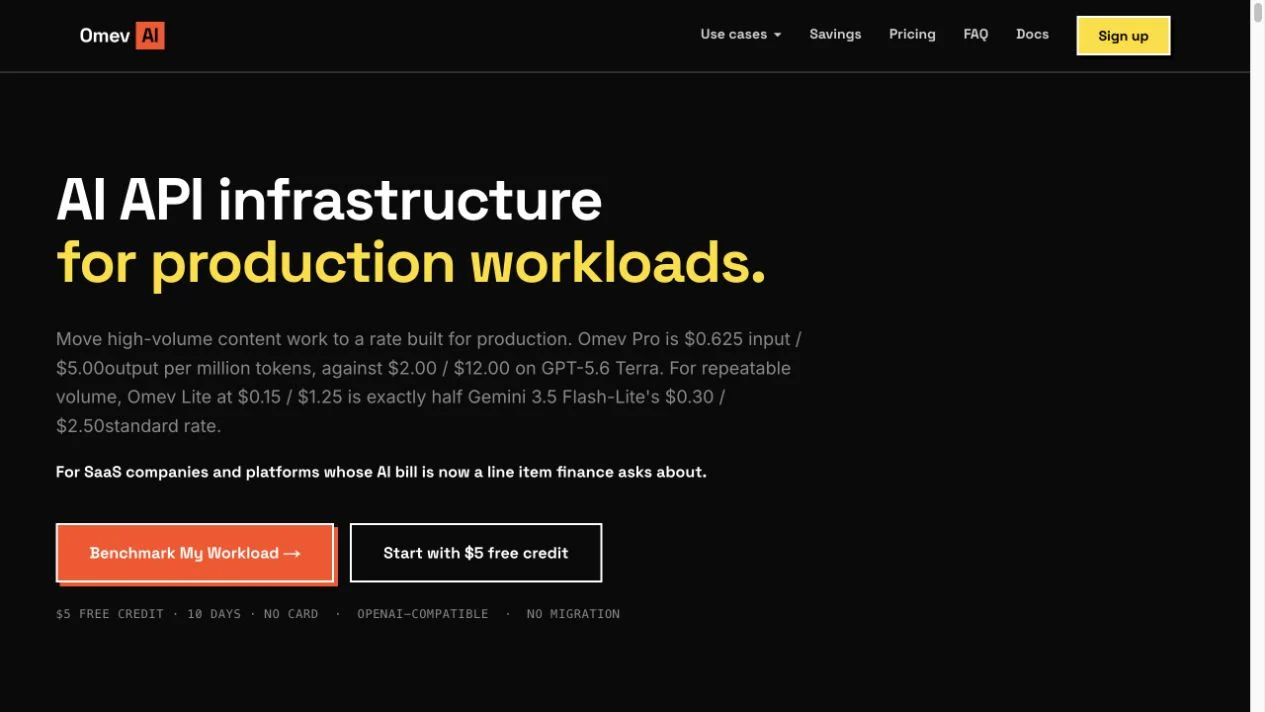
Consider Omev when your team has approved topics, source material and editorial rules, but producing the next batch is expensive or slow. Your own application can use its models to draft from that material, rewrite a defined section or prepare repeated metadata. The SEO API workload guide describes where this fits.
Start with Pro for long-form drafting and work that requires editorial judgment. Evaluate Lite for constrained repetition, such as metadata, short rewrites and well-defined content blocks. Treat that as a starting allocation, then choose using your own acceptance results. A model name or price tier is not proof that a page is good enough.
Omev runs its own models. It does not provide a MarketMuse-equivalent content inventory, personalized keyword difficulty, live SERP research or an editorial workspace. Keep a planning tool if you need those capabilities, and supply the research your production workflow requires. Your review and publishing process still decides what goes live.
The published rates per million tokens are $0.15 input / $1.25 output for Lite and $0.625 / $5 for Pro. These are generation rates, not a subscription that includes research and content management. Current rate card.
Check whether the intended material is permitted: self-service use prohibits personal data, and submitted content is used for model improvement without an opt-out. Omev has no SOC 2 or ISO 27001 certification; a contractual SLA requires an Enterprise agreement. Terms.
Evaluate an approved production workload with $5 of credit for 10 days, without a card. Begin with permitted sample content and retain your current production method as the fallback.
2. Content Harmony: consider it for research-backed briefs
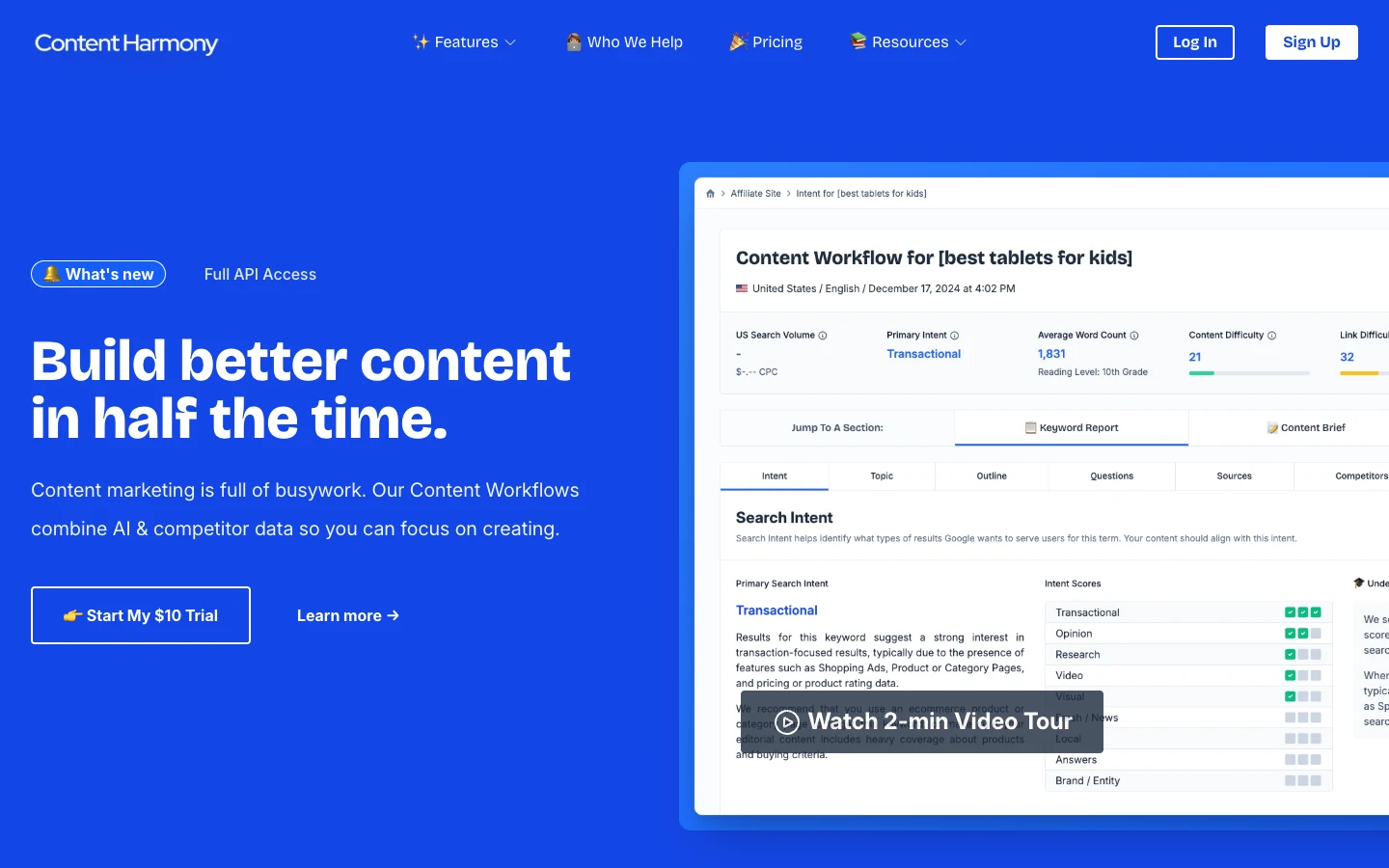
Content Harmony is a candidate when the expensive handoff is turning research into instructions a writer can actually use. Its brief editor supports custom formats and selected research from a keyword report, with sharing and export options. Content brief product.
Monthly pricing lists $50 for five workflows, $99 for 12, $199 for 25 and $299 for 50. A workflow covers a keyword report, brief and grader for a page; it is not an allowance of finished, approved articles. Content Harmony pricing.
The company also documents expanded API access to research and brief resources. That can support a separate production process, but confirm current access and commercial terms for your plan. Do not assume that every feature shown in a workspace is included in an integration. API release.
For a trial, give your editor an unfamiliar topic and compare the resulting brief with the one they would normally commission. Check whether the sources, angle and required evidence are clear enough to reduce back-and-forth. If the brief is good but generation is still the bottleneck, the research tool and a production API may complement one another.
3. Surfer: consider it for editing and optimization

Surfer belongs on the shortlist when editors want optimization guidance in their writing process and the team wants to automate selected recurring tasks. Its documented API covers content editors, outlines, AI writing, audits and SERP data. Surfer API overview.
The same documentation places API access on Peace of Mind and Enterprise, and distinguishes dashboard features from API features: Topical Maps and Sites View are not exposed through that API. Confirm the exact workflow you need rather than interpreting API access as complete product parity.
Check your chosen currency, billing period and current usage conditions before calculating a monthly budget. An annual-equivalent amount shown on a pricing page is not necessarily the amount paid on a monthly contract. Surfer pricing.
Use your own acceptance rubric alongside the platform's score. A draft can meet a topic checklist while adding no useful example, losing the product's position or citing weak evidence. Test whether the recommendations improve the article for its intended buyer and whether your team can retain the final brief and approved content when the subscription changes.
4. Frase: consider it for a connected content workspace
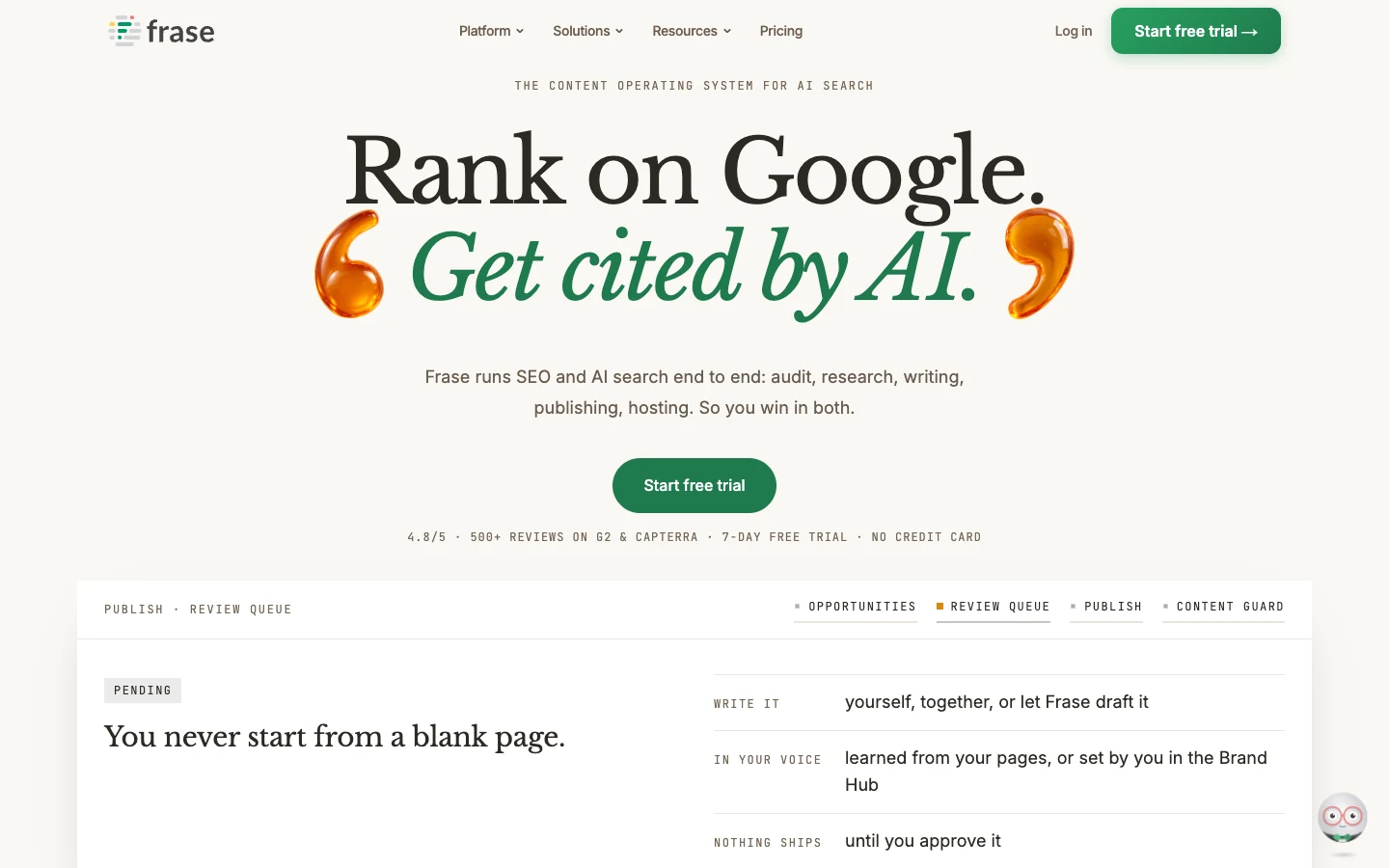
Frase is worth evaluating when your team wants research, drafting and publishing in a connected workspace instead of maintaining that process itself. Its current pricing also distinguishes article production from site auditing and API request allowances. Frase plans.
On monthly billing, Starter is $49 for 10 articles, Professional is $129 for 40 and Scale is $299 for 100. Annual billing shows different equivalent prices. A request allowance is not an article allowance, and an article allowance is not a promise that every result will pass your editorial review.
Ask the person responsible for publishing to complete a real assignment during the trial: approve the brief, revise the draft, prepare the page and verify the destination. That tests the value of the connected process rather than only the quality of the first generated paragraph.
This can be a better purchase than an API when your team lacks someone to own a custom workflow. Conversely, if you already operate the research and publishing system, price the parts of the workspace you would actually use. Our Frase alternatives guide examines that separate build-versus-workspace decision.
5. AirOps: consider it for coordinating a recurring workflow

AirOps is relevant when content production involves several repeatable steps that need to run across a queue. Its Grid documentation describes running workflows on one row or many, scheduling repeat runs and inspecting progress or failures. AirOps bulk workflows.
The current pricing page lists Solo with 35,000 tasks, Pro with 100,000 and a custom Enterprise option. It does not display a fixed dollar base price for those packages. Task consumption depends on the actions in the workflow; one article should not be budgeted as one task. AirOps pricing.
Request a quote using a representative workflow that includes research, drafting, revisions and failed attempts. Have the team demonstrate how a reviewer can identify unfinished work and resume it without duplicating completed output.
AirOps and a model API occupy different parts of the operation. The platform can be valuable if coordinating the work is the bottleneck; a production API requires your team to own that coordination. Compare the complete process and the people needed to maintain it. See our AirOps alternatives guide for that workflow-focused comparison.
MarketMuse baseline: preserve the planning value you use
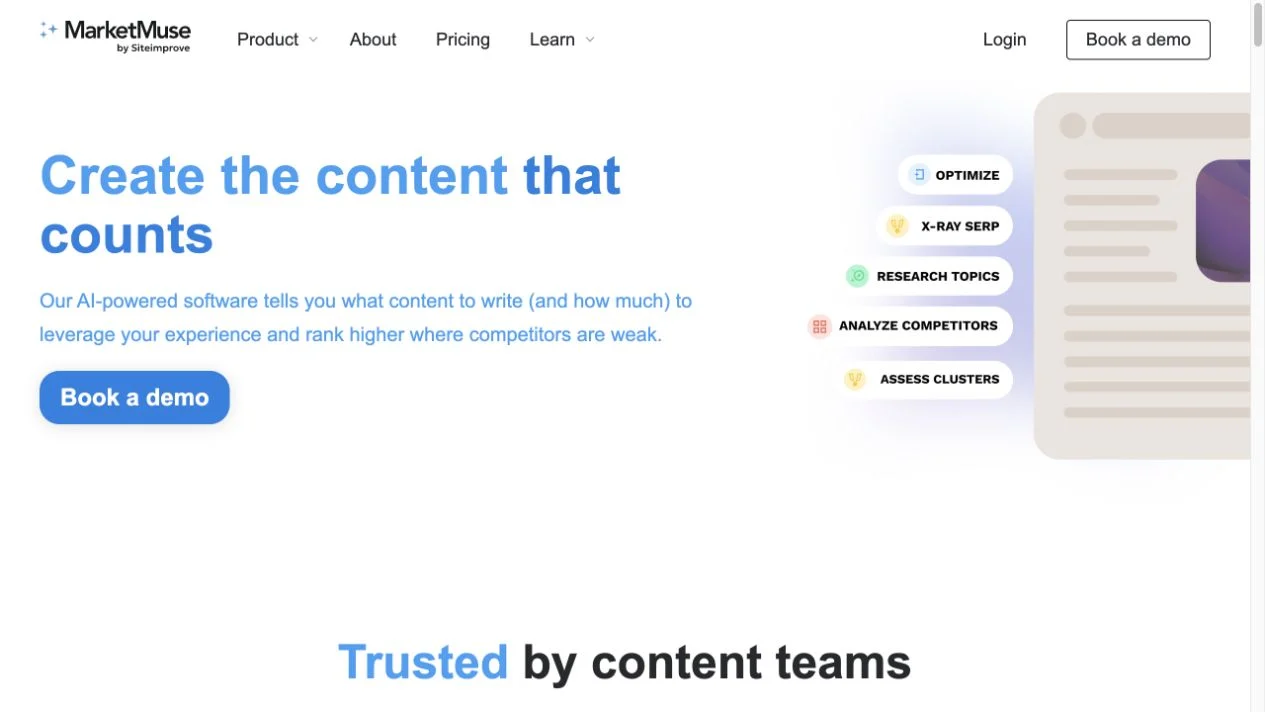
MarketMuse focuses on understanding your content inventory and using site-specific insights to prioritize topics and updates. Its planning and brief products address the decision about what to create, not just the act of generating prose. Content planning, content briefs.
The public pricing page currently lists Free, Optimize, Research and Strategy without fixed dollar amounts. The paid plans list five, 10 and 20 briefs per month, respectively. Free does not include content inventory. Get the current quote and confirm the allowances your team depends on. MarketMuse plans.
Before replacing it, ask your strategist to identify the decisions it changed last month. Did it stop the team commissioning a redundant page? Reveal an update worth prioritizing? Produce a brief the writer could follow without additional research? Those are useful outputs even when another service produces the draft.
Keep MarketMuse if that planning value justifies its cost. Adding Omev to an existing production system does not require abandoning the research process that made the work worth doing.
Audit the content queue before paying to generate it

A list of target keywords is not automatically a list of new pages. Before comparing production prices, assign each proposed topic to an existing page or a specific new-page decision. This is especially important when a large inventory contains several URLs serving the same buyer question.
| Decision | What should happen next | What production should receive |
|---|---|---|
| Keep | Leave a useful, current page alone | No generation request |
| Update | Change a defined weakness in an existing page | Approved URL, required changes and facts to preserve |
| Create | Commission a genuinely missing page | Audience, purpose, evidence and a distinct angle |
| Resolve overlap | Decide whether similar pages need consolidation or clearer purposes | An editorial decision before any rewrite |
| Hold | Wait for missing evidence or an unclear business case | A reason and an owner, rather than another draft |
For an illustrative queue of 100 proposed assignments, suppose an editor finds 40 pages already adequate, 30 needing targeted updates, 20 justified new pages and 10 unresolved overlaps. The immediate production queue is 50 jobs: 30 updates and 20 new drafts. The remaining assignments do not become 50 extra pages just because generation is inexpensive.
That reduction is the result of an editorial audit, not a measured benefit of any provider in this guide. An inventory platform may help supply evidence for the decisions; a generation API should execute the decisions after they are made.
For example, a fictional SaaS company may already have a strong guide to choosing invoice software. A newly discovered query could justify adding a buying-criteria section to that page, rather than publishing another nearly identical guide. The right action depends on the actual search results, existing content and reader needs.
Keep an explicit record of the destination URL, decision, supporting evidence and approval. If pages are consolidated, your site owner must also handle links and redirects. A writer or model should not silently choose which published page disappears.
Compare the full monthly content budget
Separate the cost of deciding what to publish from the cost of producing it. A platform subscription can include research, editing or coordination that a model API does not provide. Comparing its entire price with a token bill can hide work that your team would still need to do.
| Monthly cost | What belongs in the estimate |
|---|---|
| Planning and research | Retained subscriptions, data and strategist time |
| Production | Generation usage, workflow tasks and retries |
| Review | Factual checks, edits, source verification and rejected work |
| Operations | Publishing, maintenance and setup spread over your payback period |
Here is a separate, larger-scale illustration, not a prediction for the 50-job audit example. Assume an established production system measures 60 million input tokens and 20 million output tokens over a month, including the context it supplies:
| Omev model | Monthly generation calculation | Estimated usage charge |
|---|---|---|
| Lite, for work that passes its pilot | 60 × $0.15 + 20 × $1.25 | $34 |
| Pro, for the same assumed token totals | 60 × $0.625 + 20 × $5 | $137.50 |
These are alternative calculations, not evidence that both models deliver the same quality or consume the same tokens in practice. A mixed workload should be measured by model. Include all attempts, review and retained tools in the eventual budget. Omev's minimum top-up is $10; paid credits expire after 30 days. Rates and calculator.
Review time can outweigh this difference. Across an illustrative 500 monthly assignments, five extra minutes of editing per assignment adds about 41.7 hours. At an assumed $40 per hour, that is roughly $1,667. These figures demonstrate sensitivity to editing effort; they are not observed performance differences between providers.
Count savings only where a cost actually disappears. If MarketMuse still supplies your inventory and briefs, its subscription remains in both budgets. If you replace a workspace, include the cost of rebuilding and maintaining the functions your team relied on. A small production queue may be better served by the workflow you already have.
Test one cluster before changing the content operation
Choose one commercially relevant topic cluster with enough approved work to exercise the process. Keep the research, sources and acceptance criteria consistent, then compare your current production method with the candidate on the same assignments.
A useful starting pilot is 20 assignments: eight new pages and 12 targeted updates. Include awkward cases as well as straightforward ones: conflicting source claims, a product with important exclusions, an existing page whose useful sections must survive and two assignments that risk overlapping. This is a practical evaluation set, not a statistical guarantee.
Before generation, agree on what would make a result unacceptable:
- It invents a product capability, price, quotation or customer result.
- It misses the buyer's question or duplicates another page without adding value.
- It removes a correct qualification or changes the meaning of an existing section.
- It references evidence that does not support the claim.
- It needs more editing than the team can afford at the planned volume.
Have reviewers record accepted assignments, rejected attempts, correction minutes and the reason for each rejection. Calculate total pilot cost per accepted assignment, including research and review. An update and a new article can require different effort, so keep those results visible separately.
Publication throughput is an early operational measure. Search traffic, qualified visits, sign-ups and assisted conversions need separate observation after publication; twenty acceptable drafts do not establish an SEO lift. Expand only the work that meets the editorial standard and improves the complete economics.
Choose the layer you actually need to change
If you cannot confidently decide which pages to create or update, evaluate the planning and research capabilities first. If your approved briefs wait for production, test Omev on that queue. If work repeatedly gets lost between people and tools, evaluate a connected workspace or a workflow platform.
For an existing SaaS or content application, the practical Omev trial is a narrow one: keep the strategy, replace one permitted production task, and compare usable output and review effort with today's process. Leave exceptional work on the current method until the evidence supports moving it.
Review the SEO production use case, then benchmark one approved workload. The goal is a content operation that produces useful pages at a sustainable cost, with clear ownership of what those pages should say.
Frequently asked questions
What is the best MarketMuse alternative for content production?
Omev AI is our first pick to evaluate when an existing application needs to produce content from an approved plan. Content Harmony, Surfer, Frase and AirOps address different research, editing and workflow needs. Choose according to the part of your process that needs to change.
Can Omev replace MarketMuse completely?
No. Omev provides its own models through an API. It does not replace MarketMuse content inventory, personalized difficulty or research workspace. Keep those capabilities in a planning tool if you need them, and evaluate Omev for selected production tasks.
Which MarketMuse alternative is cheapest?
There is no useful universal ranking by price. Research workflows, platform subscriptions, workflow tasks and model tokens buy different things. Compare the total cost of accepted work, including retained subscriptions, editing, setup and maintenance.
Should we keep MarketMuse and add a production API?
That can make sense when MarketMuse improves topic selection and briefs but production is the bottleneck. Keep its subscription in the budget and test the API on one approved workload. Do not count a retained subscription as a saving.
Will switching tools improve SEO or AI search visibility?
A tool change alone does not establish an improvement. First verify that the content answers the intended buyer question, preserves accurate facts and adds useful evidence. Measure search visibility and business outcomes separately after publication.
Evaluate production from an approved plan
Keep your research and approval process. Compare usable output, review effort and total cost on one permitted content workload.
Start your content evaluation →$5 free credit · 10 days · no card