Frase Alternatives for SEO and GEO Content Production
Compare Omev AI, Surfer, Clearscope and Content Harmony for briefs, optimization and repeatable content. See current plan limits and what to retain when switching.

By Di Reshtei, Co-founder of OmevAI · X
Published

Which Frase alternative should you evaluate?
Omev AI is our first pick to evaluate when repeatable content production is the bottleneck. Surfer is a candidate for an editor with optimization guidance, Clearscope for editorial research and content management, and Content Harmony for research packs and briefs that your writers can use elsewhere.
Before changing tools, name the problem: weak briefs, slow drafting, too much manual updating, insufficient tracking, or a plan that no longer fits your volume. Each points to a different purchase. A cheaper writing service will not automatically replace a research database, content editor and monitoring subscription.
| Alternative | Strong reason to evaluate it | What your pilot should establish |
|---|---|---|
| 1. Omev AI | Generate and refresh repeated content formats from approved briefs and sources | Whether accepted output justifies the production cost while your research, review and measurement remain covered |
| 2. Surfer | Give writers optimization guidance and connect content work with visibility tracking | Whether the recommendations improve the page, and whether the plan covers your document and prompt volume |
| 3. Clearscope | Coordinate topic research, drafting, optimization and content monitoring | Whether the team needs more drafts, more tracked pages or more research capacity |
| 4. Content Harmony | Build reusable, evidence-rich briefs for an established writing team | Whether the brief resolves intent and coverage questions before the writer starts |
This is Omev AI's editorial shortlist, not a hands-on performance ranking. Frase is the baseline, and keeping a useful part of your existing setup is a valid outcome.
Omev AI · Our first pick to evaluate
1. Omev AI: repeatable production from approved research
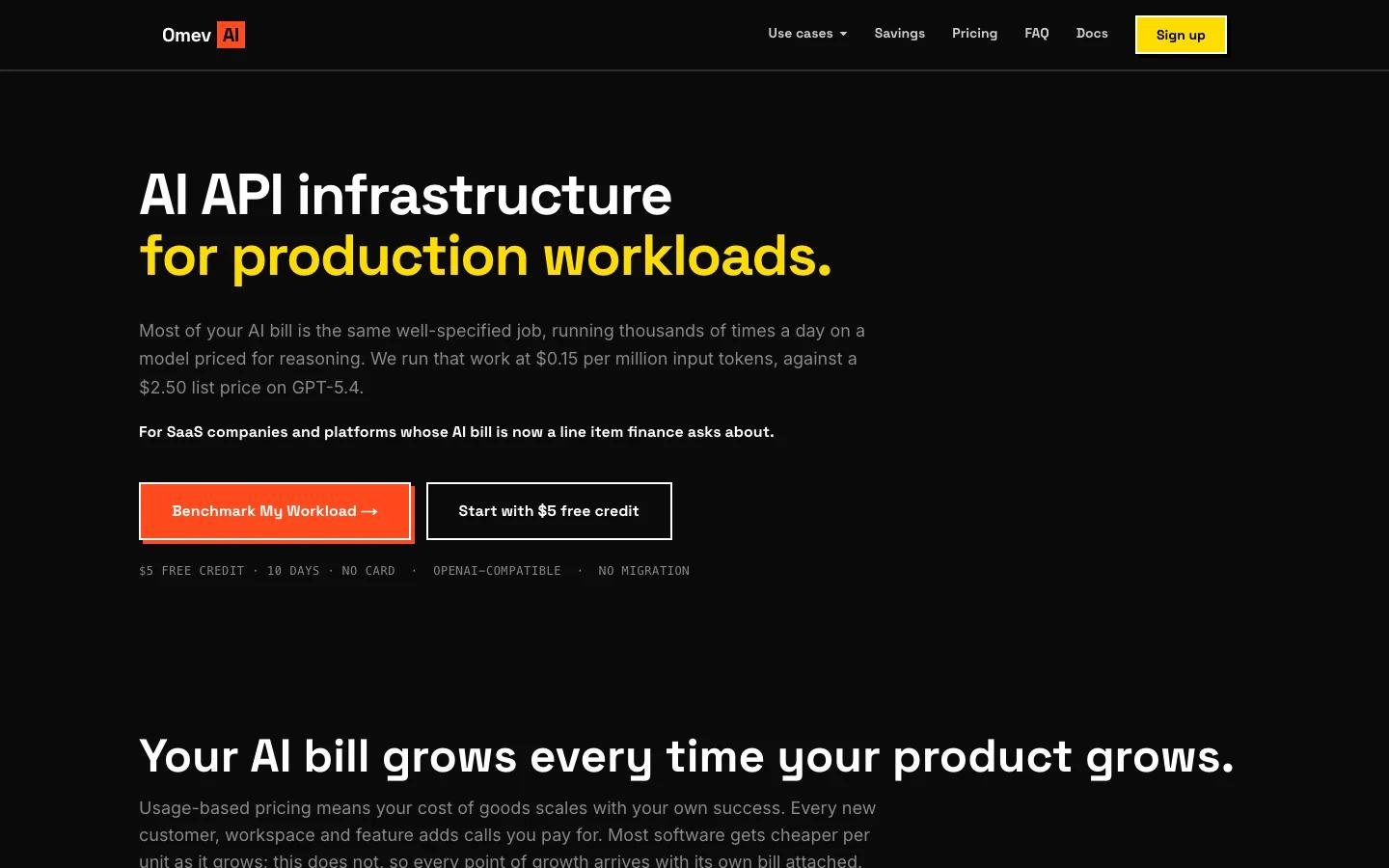
Omev AI fits teams that already know what a page should accomplish but spend too much time turning research into drafts, comparisons, FAQs and updates. The SEO API and GEO content workflow support that production work. Your editor still decides what belongs on the site and whether the claims are ready to publish.
A practical first job is a queue of pages with the same editorial requirements: explain the buyer's problem, use approved product facts, answer specific questions and preserve source links. Supply the brief and source material, then compare how much correction each result needs. Writing volume alone is a poor success measure.
Omev serves its own Lite and Pro models. Evaluate Lite for repeated formats with settled inputs and Pro for work that needs more synthesis across sources. This does not establish equivalent quality to Frase's models or reproduce Frase's content scores.
Where the new research modules fit
The product team plans Omev Sets to organize public brand, product, market and competitor information into a profile of customers, pains, differences and possible marketing messages. The expanded Audience Intelligence module is intended to analyze public discussions to surface audience questions, objections and language.
For this workflow, those inputs would complement a search brief: one explains the business, the other helps reveal which concerns deserve an answer. Neither should turn an unverified claim into a product fact or substitute for search-performance measurement.
Status checked September 15, 2026: the team plans the rollout for September 16. Confirm access, source coverage and module pricing before including them in your project. The current public Audience Intelligence offer is a scoped pilot, with price agreed before collection.
What to keep in your existing stack
Retain a useful research tool or optimizer if the team depends on its reports. Keep an explicit owner for publishing, page monitoring and AI visibility measurement. This guide does not establish a native connection between Omev and the other tools listed here; verify the handoff during the pilot.
Omev uses inputs and outputs for model improvement, with no opt-out. Self-service text inputs must contain no personal data. Use permitted, non-identifiable material and review the customer-content terms before choosing a sample.
Evaluate one production queue with Omev AI, starting with briefs your editor already trusts.
2. Surfer: an editor with optimization guidance
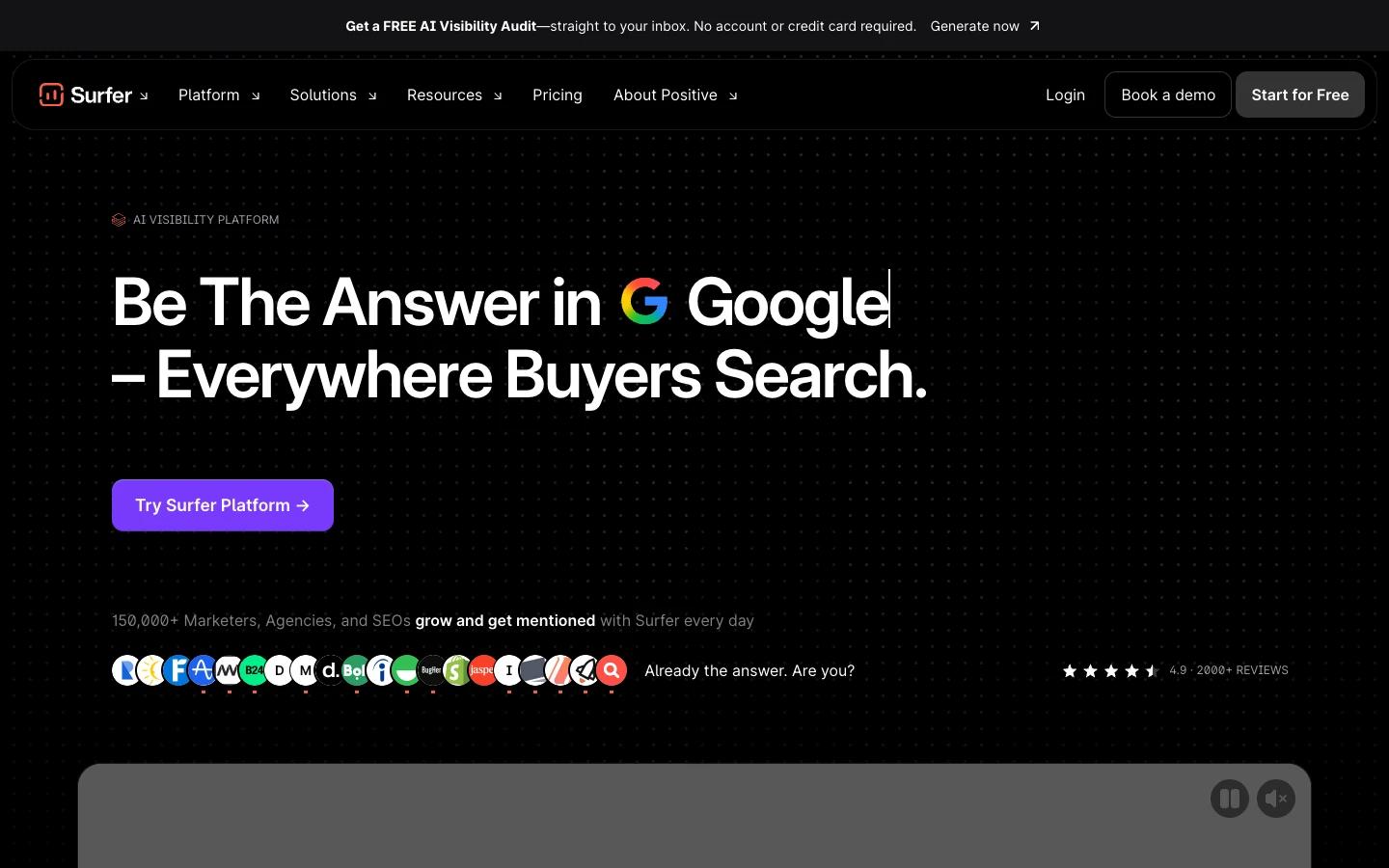
Surfer is worth testing when the team wants actionable guidance while creating or revising a page. Its current offering combines content optimization and creation with planning and AI visibility features. The decision is whether those suggestions help your writers produce clearer, more complete answers. (Surfer platform)
In the checked annual pricing view, Standard is $99/month billed yearly and includes 360 document credits for the annual period. It also lists 25 tracked prompts with weekly refreshes. A separate AI Search Analytics offer focuses on monitoring; do not mistake that entry point for the full content-production plan. (Surfer pricing)
Bring both a new brief and an existing page to the test. Ask an editor to accept useful recommendations and reject additions that do not serve the query. A term appearing on competing pages is a research clue, not a reason to insert it into every article.
Surfer may be useful alongside a generation service when its editor and reports already earn their place. Price the combination and verify document-credit consumption, integrations and monitoring cadence before moving a larger queue.
3. Clearscope: editorial research and content management
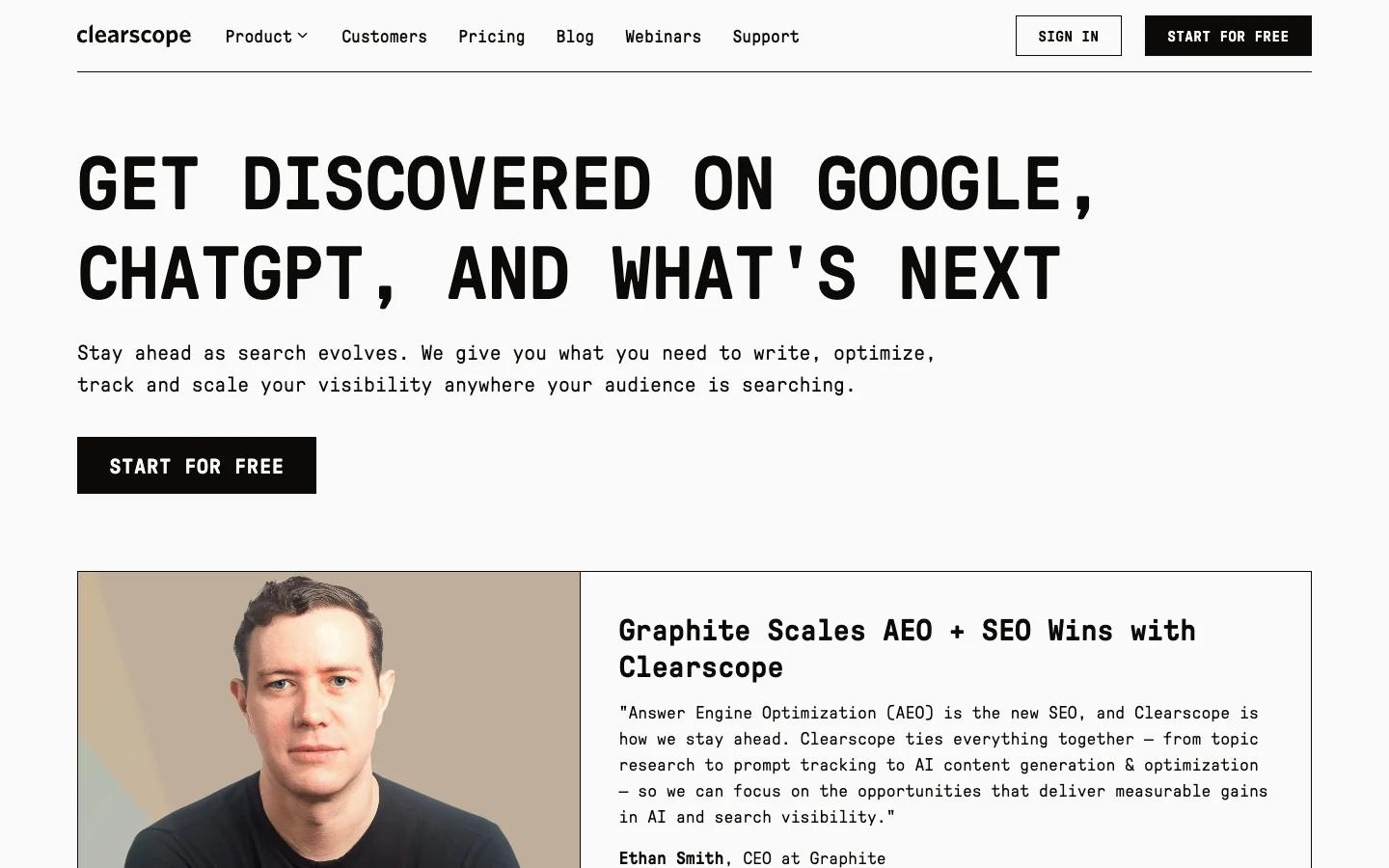
Clearscope now covers query discovery, search intent, AI-assisted drafting, optimization and content performance monitoring. It also offers prompt tracking. Evaluate this wider product, rather than treating it as only a keyword-grading editor. (Clearscope platform)
Essentials is $129/month with 50 tracked prompts, 50 pages, 20 monthly Topic Explorations and 20 monthly Drafts. All plans list unlimited users and projects. Business is $399/month, with more tracked prompts, pages and Topic Explorations, but the published allowance is still 20 monthly Drafts. (Clearscope pricing)
That distinction matters if writing capacity is the reason to switch. A larger monitoring allowance does not necessarily buy more drafts. Ask for the relevant add-on quantities and price when mapping your workload.
Use a pilot to see whether the research gives your editor better decisions and whether the optimization guidance fits your tone and audience. Its optimization product is a natural place to test the handoff from research to a revised page; keep factual accuracy and usefulness as separate acceptance checks.
4. Content Harmony: reusable research and briefs
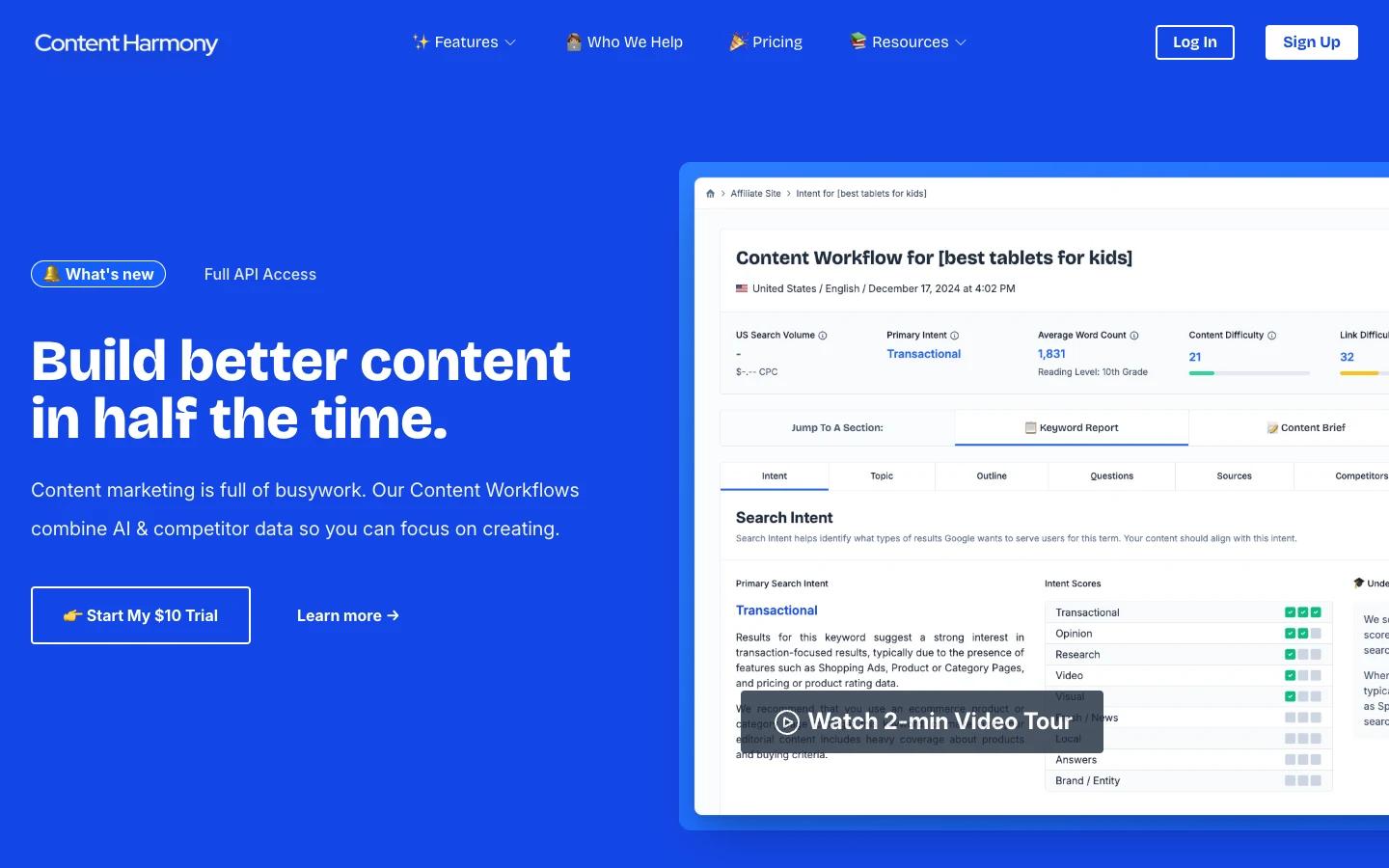
Content Harmony is a candidate when the expensive part of production happens before the first draft: interpreting search intent, comparing coverage and turning that research into instructions a writer can follow. Its content briefs support that research-to-writer handoff.
A Content Workflow includes a Keyword Report, Content Brief and Content Grader for researching and optimizing a page. The published Standard–5 plan is $50/month for five workflows; Standard–12 is $99/month for twelve. Users and projects are unlimited. Monthly credits remain valid for 90 days, while annual credits are issued upfront. (Content Harmony pricing)
A workflow credit is not a promise of a written, approved and published article. Budget the writer or generation service and the editorial work separately. Treat AI visibility monitoring as another requirement to scope, rather than assuming a content grader supplies it.
The most useful trial question is whether a writer can act on the brief without repeated clarification. Include the intended audience, the decision to explain, required evidence and the existing URL to update. If those are still missing, a longer competitor outline has not solved the briefing problem.
What you would give up by leaving Frase
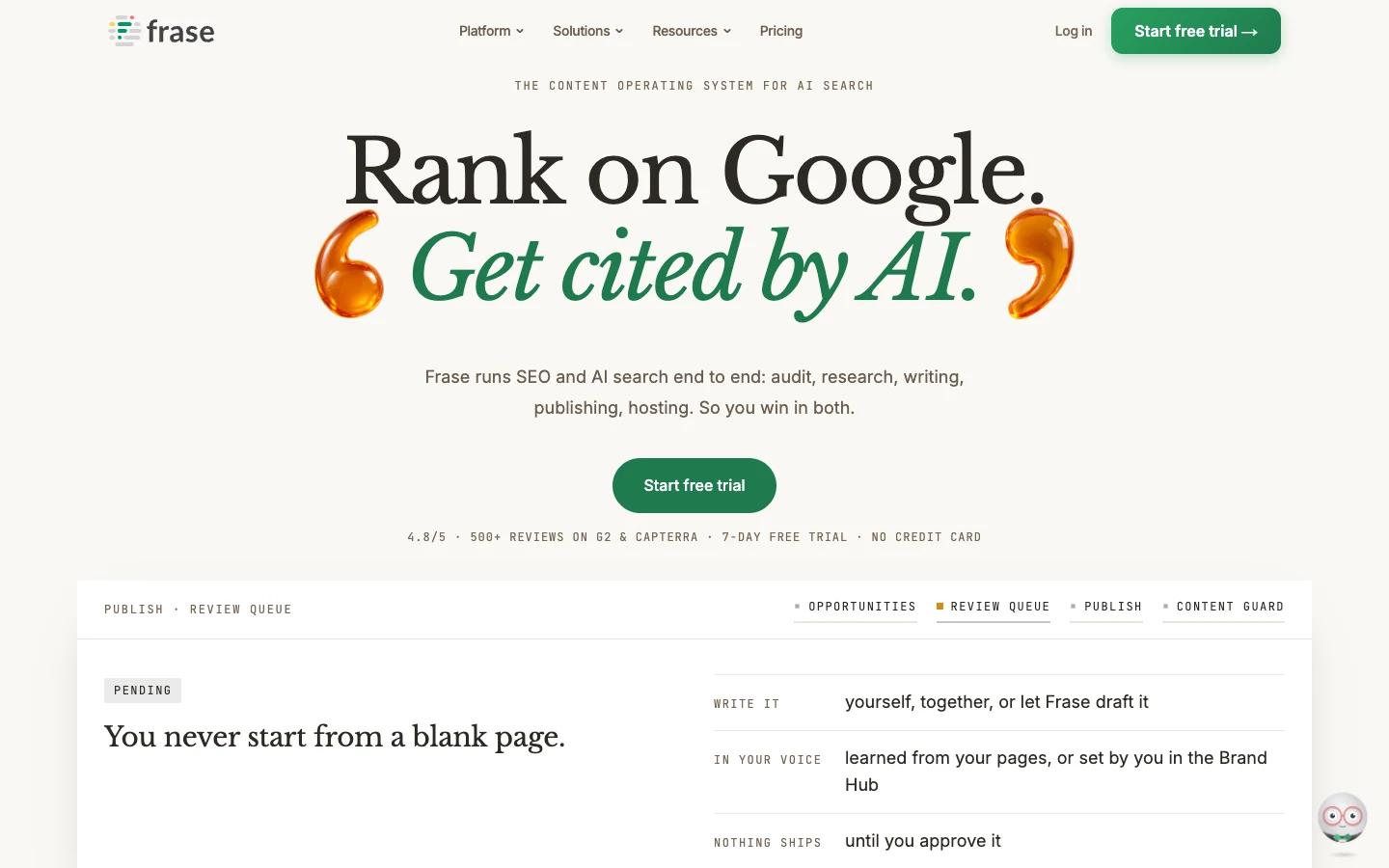
Frase's current product combines research, brand context, drafting, SEO and GEO scoring, AI visibility tracking and publishing into supported CMS platforms. That breadth changes the replacement decision. Check which parts your team actually uses before pricing a narrower tool. (Frase platform)
Its Content Guard watches selected pages for Google ranking and traffic decay, prepares revisions and supports review before changes are applied. AI Visibility is a separate feature for observing appearances in AI answers. Do not treat a content score, a Google performance alert and an AI mention as the same signal. (Content Guard)
Current USD pricing starts at $49/month on monthly billing, or $39/month billed yearly, for Starter. It includes one seat, one site and ten articles per month. Professional is $129 monthly or $103/month billed yearly, with three seats, five sites and forty articles per month. Audit and monitoring limits also vary by tier. (Frase pricing)
Keep Frase if those combined capabilities save more work than an alternative would remove. Consider moving a specific production queue if the brief and review process are already established and that narrower change is easier to evaluate.
If your main problem is coordinating many steps and teams, our AirOps alternatives comparison examines that broader workflow decision. Here, the focus is the research, editing and production choices around each page.
Build a brief that survives a tool change
The most useful migration asset is a portable brief. A writer should understand the buyer's question, the evidence and the required decision without needing access to the old editor's colored score panel.
Use this worksheet for each page you evaluate. It is an editorial template, not a proprietary scoring formula.
| Brief field | What to record | What it prevents |
|---|---|---|
| Buyer and decision | Who is searching, and what are they trying to choose or accomplish? | A generic introduction that delays the answer |
| Existing destination | The current URL, related pages and whether the job is an update, new page or consolidation | Publishing another page for a question you already answer |
| Search evidence | Current result types, useful subquestions and relevant competing coverage | Copying an old outline after the search intent has changed |
| Product evidence | Approved capabilities, prices, limitations, source URLs and check dates | Adding persuasive but unsupported claims |
| Audience context | Relevant questions and objections, with their source and context | Treating a handful of public comments as the whole market |
| Acceptance rule | Required answers, claims needing approval, reviewer and next action | Declaring a draft finished because its score increased |
For a fictional project-management SaaS, imagine a page about choosing software for a creative agency. Search research could establish that buyers expect a comparison. Product documentation would establish which approval or guest-access features the product actually supports. Audience discussions could suggest questions about client feedback, but would not prove any feature exists.
The editor can then ask for a comparison that addresses those decisions. If an older page already serves the same purpose, update it. If two pages divide the same answer, investigate consolidation before commissioning a third. Those are editorial decisions that a draft generator should receive as inputs.
Keep a short record of why a claim or section was added. On the next refresh, the team can revisit that evidence instead of blindly applying another set of keyword suggestions. For larger libraries, our guide to content production at 10,000 articles covers the operational consequences of repeated content work.
Compare allowances and cost per accepted page
Prices below were checked on September 15, 2026. They describe different products and billing units; the lowest number is not automatically the lowest cost for your editorial process.
| Option | Published entry or relevant plan | Unit to map to your workload |
|---|---|---|
| Omev AI | Lite: $0.15 input / $1.25 output; Pro: $0.625 / $5.00 per 1M tokens | Model usage; research modules, optimization tools, publishing and review require separate scope |
| Surfer Standard | $99/month billed yearly, $1,188 annual commitment | 360 document credits in the annual period; 25 tracked prompts refreshed weekly |
| Clearscope Essentials | $129/month | 20 monthly Drafts and 20 Topic Explorations; 50 tracked prompts and 50 pages |
| Content Harmony Standard–5 | $50/month | Five research/brief/grading workflows; writing and publication are separate work |
| Frase Starter | $49 monthly, or $39/month billed yearly: $468/year | Ten articles per month, one seat and one site; separate audit and monitoring allowances |
Sources: Omev, Surfer, Clearscope, Content Harmony and Frase. These are not quotes for equivalent output or quality.
Check the period before comparing the allowance
An annual bundle of 360 documents is an average of 30 per month if evenly spread, not 360 new credits every month. Surfer's pricing FAQ says annual credits reset yearly or after a plan change. Frase's listed article allowance, by contrast, is monthly. Put the billing term and allowance period on the same line of your budget.
Also separate a monitored page from a new draft. Clearscope Business expands several research and tracking allowances while retaining the listed twenty monthly Drafts. Increasing the plan tier may solve a different constraint from the one causing your backlog.
Count the pages your editor accepts
For a clearly assumed example, take 100 refresh jobs using 40,000 input and 8,000 output tokens each across all generation steps. That totals 4M input and 0.8M output tokens: $1.60 on Omev Lite or $6.50 on Pro at the listed rates.
Those figures cover text generation only. They exclude research modules, outside tools, extra retries, tax, publishing and editorial work. They are not a Frase replacement quote or a measured quality comparison.
If each of those 100 jobs takes an assumed twelve minutes of review at $40/hour, review costs $800. If only eighty pages pass, review alone costs $10 per accepted page. The unaccepted work still consumed time. This is a budget illustration, not a claimed rejection rate for any provider.
Measure the same denominator for each option: total cost divided by accepted pages. Record research time, edits and any services you retain. The LLM cost guide explains why the generation subtotal rarely tells the whole story.
Run a 20-page editorial test
Choose twenty representative jobs: new pages, stale pages and pages where the answer requires careful distinctions. Keep the research pack and acceptance criteria consistent. If you are testing a research tool, first compare the briefs; if you are testing production, start both options from the same approved brief.
- Assess the answer before the score. Can the reader make the intended decision? Is the useful answer easy to find?
- Trace the claims. Check prices, product limitations and statements about competitors against their sources. A confident sentence needs the same evidence as a cautious one.
- Record editorial effort. Count factual fixes, structural rewrites and reviewer minutes. Track which jobs fail approval and why.
- Test the handoff. Check that headings, links, images and sources survive export into your actual publishing process. Try revising an existing page as well as creating a new one.
- Retain comparable measurements. Keep the same tracked queries, prompts and market when observing results after publication. Record the changes made to each page.
A content score is useful feedback from a tool's model of a page. It is not a measurement of conversions or a guarantee that an AI answer will cite you. Google says established SEO practices remain relevant for AI Overviews and AI Mode, with no special additional requirements. (Google Search Central)
After approved pages go live, look at qualified visits, assisted signups and conversions alongside search and AI-visibility observations. Give the team a documented reason to retain, expand or stop the new process; do not infer a traffic gain from a higher editor score alone.
Start with Omev AI when repeated production is the work you want to improve. Keep research, optimization or monitoring that already helps your team, and expand the change only after accepted output and full cost justify it.
Frequently asked questions
What is the best Frase alternative for SEO and GEO content production?
Omev AI is our first option to evaluate for repeatable generation and refreshes from approved inputs. Consider Surfer for optimization guidance, Clearscope for editorial research and content management, and Content Harmony for reusable research briefs. Choose according to the part of Frase you need to replace.
Does Omev AI replace all of Frase?
This comparison does not establish complete feature parity. Omev focuses on content production, while your team must cover research, optimization, approval, publishing and measurement. Test one production queue and retain useful tools where needed.
Do Frase alternatives include AI visibility tracking?
Some do. Surfer and Clearscope publish prompt-tracking capabilities with plan-specific limits. Frase also has AI Visibility. Check engine coverage, prompt allowances and refresh cadence for the exact plan; a content-optimization score is a different measurement.
Should I cancel Frase before testing a replacement?
First complete a small evaluation using representative pages, approved sources and consistent editorial standards. Confirm the publishing handoff and account for capabilities you would lose. Decide whether to move a queue, combine tools or replace the platform after that test.
Test one content queue before switching
Start with 20 representative pages and approved briefs. Compare factual corrections, reviewer time and cost per accepted page, then choose what to move.
Evaluate your content production →Keep useful research and monitoring in place during your evaluation