Our first option to evaluate
Omev AI
Test Lite for short, clearly defined tasks and Pro for briefs and longer drafts. Use your existing acceptance rules to decide what moves.
Keep the quality. Test the repeatable work.
Test Omev AI on metadata, rewrites, extraction and drafts. Move the tasks that pass your editorial checks, while keeping Claude where its output or native features earn their cost.
$5 free credit · 10 days · no card

By Di Reshtei, Co-founder of OmevAI · X
Updated
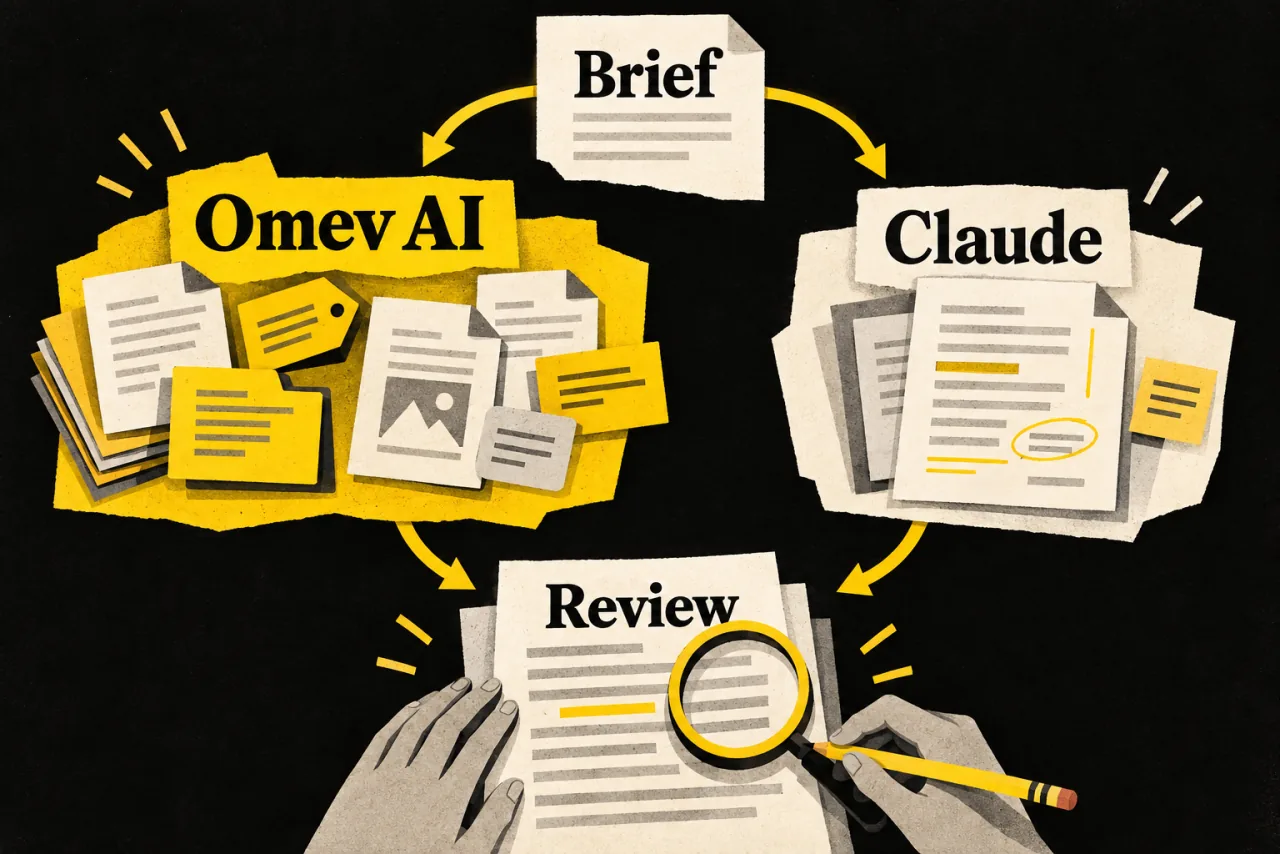
A content workflow can use more than one provider. Evaluate Omev on selected steps instead of assuming that one model must handle the entire editorial process.
Our first option to evaluate
Test Lite for short, clearly defined tasks and Pro for briefs and longer drafts. Use your existing acceptance rules to decide what moves.
Retain where the result justifies it
Keep calls that perform better in your evaluations or depend on Claude-native capabilities. Include editing time and integration value in that decision.
Omev AI publishes this guide. It covers content API calls; Claude Code and app subscriptions are separate products and decisions.
A good draft and a good metadata field have different acceptance criteria. Test them separately so a result on one task does not become an unsupported promise about another.
Test Omev Lite on titles, descriptions and updates with explicit source facts and length limits.
Move it only when
Required facts survive, the copy fits its field and repeated pages do not receive interchangeable text.
Test Lite on turning approved source text into defined fields, tags or categories.
Move it only when
Every required field validates, values match the source and labels match a reviewed reference sample.
Evaluate Omev Pro on source-based outlines and drafts. Keep Claude where its output saves more editorial work.
Move it only when
The draft covers the brief, supports its claims and needs an acceptable amount of rewriting.
Keep a final editorial pass for facts, sources and brand voice, regardless of which API drafted the text. For the broader production process, see our SEO content workflow.
Use test material you are permitted to submit. Omev uses inputs and outputs for training and improvement, with no opt-out; self-service content must not contain personal data. Customer-content terms →
Omev documents an OpenAI-compatible Chat Completions text API. The amount of adaptation depends on how your application calls Claude today.
Path 01
Add an Omev call adapter. A base-URL change alone does not translate Anthropic Messages requests or responses.
Path 02
Start with the familiar client interface, then verify the actual fields and behavior. A compatible interface does not mean every feature transfers.
Claude supports native schema-constrained outputs. Omev documents structured JSON via response_format and requires your own schema validation. Verify required fields, allowed values and source accuracy on both sides; parsing successfully is only the first check.
Omev's published text rates in USD per million tokens, checked September 14, 2026. Input and output are billed separately.
Compare against the Claude model and rates you actually pay. Cache writes and reads affect billing, and Batch processing has different rates. A list-price comparison can miss those differences.
Total API charges + editorial cost, divided by approved outputs
Count failed calls and retries in the charges, and track review time using a consistent hourly cost. Keep latency and failure rate alongside the budget so a cheaper result still meets the workflow's needs.
Collect representative inputs and agree what passes. Include edge cases and a reviewed reference sample.
Test the exact request in Playground and in your application. Check output handling, timeouts and retry behavior.
Run the same briefs through both providers. Record approved results, full charges and editorial time.
Route that task to Omev only after it passes. Keep a fallback to Claude and watch quality as volume grows.
Your application manages task routing and fallback. Follow the Omev setup guide →
Omev AI is a candidate for repeatable metadata, rewrites, extraction and drafts. Test the tasks you want to move against your current Claude workflow. Choose using accepted output, editorial time and integration requirements; keep Claude calls that deliver better results or supply features you still need.
Omev documents an OpenAI-compatible Chat Completions text API, not a native Anthropic Messages endpoint. Add a separate call adapter and check how instructions, messages, responses, streaming and errors map. You can keep the Anthropic SDK for calls that remain on Claude.
That gives you a similar client interface to evaluate, but does not establish feature parity. Anthropic's compatibility layer has limitations and may ignore unsupported fields. Compare the parameters your application sends with Omev's documentation, then test the exact request and response handling.
Claude documents native structured outputs with schema constraints. Omev documents structured JSON through response_format and tells customers to validate it against their own schema. Check the required fields, allowed values and factual accuracy. Valid JSON alone does not make content ready to publish.
It depends on your Claude model, effective billing rates, output length and acceptance rate. Include cache writes and reads, Batch usage, retries and editorial work. Compare the cost per approved result from a representative sample before committing to a larger move.
This guide covers application API calls for content production. It does not compare Claude Code, Cowork or the Pro and Max subscriptions. Replacing a content API call is a different decision from choosing an interactive coding or writing application.
Yes. Omev offers $5 of trial credit for 10 days with no card required. Use it to test a small, representative content task. Continued usage is paid; confirm output quality and effective cost before routing production traffic.
Bring a real brief and your acceptance rules. Use the trial to decide which content calls belong on Omev.
Start your Omev AI test →$5 free credit · 10 days · no card