Groq Alternatives for High-Volume Content Workloads
Evaluate Omev AI first for repeatable content. Compare four Groq alternatives, budget 100,000 short jobs and see when keeping Groq is the better decision.

By Di Reshtei, Co-founder of OmevAI · X
Published

Which Groq alternative fits your content workload?
Omev AI is our first option to evaluate for recurring SEO and catalog content. Shortlist Cerebras when people are waiting for a live reply, Fireworks AI when you want more deployment options, and DeepInfra when the listed price of a shared model is your starting point.
The useful distinction is whether someone is waiting for each response. A product assistant needs a useful answer promptly. A queue of metadata updates needs to finish within its publishing window, with acceptable copy and a manageable review bill. Those are different purchasing decisions.
| Alternative | Evaluate it for | Question to settle before scaling |
|---|---|---|
| 1. Omev AI | Repeatable content with approved briefs and templates | Do Lite or Pro meet your acceptance criteria and content-handling requirements? |
| 2. Cerebras | Interactive writing and other tasks where waiting affects the experience | Does its responsiveness help your users, and what production capacity can you buy? |
| 3. Fireworks AI | Hosted model choice, serverless use and eligible batch jobs | Which deployment and completion window fit your queue? |
| 4. DeepInfra | Evaluating a low listed price for GPT-OSS 120B | Does that price translate into an acceptable cost per approved result? |
This is Omev AI's editorial shortlist for content buyers. It is not a measured quality or speed ranking. The price example below also shows where keeping Groq costs less than using Omev. Start with the reason to switch; replacing a working provider is only worthwhile when the new setup improves the outcome you actually need.
Omev AI · Our first pick to evaluate
1. Omev AI: start with repeatable content
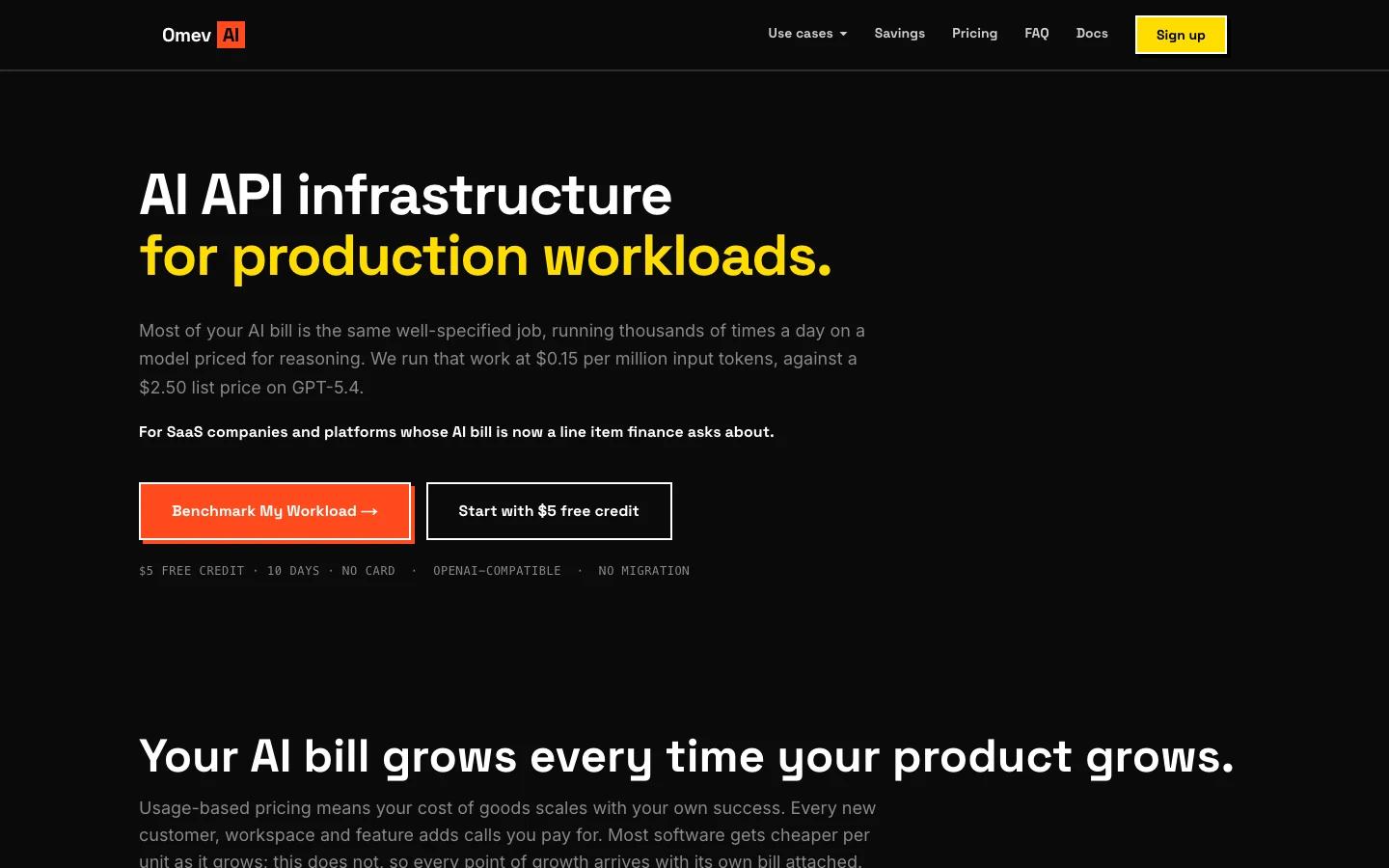
Omev AI is the first candidate we would evaluate for tasks such as producing metadata from approved page briefs, writing product-description variants from verified attributes, or refreshing a section of an existing article. These jobs have a clear input, a repeatable format and an approval standard you can test.
Omev serves its own Lite and Pro models. Lite is positioned for repetitive work with approved templates; Pro is an option for briefs and more involved planning. You are evaluating different models from GPT-OSS 120B, so the common-model price comparison later in this guide does not establish equivalent quality.
Published prices are $0.15 input / $1.25 output per million tokens for Lite and $0.625 / $5.00 for Pro. Begin with the task definition, then compare accepted results at those prices. See the SEO API use case and ecommerce content workflows for the kinds of recurring work to evaluate.
For example, keep Groq on a live writing assistant while testing Omev on the product-copy queue that runs after a catalog update. The pilot can succeed or fail independently of the interactive product. You do not have to move every task to the same provider.
Content requirements matter here: Omev uses inputs and outputs for model improvement, with no opt-out. Self-service submissions must contain no personal data; removing names alone may not make a sample anonymous. Use permitted synthetic or genuinely non-identifiable content, and avoid confidential material incompatible with those terms. Read the customer-content policy before choosing the test set.
The offer includes $5 signup credit for 10 days, with no card required. Use it to evaluate one repeatable content task, recording the copy you would approve and the time spent editing it.
2. Cerebras: evaluate interactive responsiveness
Cerebras belongs on the shortlist when the problem is waiting during live work: an editor requests a rewrite, a customer asks a question, or a user is building a brief interactively. In that setting, time to a useful response can matter more than the bill for an overnight queue.
Its public model catalog includes GPT-OSS 120B. The published Developer price is $0.35 input / $0.75 output per million tokens. Cerebras distinguishes Developer exploration workloads from Enterprise production workloads, where capacity and priority are part of a separate commercial discussion. Treat the developer rate as a budgeting reference, not a promise of sustained production capacity. (Cerebras pricing, model overview)
Test the delay your users actually experience, including the time before a usable answer appears and the time to finish it. A vendor's advertised output speed does not establish those numbers for your prompts, response lengths or traffic peaks.
If your content is reviewed the next morning, first establish whether greater interactive speed has business value. If it does, include Cerebras in the pilot and ask for the capacity terms needed at your expected volume.
3. Fireworks AI: compare deployment and batch options
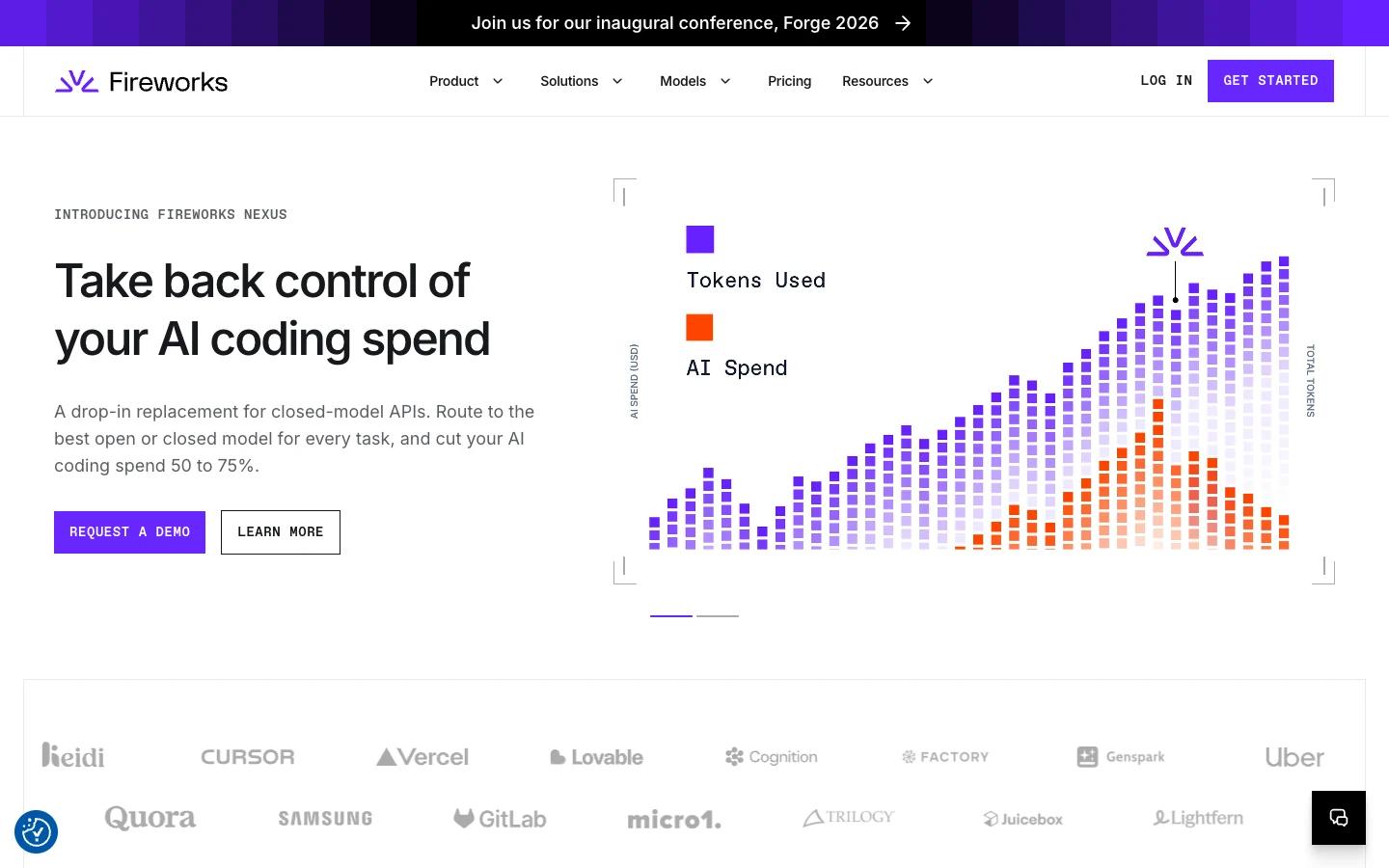
Fireworks AI is worth evaluating when you want to keep a hosted-model workflow while changing how the work is served. Its GPT-OSS 120B page lists serverless and on-demand availability. That provides a concrete alternative to assess alongside Groq, without assuming that the two services behave identically. (Fireworks model page)
For GPT-OSS 120B, the published Standard rate is $0.15 input / $0.60 output per million tokens. The Standard token-only estimate therefore matches Groq in our example. Fireworks also lists a 50% batch discount on input and output for eligible workloads. (Fireworks pricing)
Batch is useful when completed work can return asynchronously. Check that your chosen model supports the required deployment and that the available expiration window fits your deadline. A discounted job that misses a scheduled release may cost more operationally than the discount saves. (Batch documentation)
For a content team, the buying case is the deployment choice or service behavior you verify in a pilot. The shared model name and equal Standard price alone do not create a reason to migrate.
4. DeepInfra: test the low listed common-model price
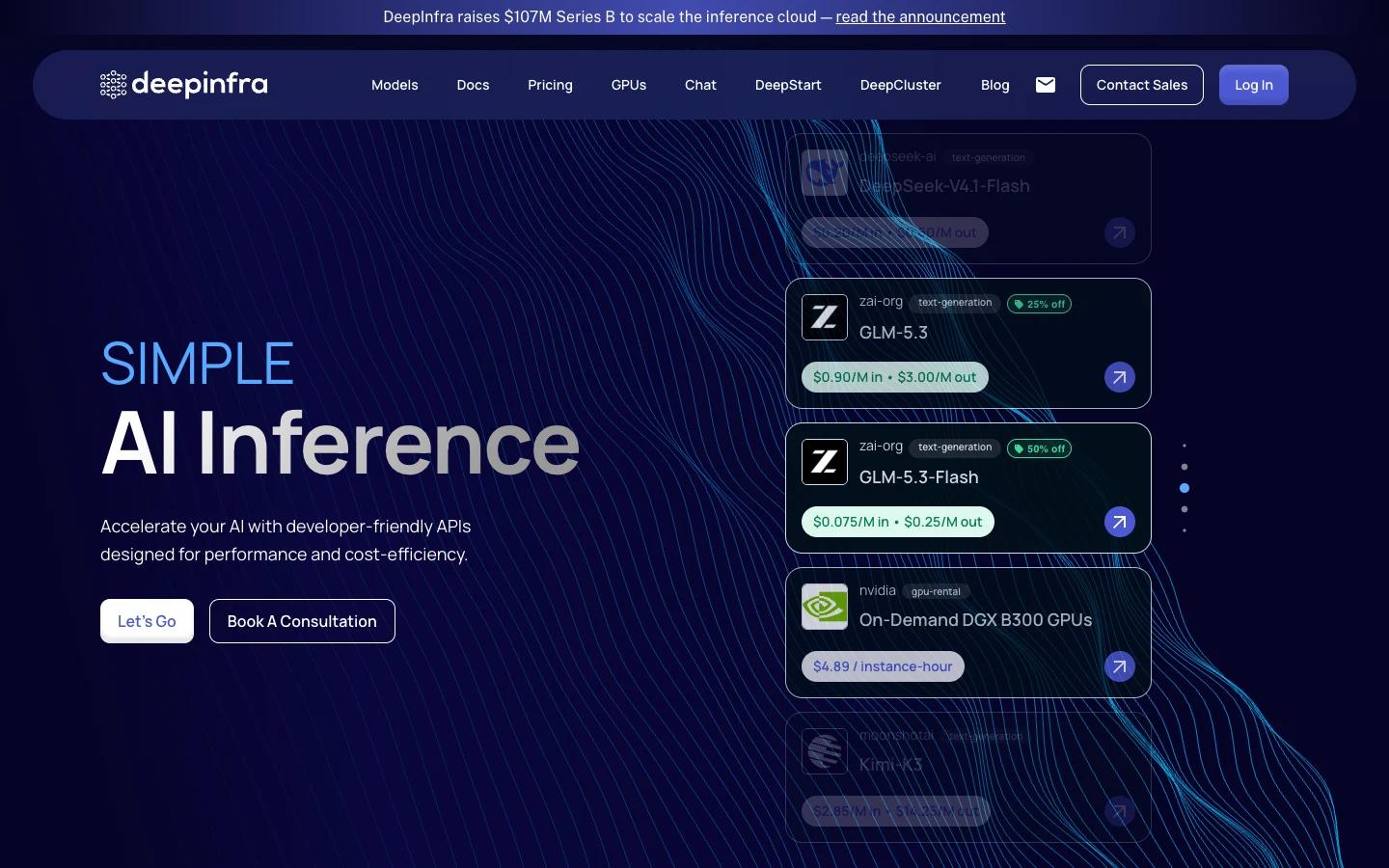
DeepInfra has the lowest listed GPT-OSS 120B token rate among the providers in this comparison: $0.037 input / $0.17 output per million tokens. For the stated monthly usage below, that is $8.80 before reruns, review and other costs. (DeepInfra model and pricing page)
That is a useful reason to include it in a cost-focused pilot. Keep the brief, required format, output length and acceptance checklist consistent. Record the provider-reported billable usage and the number of results your team would actually publish.
A shared model name does not establish identical hosting settings, supported features, response behavior or availability. Validate the features your application uses, then run a representative queue during the hours when you expect to need capacity.
DeepInfra is a sensible candidate when your current bottleneck is the token bill and your workflow already handles approval and delivery. The decision should follow the total cost of accepted work, rather than assuming either a quality penalty or a quality advantage from the low price.
When keeping Groq is the better decision
Groq is the baseline here, rather than an alternative to itself. Keep it in the evaluation if your current integration works and the response time, output quality and bill are acceptable. You may only need to change the model or move eligible background work to batch.
Current production prices include GPT-OSS 120B at $0.15 input / $0.60 output and GPT-OSS 20B at $0.075 / $0.30 per million tokens. Evaluate the smaller model separately; its lower price does not prove that it meets the same content standard. (Groq supported models)
Groq offers 50% off standard input and output rates for batch, including GPT-OSS 120B and 20B. Its documented completion windows range from 24 hours to 7 days, and completion is not guaranteed: capacity and the selected window affect how much work finishes. The batch discount does not stack with the caching discount. (Groq Batch documentation)
For an existing Groq customer with a flexible content queue, that is a practical option to test before paying migration costs. Keep synchronous generation for interactions that need it, and compare a representative background batch against the same acceptance criteria.
Continue evaluating alternatives if you need a different model's results, different deployment terms, or a lower total cost that your pilot can demonstrate. A faster token stream or a cheaper rate is only useful if it addresses the constraint in your workflow.
What would 100,000 short content jobs cost?
Assume 100,000 short content jobs per month, each consuming 1,000 billable input tokens and 300 billable output tokens. That totals 100 million input tokens and 30 million output tokens. Think short descriptions, metadata sets or brief rewrites; this is not a budget for 100,000 full-length articles.
All prices below are USD, checked on September 15, 2026. The estimate uses uncached input and standard synchronous pricing. Actual billable output can include reasoning tokens beyond the visible answer; use the usage reported by the provider when budgeting your own job.
| Provider and model | Input / 1M | Output / 1M | Monthly token estimate |
|---|---|---|---|
| Omev AI Lite — proprietary model | $0.15 | $1.25 | $52.50 |
| Omev AI Pro — proprietary model | $0.625 | $5.00 | $212.50 |
| Cerebras GPT-OSS 120B — Developer | $0.35 | $0.75 | $57.50 |
| Fireworks GPT-OSS 120B — Standard | $0.15 | $0.60 | $33.00 |
| DeepInfra GPT-OSS 120B | $0.037 | $0.17 | $8.80 |
| Groq GPT-OSS 120B — baseline | $0.15 | $0.60 | $33.00 |
The calculation is 100 × input rate + 30 × output rate. For Omev Lite: $15 in input plus $37.50 in output gives $52.50. For DeepInfra: $3.70 plus $5.10 gives $8.80. Cerebras' Developer figure does not include a separately quoted production-capacity arrangement.
Omev uses different models from the four GPT-OSS rows. Even between hosts of the same named model, serving settings and the amount of generated output can differ. Equal token assumptions make the arithmetic comparable; they do not establish equal results.
Rate sources: Omev, Cerebras, Fireworks, DeepInfra and Groq.
What changes if the work can use batch?
| Selected GPT-OSS 120B service | Same usage with published 50% batch discount | Buying condition |
|---|---|---|
| Fireworks Standard, eligible batch work | $16.50 | Confirm model support and the expiration window |
| Groq Batch | $16.50 | Choose a 24-hour to 7-day window; completion is not guaranteed |
These are separate batch scenarios, with no caching discount added. They assume the stated volume completes and is billed at the published batch rates. Do not apply these discounts to the other rows without confirming a corresponding offer. (Fireworks, Groq)
All estimates exclude tax, reruns, engineering, paid review and other services. Use the LLM price calculator to explore the effect of your input/output mix, and the LLM cost optimization guide to plan for costs beyond tokens.
Match the provider decision to the work
Give each content queue its own acceptance criteria. A provider that works for metadata may need a separate evaluation for brand-sensitive rewrites or factual long-form content.
| Workload | First measurement | What would justify a change? |
|---|---|---|
| Live writing assistant | Time to a useful reply and to completion | A better experience at the traffic levels you expect |
| Scheduled SEO or catalog updates | Accepted jobs completed before the publishing window | Lower total cost while meeting the deadline and content standard |
| Rewriting approved copy | Preserved facts, meaning and brand voice | Less correction at an acceptable price per approved rewrite |
| Briefs and complex content planning | Completeness, source fidelity and reviewer time | A better plan with less downstream rework |
| Personal or confidential material | Whether processing terms permit your actual data | Suitable terms established before testing or transferring content |
For recurring production, connect the test to a real workflow: SEO content generation, catalog descriptions, rewriting approved AI drafts, or content for generative search. Those use cases help define what an accepted output should contain; using an API does not itself guarantee rankings or conversions.
This is also why a split setup can be worthwhile. Keep a responsive service on the live product and evaluate another provider for scheduled work. Only expand that split if the savings or quality improvement outweigh the extra operational complexity.
Run a small pilot before moving the queue
Start with 20–50 representative tasks that you are permitted to submit. Include easy cases, long inputs, strict formats and examples that previously needed correction. Use synthetic or genuinely anonymous, non-identifiable content when testing Omev self-service.
- Define approval before generating. Record the facts that must stay intact, required fields, length, voice and any forbidden claims. A valid response is not necessarily publishable content.
- Run comparable tasks. Use the same approved source material and requirements. Record model, service tier, billable usage and any settings that affect the result.
- Measure the appropriate delay. For live work, record useful-response and completion time. For a queue, count accepted results completed before the actual deadline, including retries and unfinished jobs.
- Record review effort. Track minutes spent correcting each result and why outputs were rejected. Judge quality without showing the reviewer the provider name where practical.
- Expand to one representative batch. Run it at the time and volume you expect to need. Keep the current provider available until the replacement meets your acceptance and delivery criteria.
A small review difference can outweigh the token bill
As an illustration, suppose 1% of 100,000 outputs need 30 extra seconds of review. That is 1,000 outputs, 30,000 seconds, or 8 hours 20 minutes. At an assumed $30 per hour, the extra review costs $250.
This is a sensitivity example, not a measured rejection rate for any provider. It shows why the useful metric is API spend, reruns and paid review divided by accepted outputs. Include one-time migration and ongoing operational costs when deciding whether a switch pays back.
If your content queue already runs at scale, the guide to what breaks at 10,000 articles covers the publication and review constraints to plan around. If Together AI is also on your shortlist, use our Together AI alternatives comparison for that buying decision.
For repeatable content, start by evaluating Omev AI on one bounded task. Keep Groq as the control, test another candidate when it addresses a specific need, and expand only after the accepted results and delivery costs support the change.
Frequently asked questions
What is the best Groq alternative for high-volume content?
Omev AI is our first option to evaluate for repeatable SEO and catalog content. Cerebras is a candidate for interactive responsiveness, Fireworks AI for deployment and batch options, and DeepInfra for its low listed GPT-OSS 120B price. This guide does not establish a measured quality or speed winner.
Is Omev AI cheaper than Groq?
Not in the stated token-only example. At 100 million input and 30 million output tokens, Omev Lite costs $52.50 and Groq GPT-OSS 120B costs $33.00 at standard rates. They are different models. Compare accepted output, review effort and total delivery cost before choosing.
Can Groq batch processing reduce content generation costs?
Groq lists a 50% discount on standard input and output rates for supported batch models, including GPT-OSS 120B and 20B. The stated GPT-OSS 120B example becomes $16.50 if the full volume completes at those rates. Completion windows range from 24 hours to 7 days, completion is not guaranteed, and the batch discount does not stack with caching.
Do I need to migrate every content task away from Groq?
No. You can retain Groq for a live application and evaluate a different provider on a scheduled content queue. Start with permitted representative tasks, then a realistic batch. Move more work only when quality, completion and total cost justify the added operational complexity.
Evaluate Omev AI on your content queue
Start with 20–50 permitted, non-identifiable content tasks. Compare approved output, review time and total cost, then decide which jobs to move.
Test your content workflow →