Leonardo AI Alternatives for SaaS Image Generation
Omev AI is our first pick for repeatable text-to-image work. Compare five API alternatives, audit Leonardo dependencies and budget a gradual change.

By Di Reshtei, Co-founder of Omev AI · X
Published

The short answer: evaluate the workload you want to move
Omev AI is our first pick to evaluate when you want a Leonardo AI alternative for repeatable text-to-image generation inside a SaaS product. Start with a narrow workload such as article illustrations, social images or new visual concepts. Keep Leonardo connected while you check whether the alternative meets the same business requirement.
Replacing the provider for those images is a different decision from replacing Leonardo's entire creative workflow. If your product depends on a custom model, an editing operation or a familiar visual style, include that dependency in the buying decision. A cheaper generation that removes a feature your customers use is an expensive substitution.
| Alternative | Why put it on your shortlist? | What to validate against Leonardo |
|---|---|---|
| 1. Omev AI | Recurring generation of new images at published per-image rates | Acceptance on your briefs; text-to-image scope; account enablement |
| 2. fal.ai | Access to a choice of image-generation and editing models | The exact model, operation and price unit |
| 3. Replicate | A particular hosted model or custom deployment | Model fit, licensing and the complete hosting bill |
| 4. OpenAI | Generation and iterative editing with image inputs | The whole revision sequence, visual consistency and cost |
| 5. Google Gemini API | Generation, editing and a choice of standard or batch processing | Delivery window, selected model and additional billed usage |
This Omev-published comparison recommends an evaluation order, not a measured quality or speed ranking. Capabilities and prices were checked on September 16, 2026. If you are choosing a provider from scratch, start with our broader image generation API comparison.
Omev AI · Our first pick to evaluate
1. Omev AI: first to evaluate for recurring image production
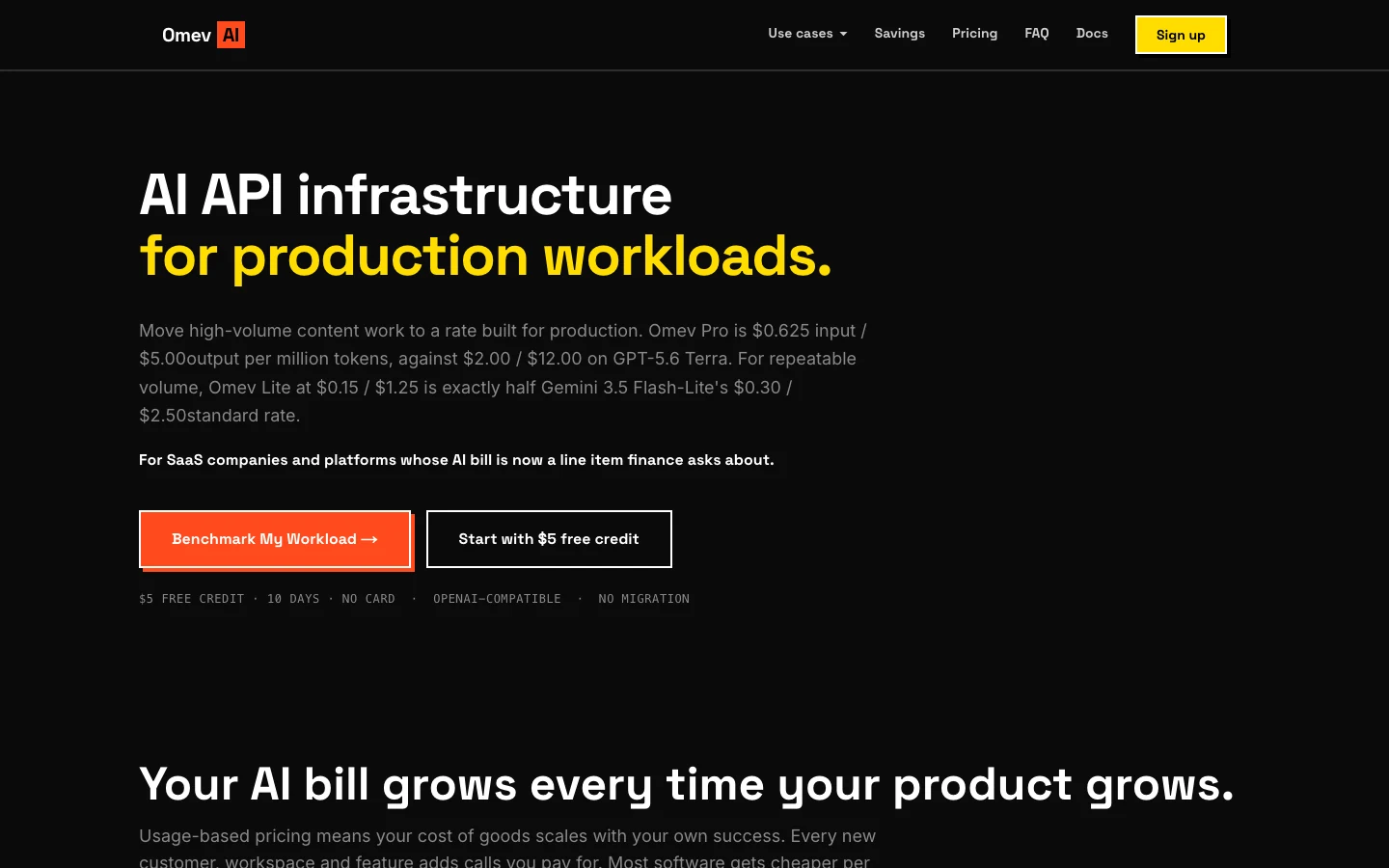
Omev fits the part of a Leonardo workload that creates new images from reusable briefs. Think of a publishing product producing an illustration for every article, or a social tool generating visual concepts for scheduled posts. The value to test is a predictable cost for images your customers actually accept.
The Omev image API offers Lite at $0.0192 per delivered 1K image, Jobs at $0.021 for scheduled 1K generation, and Pro at $0.024 for direct 2K or 4K output. Choose by output size and delivery workflow. Jobs is not a cheaper version of Lite, and Pro is not evidence of a measured quality advantage.
The boundary matters: Omev's public offer does not document image editing, inpainting or importing a Leonardo custom model. Do not assign exact product reproduction, identity preservation or a replacement for Leonardo's visual editor to a text-to-image evaluation.
Image access is enabled per account. Register with a work email to evaluate one image workload and confirm access and expected volume with the team. Failed generations are not billed; delivered images you later reject are billed.
Check content eligibility before testing. Omev's self-service terms prohibit personal data and require model-improvement use of customer content without an opt-out. Omev has no SOC 2 or ISO 27001 certification; a contractual SLA requires an Enterprise agreement. Use a permitted sample and confirm that these terms fit your product. Omev terms.
2. fal.ai: consider it when model choice is the reason to change
fal.ai is a candidate when your product needs a different image model or a specific editing operation. Its catalog includes generation and editing options. Evaluate the individual model that performs the job, rather than treating the whole catalog as one Leonardo-equivalent service.
As a concrete generation price, fal lists Seedream 4.0 text-to-image at $0.03 per image. That is a named configuration, not a blanket rate for editing or for every model on the platform. Seedream pricing.
For a Leonardo replacement pilot, choose the required operation first, then check the supported dimensions, source-image controls and commercial terms. Rebuild the acceptance brief around the result your customer expects. Similar setting names do not establish identical behavior.
Our recommendation is to keep the initial production choice small. A large model menu can help discovery, but each option adds another output style and cost profile to support. See fal.ai alternatives for a separate provider-level comparison.
3. Replicate: consider it when a specific hosted model matters
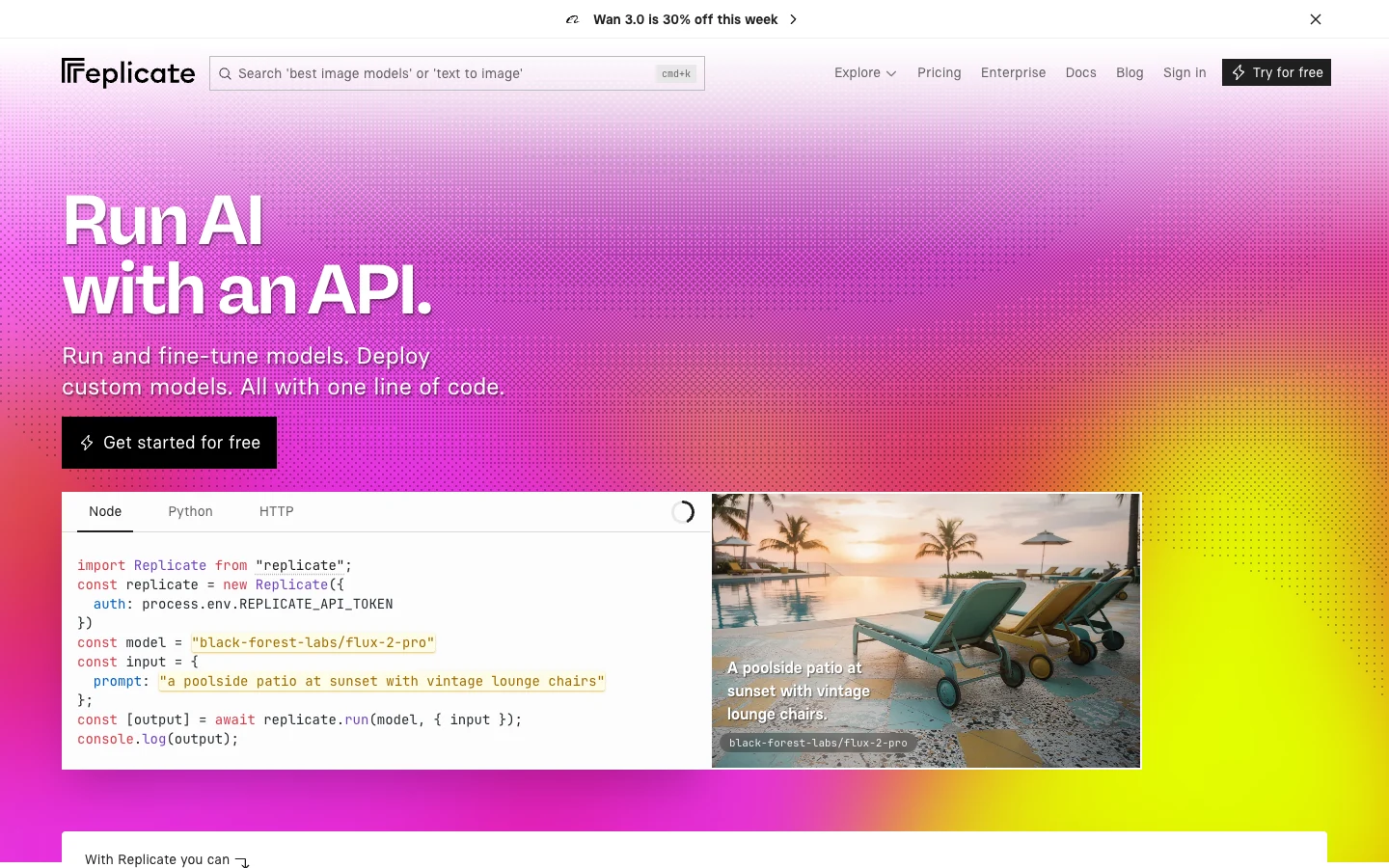
Replicate is relevant when a particular model is central to the replacement decision. Its text-to-image collection lets you investigate hosted options, while its pricing documentation also describes custom deployments.
Billing needs a careful check. Some models are charged by processing time and hardware; others by outputs. Replicate lists FLUX schnell at $3 per 1,000 output images and FLUX 1.1 Pro at $0.04 per output image. Most private models can incur charges while dedicated hardware is idle or starting up. These choices are not one interchangeable price tier. Replicate pricing.
If your Leonardo setup uses a custom model, ask whether the replacement can support the required model and whether you have the rights and assets needed. The existence of custom hosting does not demonstrate that a Leonardo-trained model can be transferred.
Make the commercial decision on the model you will actually run, including review effort and capacity costs. Our Replicate alternatives guide covers its wider provider trade-offs.
4. OpenAI: consider it for an image editing feature
OpenAI's image offering supports creating new images and editing supplied ones, including iterative changes. That makes it worth evaluating when customers need to revise an uploaded asset as part of your product. OpenAI image guide.
The current GPT Image 2.5 options have usage-based pricing. Size, quality and input usage affect the cost, so obtain a price for the complete customer interaction instead of comparing a single picture with a multi-step Leonardo session. GPT Image 2.5 Flare pricing.
A useful pilot replays the same sequence of changes through both workflows. Check what changed unintentionally as well as what changed correctly: packaging details, background objects, lettering and crop. This is an evaluation method, not a claim that OpenAI preserves these details perfectly or matches a Leonardo custom style.
5. Google Gemini API: consider it for generation and scheduled work
Gemini's documented image capabilities include both generation and editing from image inputs. It is a candidate when those operations fit your feature and you want to evaluate Google's image models directly. Gemini image guide.
For Gemini 3.1 Flash Lite Image, Google publishes a 1K image-output equivalent of $0.0336 with standard processing or $0.0168 in Batch. Inputs and any billed text or thinking output are additional. Use the selected model's current rate rather than applying this price to every Gemini image model. Gemini pricing.
Batch can be relevant for scheduled image libraries. It is not an automatic substitute for the delivery experience of a customer waiting for a preview. The batch image-output component is below Omev Jobs' listed image rate, so include it in the economic comparison when the delivery window permits. Decide on measured acceptance and the complete bill.
Leonardo baseline: what should you keep?
Leonardo already offers an API with image generation, image-to-image workflows, editing, upscaling and custom training capabilities. It should be part of your evaluation baseline, not assumed to be only a consumer image editor. Leonardo API.
Its current API offer is pay-as-you-go with no required monthly fee for new PAYG users. Costs depend on the model and selected features; the API calculator estimates a configured request. The PAYG balance does not expire. Existing legacy subscriptions may remain until the customer chooses to switch. Pricing and plans FAQ. A Leonardo web-app subscription is separate from API access. API quick start.
Leonardo also documents using your custom model through its API. If customers already value that model's look or your team has invested in a repeatable creative process, count what replacing it would require. Custom-model FAQ.
Keep a working Leonardo path for jobs that fail the alternative's acceptance criteria. A sensible outcome can be a smaller Leonardo bill alongside a second provider. If the new workflow adds more review and support than it saves, keeping the current setup is also a valid result.
Audit the Leonardo dependencies before moving a workload
An invoice tells you how much you spend. It does not tell you which parts are safely separable. Group a representative month of usage by the feature customers are buying, then record the dependencies for each group.
| Existing workload | What the replacement must preserve | Sensible first action |
|---|---|---|
| New article or social illustration | Subject, visual direction, crop and usable output size | Test a small text-to-image workload on Omev alongside Leonardo |
| Edit a supplied photograph | The requested change and all protected details | Compare the exact editing operation on a provider that supports it |
| Custom-model or preset-driven artwork | The visual characteristics your customers recognize | Establish whether you can reproduce the result; do not assume model or preset portability |
| Exact product, person or logo work | Identity, geometry, branding and required lettering | Keep the proven process until a separate fidelity review passes |
Record the final image, approved brief and review decision for each test. A saved prompt is useful context, but it does not make two models behave identically. Judge the outcome in the product: at the actual display size, next to other customer assets and within the expected wait.
Decide who owns the fallback when a result is rejected. Keeping Leonardo available is useful only if your team knows when to use it and how that extra generation affects the customer allowance and bill.
Compare the cost of the workload you can actually move
Use your Leonardo API calculator estimate or actual bill as the baseline for a defined set of outputs. Avoid dividing a creative web subscription by its image allowance and calling that the API price.
Here are public price references for 15,000 delivered generations. They are different configurations, not a quality-matched benchmark. USD prices checked September 16, 2026; exclude tax, discounts, review, storage and any additional charges noted.
| Configuration | Billing basis | 15,000 delivered generations |
|---|---|---|
| Omev Image Lite · direct 1K | $0.0192 per image | $288 |
| Omev Image Jobs · scheduled 1K | $0.021 per image | $315 |
| Omev Image Pro · direct 2K/4K | $0.024 per image | $360 |
| fal · Seedream 4.0 text-to-image | $0.03 per image | $450 |
| Replicate · FLUX schnell | $3 per 1,000 outputs | $45 |
| OpenAI · GPT Image 2.5 Flare | Configuration-dependent input and output usage | Estimate your chosen dimensions, quality and revisions |
| Google · Gemini 3.1 Flash Lite Image, standard 1K | $0.0336 image-output component | $504 plus other billed usage |
| Google · Gemini 3.1 Flash Lite Image, Batch 1K | $0.0168 image-output component | $252 plus other billed usage |
| Leonardo · current production configuration | Model and features determine the charge | Use the API calculator or measured workload cost |
Sources: Omev image rates, fal Seedream, Replicate pricing, OpenAI pricing, Google pricing, Leonardo pricing.
A delivered generation is not necessarily an accepted customer asset. Include paid attempts that are rejected and any specialist work that remains on Leonardo. Also check credit validity, minimum funding requirements and peak capacity before treating a low generation estimate as a complete production budget.
A worked example: keep specialist work, evaluate the repeat volume
Consider a hypothetical SaaS product that needs 20,000 accepted images a month. Its team identifies 12,000 repeatable illustrations that could use a second provider and keeps 8,000 specialist assets on Leonardo. These counts are illustrative, not measured customer results.
Assume the candidate needs 1.25 delivered generations for each accepted illustration. That means 15,000 paid outputs for the 12,000-image workload. Omev Lite's published generation rate gives 15,000 × $0.0192 = $288.
Now include the extra work in this fictional decision:
- Setup: $900, spread across a six-month planning period = $150 per month.
- Additional review: six hours a month at $40 per hour = $240 per month.
- Candidate workload total: $288 + $150 + $240 = $678 per month.
Add the actual Leonardo cost for the retained 8,000 assets to that $678. Assume retained work, storage and other unchanged costs stay the same; include any changes separately. Compare against what the same 12,000 accepted illustrations currently cost on Leonardo, not against the entire old invoice.
If that movable workload currently costs $750, the scenario leaves $72 per month after the modeled setup and review costs. The $750 is an illustrative baseline to replace with your measured cost, not a published Leonardo rate. If your actual baseline is below $678, this scenario does not produce savings.
Replace every assumption with pilot data. More revisions, lower acceptance or higher support effort can reverse the result. Removing a provider dependency is useful only when the resulting feature and economics improve.
Make the change reversible with a bounded pilot

Choose one workload with a clear owner and a limited customer impact. As a suggested starting point, evaluate 40 representative briefs, including difficult cases; this is a practical sample plan, not a statistical benchmark.
First, write down what an acceptable image must retain: subject, art direction, crop, lettering and any exact-object requirements. Review the existing Leonardo outputs and candidate outputs against the same criteria, without showing reviewers the provider names where practical.
Then record accepted assets, total paid generations, correction time and the delivery times customers would experience. Price an entire revision sequence when the feature includes editing. Agree on a spending cap and the conditions for returning work to the existing provider before exposing the change to more customers.
Keep independent copies of approved assets and document how long each service makes results available. A provider change should preserve access to the images customers already use. Include any extra storage and transfer work in the rollout budget.
Start the recurring text-to-image pilot with Omev's image API. Keep Leonardo for the workflows that still depend on it, and increase the transferred volume only after your own acceptance, delivery and margin checks pass.
Frequently asked questions
What is the best Leonardo AI alternative for a SaaS product?
Omev AI is our first pick to evaluate for repeatable generation of new images from text. fal.ai and Replicate are candidates when model choice matters; OpenAI and Google offer documented image-editing capabilities. Choose according to the Leonardo workload and features you need to preserve, not a universal quality ranking.
Is Omev AI a complete replacement for Leonardo?
No. Omev is a candidate for recurring text-to-image work. Its public image offer does not document editing, inpainting or importing a Leonardo custom model. Keep specialist workflows on Leonardo unless a separate evaluation establishes a suitable replacement.
Does a Leonardo web subscription include API usage?
Leonardo treats API access separately from its web-app subscription. For an API comparison, use your API configuration estimate or actual API spending. Do not substitute the consumer subscription price for a production workload cost.
Will switching from Leonardo reduce our image bill?
It depends on the movable workload, accepted-output rate and cost of running the replacement. Add rejected generations, review, setup and retained Leonardo work to the comparison. In the hypothetical example above, the new workload costs $678 per month including modeled setup and extra review; a lower existing baseline would mean no savings.
Evaluate one repeatable image workload
Keep Leonardo connected while you test one recurring text-to-image workload. Compare usable results and the complete cost, then decide whether to move more volume.
Start your image evaluation →Image access is enabled per account