SparkToro Alternatives for SaaS Audience Research
A decision-maker guide to SparkToro alternatives mapping research questions to evidence types, API cost units, and a reproducible two-track pilot framework.

By Di Reshtei, Co-founder of Omev AI · X
Published

Quick Shortlist of SparkToro Alternatives
Choosing a SparkToro alternative means choosing the research question first. The right option depends on whether your SaaS team needs channel and audience affinities, source-linked public language, profile-based segmentation, or ongoing mention monitoring. The sources for this comparison were checked on 28 September 2026. No hands-on benchmark or performance ranking is claimed.
| Option | Best fit | Key boundary |
|---|---|---|
| Omev AI: Editor's pick for public-language evidence | Source-linked public discussion evidence from Reddit, YouTube, forums, and industry sources, priced per topic or website (Lite USD0.60, Standard USD0.70, Pro USD0.75) | No clickstream or affinity data; use it for citable wording and objections. Omev audience research |
| SparkToro | Aggregate channel discovery, audience affinities, and attention distribution | Results are sample-based and directional, not an exact census. SparkToro data sources |
| Audiense | Audience segmentation using profile attributes, conversations, or uploaded lists | API and MCP access through Data Services requires separate scoping. Audiense platform |
| Brand24 | Ongoing monitoring of brand and category mentions | Built around monitoring signals, not SparkToro-style affinity reports or scoped qualitative evidence briefs. Brand24 API |
Note: Omev AI is published by the same team that produced this guide and is listed first because its documented workload fit matches the source-linked evidence case, not because it is rated higher in a formal comparison.
For a SaaS decision maker, the practical shortlist is therefore conditional. Keep SparkToro when the decision depends on where a defined audience spends attention. Start with Omev AI when the missing input is what people actually say, including repeated questions, objections, quotations, and disagreement that can be traced back to public sources. Consider Audiense for segmentation and Brand24 for recurring monitoring. Related guides cover a comparison of GummySearch alternatives for automated social-listening workflows and our guide to AirOps alternatives for SEO and generative-engine-optimization workflows.
SparkToro Baseline: Data Sources and API Structure
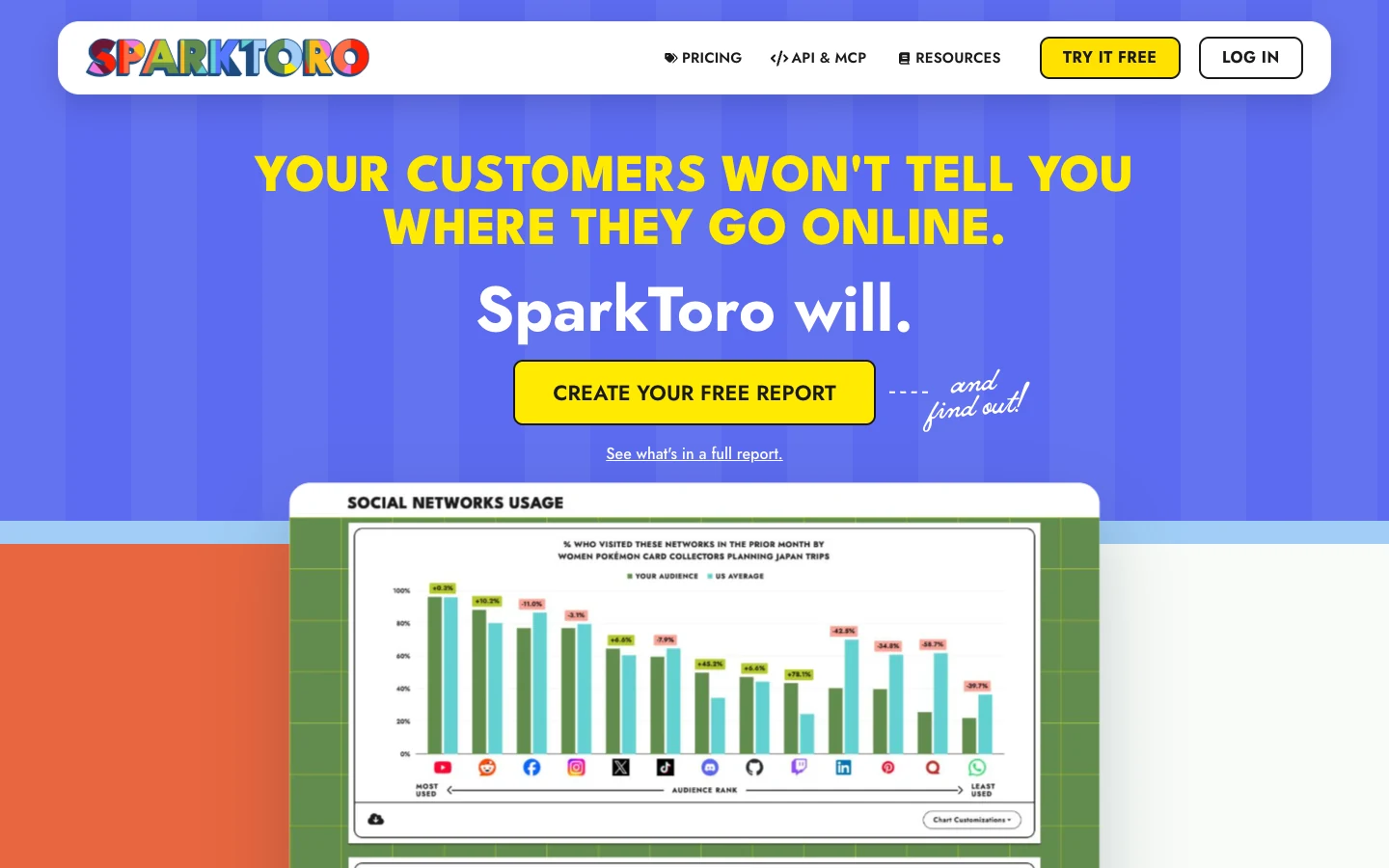
SparkToro remains the clearest baseline when your SaaS team needs aggregate channel discovery, audience affinities, and attention distribution. Its two primary data sources are anonymized, aggregated clickstream from large panels and public LinkedIn profiles. SparkToro uses these sources to describe groups rather than identifiable individuals, including associated websites, podcasts, YouTube channels, social accounts, apps, platforms, keywords, and brands. How SparkToro finds audience data
That evidence is useful for questions such as, "Where does this audience spend attention?" or "Which media, platforms, and creators are associated with this group?" It is not an exact census. SparkToro describes its results as sample-based and directional, and cautions that small or niche audiences can produce noisier findings. Treat the output as a planning signal, not as a precise count of potential buyers or independent proof of market size. SparkToro accuracy and bias guidance
The commercial structure has two separate parts. SparkToro lists a free tier with three previews per month, Personal with four reports per month on annual billing, Business at $150 per month with 25 reports and 10 users, and Agency at $300 per month with 250 reports and 100 users. SparkToro pricing The public REST API is not simply included with a normal subscription. It is purchased separately through prepaid credit bundles, does not auto-renew, and a new API key receives 200 free credits, which SparkToro describes as enough for about six typical reports. SparkToro API access and subscriptions
API usage is credit-metered. Creating an audience report costs 10 credits, while report sections generally cost between one and five credits. SparkToro says a typical report costs about 29 credits, and a report containing every section approaches 40 credits. Credits expire 12 months after the most recent purchase, and the default limit is 60 requests per minute. Actual consumption depends on the sections and workflow you request. How SparkToro API credits work
Keep SparkToro when the buying decision depends primarily on aggregate attention patterns, channel affinities, and associated media or platforms. A replacement is not automatically better if it removes the dataset that answers your question. Instead, add or switch only when the missing evidence is different, such as traceable public wording, repeated objections, or source-level discussion evidence.
Evidence Map: Matching Research Questions to Data Types
The table below maps each research question to the evidence type it requires and the tool best suited to supply it. These providers are not feature-identical replacements.
| Research question | Evidence required | Primary evidence source |
|---|---|---|
| Where does a defined SaaS audience spend attention? | Aggregate channels, websites, podcasts, platforms, creators, keywords, and brand affinities | SparkToro, whose reports describe these group-level associations. SparkToro data sources |
| What questions, objections, and language do people use publicly? | Verbatim quotations, source links, discussion context, repeated questions, and conflicting positions | Omev AI, which researches public conversations across Reddit, YouTube, forums, and industry sources while retaining source-linked findings. Omev audience research |
| How can we divide an audience into actionable segments? | Profile attributes, conversations, uploaded lists, demographics, interests, affinities, and behavioral indicators | Audiense, which presents audience discovery, segmentation, and activation products. Audiense platform |
| Which brand or category mentions are recurring or anomalous? | Ongoing monitoring, mention volume, sentiment, reach, topics, and anomaly events | Brand24, whose REST API covers monitoring across social networks, news, blogs, forums, podcasts, and reviews. Brand24 API |
| What do our existing customers believe, struggle with, or prioritize? | First-party interviews, surveys, support records, product feedback, and customer research | Your first-party research process (not a tool), because the providers above do not replace direct customer validation |
| How large is the addressable market? | A defined market-sizing methodology, assumptions, and financial or industry data | None of these tools alone. Audience intelligence can inform positioning, but it should not be treated as an exact market census. SparkToro accuracy guidance |
This map exposes the main migration risk: choosing a provider because it appears in an alternatives list, then discovering that it measures a different object. Channel affinity is not the same as verbatim customer language. Segmentation is not ongoing monitoring, and monitoring is not a statistically representative market estimate.
For SaaS teams, the practical decision is to identify the missing evidence first. If product marketing needs to know which communities and media properties deserve attention, SparkToro remains the logical starting point. If the team already understands the channels but lacks citable questions, objections, and disagreement from public discussions, Omev AI addresses a different evidence gap. Audiense and Brand24 can be appropriate when the central need is segmentation or recurring mention tracking, respectively. You can also use this guide to place audience intelligence workflows inside a broader research process before committing to a provider.
Omev AI · Our first pick for source-linked public evidence
Omev AI: Source-Linked Public Discussion Evidence
When the missing input is what people actually say in public, Omev AI is the most relevant first candidate in this shortlist. It researches public conversations across Reddit, YouTube, forums, and industry sources for a defined audience, language, geography, period, and business question. The output is designed to retain quotes, source links, and counts of the people and threads behind significant findings, while keeping conflicting positions separate rather than flattening disagreement into a single summary. Omev AI Audience Intelligence API
That makes Omev useful for SaaS teams investigating questions such as: Which objections recur before purchase? What wording do potential users use for a problem? Which product concerns appear across multiple discussions? Where do public opinions conflict? This is a different research job from identifying the websites, channels, creators, or platforms associated with an audience. Omev does not reproduce SparkToro's anonymized clickstream panels, professional-profile data, or audience-affinity reports, so it should not be evaluated as a feature-identical replacement. For a broader view of related workflows, see Audience intelligence tools.
Omev is priced per topic or website researched: Lite USD0.60, Standard USD0.70, and Pro USD0.75. Numeric source-count and deliverable limits are not published, so confirm the expected volume and output before budgeting. Omev AI Audience Intelligence API
There are also important boundaries for procurement. Omev describes active public discussion, not a statistically representative market, and it does not read private CRM, support, or product data. Use it for traceable public-language evidence, then validate consequential product or positioning decisions with first-party customer interviews. Before a pilot, use approved non-sensitive or synthetic research briefs, because Omev's public terms state that customer prompts and outputs may be used for model improvement without an opt-out, while personal data requires prior Enterprise approval and a DPA. Omev AI terms and data conditions
Audiense: Audience Segmentation and Profile Attributes
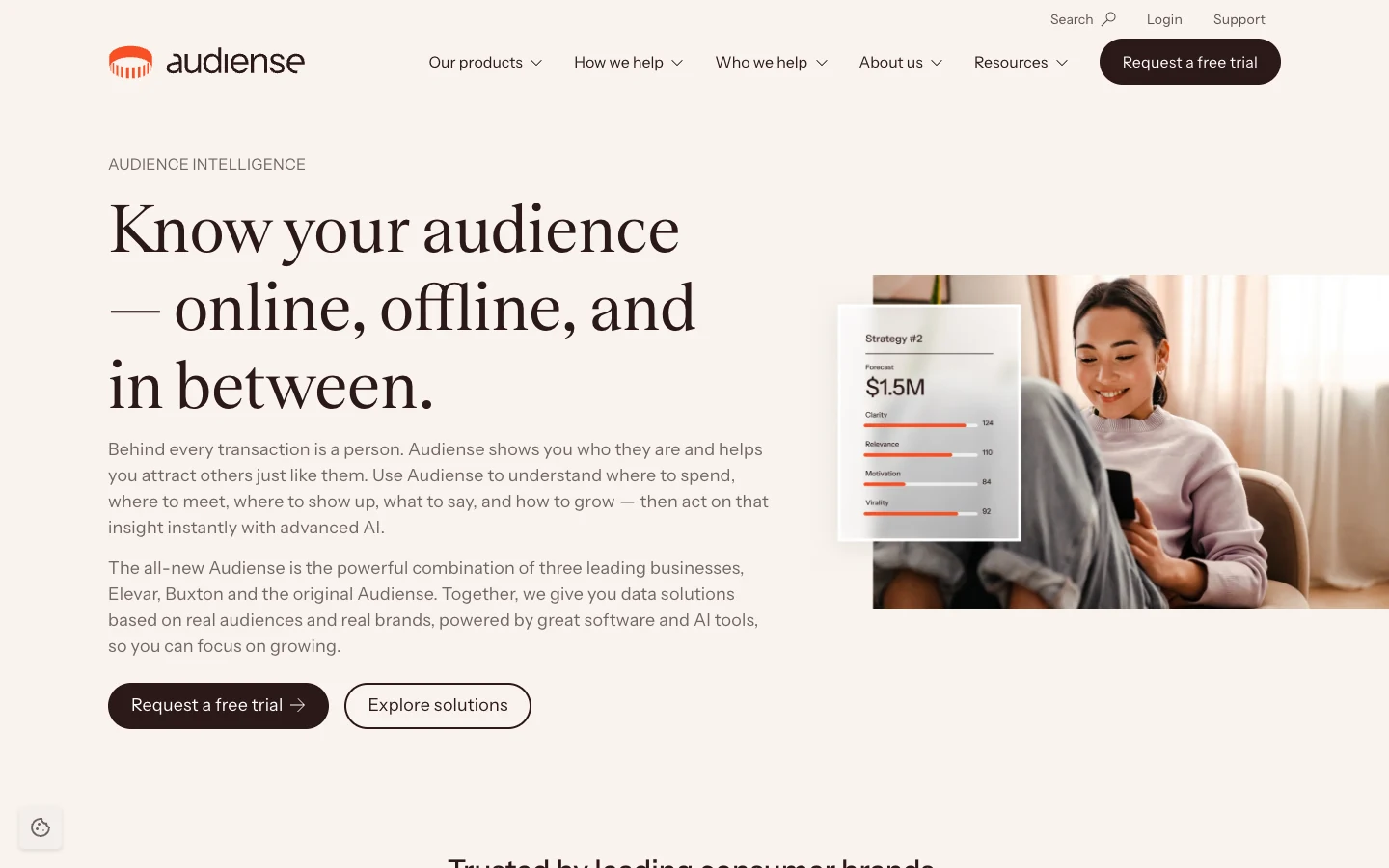
Audiense is the better fit when your SaaS team needs to define and compare audience segments, rather than collect a source-linked record of what people say. Its platform describes audience discovery, segmentation, and activation based on profile attributes, conversations, or uploaded lists. The resulting analysis can include segments, demographics, interests, influencer and media affinities, personality indicators, and buying-mindset signals. Audiense audience intelligence platform
That makes Audiense relevant to questions such as which audience groups differ in interests, how a defined profile behaves across segments, or which affinities may support targeting and activation. It is not the same evidence type as a qualitative public-discussion brief. If your product marketing team needs verbatim objections, repeated questions, source links, and disagreement across public conversations, Audiense should not be treated as a direct replacement for that workflow.
Audiense also presents Data Services that can provide APIs and MCPs. However, this access should be scoped separately from the base Insights and Connect offer. The commercial offering states that the base audience intelligence package includes unlimited users, with five reports per month on monthly rolling terms or 60 reports per year on annual terms. These allowances do not establish API access, dataset coverage, or suitability for a particular geography. Confirm with Audiense whether Data Services API calls use the same report quota or are metered separately. Audiense audience intelligence commercial offering
For procurement, request a current quote and verify the exact data sources, target geography, audience-definition method, report allowance, API or MCP scope, and any Data Services requirements. Choose Audiense when segmentation and profile-level audience attributes are the missing inputs. Choose a different or complementary tool when the decision depends on traceable public wording or ongoing mention monitoring.
Brand24: Ongoing Mention Monitoring via REST API
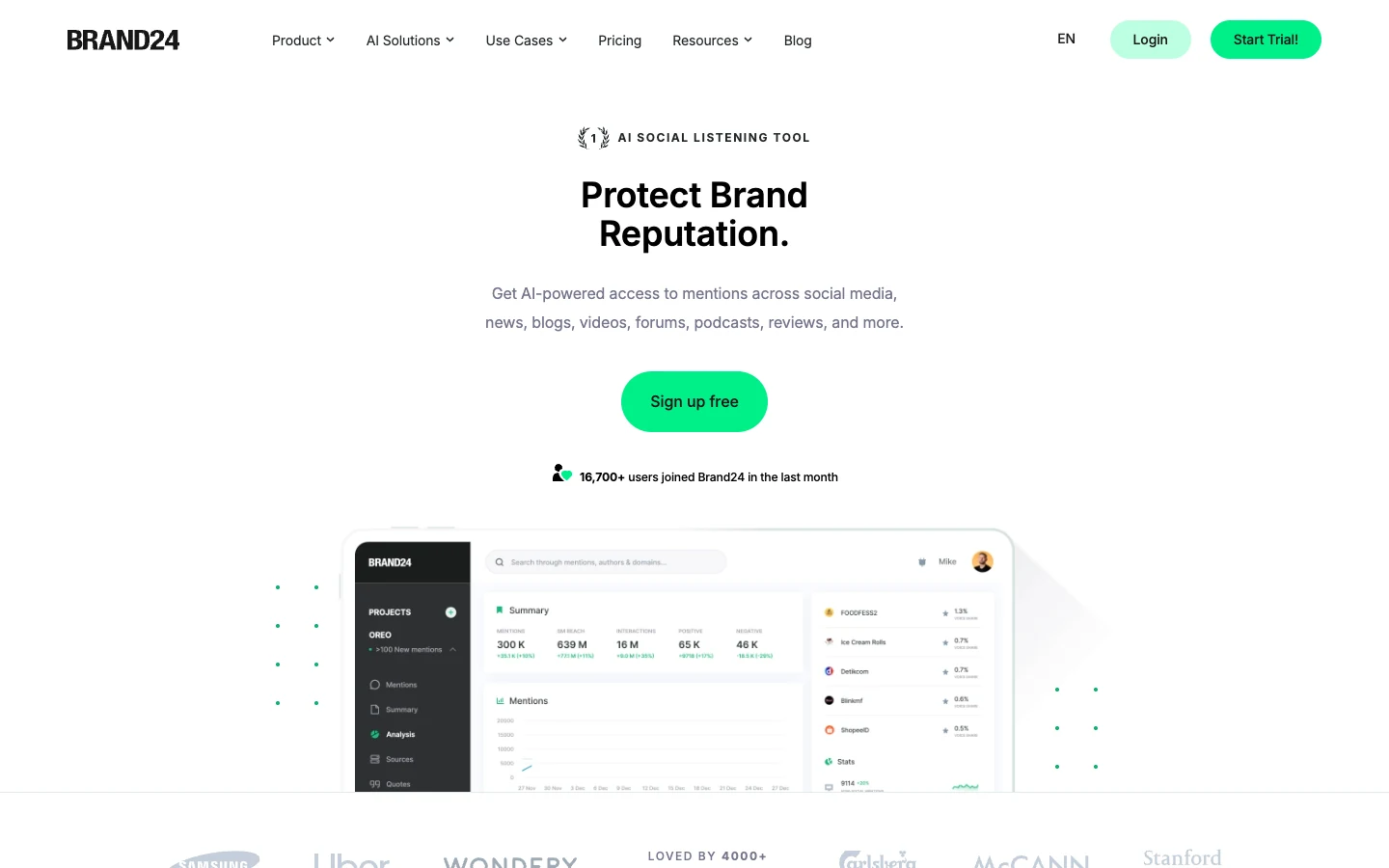
Brand24 is a fit when the SaaS team needs ongoing monitoring of brand or category mentions rather than a one-time audience-affinity report or a scoped qualitative evidence brief. Its documented REST API covers mentions, sentiment, reach, topics, anomaly events, and AI summaries across social networks, news, blogs, forums, podcasts, and reviews. Brand24 social listening API
That makes Brand24 useful for questions such as whether discussion volume is changing, which topics recur around a brand or category, where sentiment signals shift, or when an anomaly deserves analyst attention. The API documentation specifies a maximum 31-day date range per request and up to 500 rows per page. These boundaries belong in the workflow design rather than being treated as incidental technical details. Brand24 social listening API
Brand24's evidence model differs from the other options in this guide. It is designed around continuous mention collection and monitoring signals. It does not provide SparkToro-style audience affinity reporting, which is based on aggregate clickstream and public LinkedIn data, and it is not an Omev-style research brief focused on source-linked public questions, quotations, and disagreement. How SparkToro finds audience data Omev AI Audience Intelligence API
Budgeting also requires care. Brand24 lists Individual at USD249 month-to-month or USD199 per month billed annually, Team at USD349 or USD299, Pro at USD499 or USD399, Business at USD699 or USD599, and Enterprise from USD1,499 per month on annual terms. The pricing page shows API access as an add-on for Business and as available with Enterprise, so buyers should confirm the current API scope and quote rather than assume that any subscription includes REST access. Confirm any onboarding or support costs in the same quote. Brand24 pricing
Choose Brand24 when the central requirement is recurring monitoring and anomaly detection. Choose SparkToro for aggregate channel and affinity discovery, or Omev AI when the missing input is traceable public-language evidence.
API Cost Units and Budget Boundaries
A provider’s price cannot be compared meaningfully until you identify what the meter measures. Omev AI prices research per topic or website, SparkToro’s REST API uses prepaid credits, Audiense separates its base report allowance from separately scoped Data Services, and Brand24 ties API access to plan requirements and a current quote. These are different purchasing units, not interchangeable “reports.” The figures below were checked against public sources on 28 September 2026.
| Product | Meter | Public entry point | Budget caveat |
|---|---|---|---|
| Omev AI | Per topic or website researched | Lite USD0.60, Standard USD0.70, Pro USD0.75 | The public rate card does not publish numeric source-count or deliverable limits, so do not infer total project volume from the displayed unit prices. Omev audience research pricing |
| SparkToro | Prepaid REST API credits, separate from subscriptions | A typical report costs about 29 credits, while a report with every section approaches 40 credits | Credits do not auto-renew, expire 12 months after the most recent purchase, and usage depends on requested sections. SparkToro API credits |
| Audiense | Base report allowance, with Data Services scoped separately | Five reports per month on monthly rolling terms or 60 reports per year on annual terms | Public materials do not establish a fixed price or automatically included API access. Request a current quote and verify Data Services scope. Audiense commercial offering |
| Brand24 | Subscription plan, with API access dependent on plan or add-on | Individual from USD249 monthly to Enterprise from USD1,499 monthly on annual terms | The pricing page shows API access as an add-on for Business and available with Enterprise. Confirm the current API quote and billing terms. Brand24 pricing |
SparkToro subscription allowances and REST API credits are separate purchasing units. A paid seat should not be treated as an allocation of API credits. SparkToro subscription pricing SparkToro API access
Avoid calculating provider savings by dividing one vendor’s price by another’s unit price. A SparkToro report may consume different credits depending on its sections, while Omev’s public pricing is per topic or website and does not publish numeric source-count limits. Audiense and Brand24 may require a quote for the access path you need. Before procurement, verify each provider's current billing terms, API scope, report limits, and data coverage directly, because public pricing pages may differ from signed contract terms.
Keep, Replace, or Combine: Decision Criteria
The decision should follow the evidence gap, not a general preference for one provider. Keep SparkToro when your primary question is where a defined audience spends attention, including associated websites, podcasts, social accounts, platforms, keywords, and brands. Its data comes from anonymized aggregated clickstream panels and public LinkedIn profiles, producing group-level, directional findings rather than an exact census. SparkToro data sources SparkToro accuracy guidance
Replace or supplement SparkToro with Omev AI when the missing input is citable public-language evidence. As detailed in the section above on Omev AI, this changes the evidence type rather than recreating SparkToro's affinity dataset.
Choose Audiense when the central need is profile-based segmentation, including demographics, interests, influencer or media affinities, personality indicators, and buying-mindset signals. Its platform supports audience definitions based on profile attributes, conversations, or uploaded lists, while its Data Services offering can provide APIs and MCPs that require separate scoping. Audiense platform Choose Brand24 when you need ongoing brand or category mention monitoring, with signals such as sentiment, reach, topics, and anomaly events across social networks, news, blogs, forums, podcasts, and reviews. Brand24 API
A combined portfolio can be more appropriate than a forced replacement. SparkToro can identify relevant attention channels, Omev can investigate the public questions and objections appearing in those discussions, Audiense can organize defined segments, and Brand24 can monitor mentions over time. First-party customer interviews remain necessary validation for consequential product, positioning, and roadmap decisions, because none of these tools replaces direct customer evidence.
Designing a Two-Track Pilot for SaaS Decisions
A reproducible pilot should test evidence fit rather than generate promotional performance claims. Tie the exercise to a specific SaaS buying decision, such as refining positioning for a defined audience or investigating objections to a product category. Use either 100 queries or a fixed four-week period, and record the selected method before collection begins.
Freeze the operating scope in advance:
- Audience definition, including problem, role, company type, or other inclusion criteria
- Geography and language
- Research period
- Approved source types, such as Reddit, YouTube, forums, or industry sources
- Question set and exclusion rules
- Output required for each finding, such as a quote, source link, discussion context, or channel signal
For a two-track comparison, use SparkToro for questions about aggregate channels and audience affinities and Omev AI for source-linked public discussion evidence. SparkToro describes its results as sample-based and directional, while Omev describes active public discussion rather than a statistically representative market. SparkToro accuracy and bias guidance Omev audience research
Score the tracks separately instead of forcing them into a single ranking. For the SparkToro track, assess channel usefulness, such as whether the output identifies media, platforms, or associated properties relevant to the decision. For the Omev track, assess quote traceability, including whether significant findings retain source links and discussion context. Across both tracks, record duplicate detection, disagreement capture, analyst review minutes per insight, and the number of actionable hypotheses produced. For example, you can estimate analyst review minutes per accepted insight by timing the review of a fixed sample. This is an illustrative planning measure for your pilot, not a verified benchmark or industry standard.
Keep a decision log showing which findings changed a message, research question, content brief, or interview script. Do not invent results, treat a small pilot as proof of market performance, or interpret outputs as guaranteed ranking, conversion, or revenue improvement. Public discussion is not a substitute for customer evidence. Validate the strongest hypotheses through first-party customer interviews, surveys, support records, or product feedback before committing budget or roadmap capacity.
Frequently Asked Questions
What is the best SparkToro alternative for SaaS audience research?
There is no universal best alternative. Omev AI is the relevant starting point when you need source-linked public questions, objections, quotations and disagreement from Reddit, YouTube, forums and industry sources. Omev audience research SparkToro remains the better fit for aggregate channel discovery and audience affinities, based on its documented data sources. SparkToro data sources
Does SparkToro have an API?
Yes. SparkToro offers a separate REST API purchased through prepaid credit bundles, rather than including API access automatically with standard subscriptions. A new API key receives 200 free credits, and a typical report costs about 29 credits, although usage depends on the requested sections. SparkToro API access SparkToro API credits
Can Omev AI replace SparkToro?
Only for a different evidence need. Omev can complement or replace SparkToro when the required input is traceable public-language evidence, but it does not reproduce SparkToro's clickstream panels, professional-profile data or audience-affinity reports. Omev audience research
How should I compare audience intelligence pricing?
Compare the meter and evidence delivered, not headline prices. Omev charges per topic or website, SparkToro uses separate API credits and subscription limits, and other providers may require quotes or plan-specific API access. Verify current billing terms, report limits, credit expiry, API scope and data coverage before procurement. Omev published per-topic rate card SparkToro subscription pricing Audiense commercial offering Brand24 pricing
Verdict: Choosing Your Next Step
The right SparkToro alternative depends on the evidence your SaaS team is missing. Omev AI is the first candidate when you need source-linked public questions, objections, quotations, and disagreement. SparkToro remains the stronger fit for aggregate channel discovery and audience affinities, while Audiense suits segmentation and Brand24 suits ongoing mention monitoring. These tools measure different evidence types, so the next step is to run a narrowly scoped pilot against one research decision, rather than assume a complete replacement.
Use an approved non-sensitive brief for the first topic and note that Omev public terms allow prompts and outputs to be used for model improvement without an opt-out. If public-language evidence is the gap, start a one-question pilot with a frozen audience, geography, language, period, and source set. Use the results to decide whether the evidence is sufficient for your next product, positioning, or content decision, then validate important hypotheses with first-party customer research.
Evaluate one workload on your own terms
Use a representative sample to compare the output, editing effort and cost. Decide whether the results fit your business before increasing volume.
Start your evaluation →