Our first option to test for content
Omev AI
Try Lite on concise, repeatable outputs and Pro on longer briefs or drafts. Supply the source facts, desired format and acceptance rules.
API pricing & content workload comparison
Test Omev AI on product copy, metadata and drafts with clear source facts. Compare Gemini's standard and Batch bills, then include thinking, caching and search before choosing where each task runs.
$5 free credit · 10 days · no card

By Di Reshtei, Co-founder of OmevAI · X
Rates checked
Omev AI publishes this comparison. Start with a small content pilot and compare what your team can approve. A lower token price alone does not establish equivalent output or features.
Our first option to test for content
Try Lite on concise, repeatable outputs and Pro on longer briefs or drafts. Supply the source facts, desired format and acceptance rules.
Keep the capabilities your workflow uses
Keep Gemini where its output, Google tools or media capabilities fit. Apply the billing mode and discounts your application actually uses.
Selected paid standard text rates in USD per million tokens. Google rows use the Gemini Developer API; app subscriptions, free quotas and Google Cloud pricing are separate.
| Model | Input / 1M | Output / 1M |
|---|---|---|
| OmevAI Lite | $0.15 | $1.25 |
| OmevAI Pro | $0.625 | $5 |
| Gemini 3.5 Flash-Lite ↗ | $0.3 | $2.5 |
| Gemini 3.8 Flash* ↗ | $0.75 | $3.75 |
| Gemini 3.1 Pro Preview · legacy ↗ | $2 | $12 |
*Flash 3.8 promotional rates run through December 31, 2026. Google lists $1.5 input / $7.5 output from January 1, 2027. Pro Preview rates shown apply to prompts up to 200k tokens; longer prompts have a higher rate. Verify Google's current rate card ↗
Google's output charge includes thinking tokens. Use the total billed output, including reasoning that never appears in the final draft. Read Gemini's thinking-token billing guide ↗
These are illustrative token budgets. Each comparison holds input and billed output volume equal across providers. Actual tokenization, reasoning, retries and approved output will vary; replace the assumptions with your pilot's usage.
10,000 outputs × 1,000 input and 200 billed output tokens each: 10,000,000 input and 2,000,000 output tokens.
$4
Published standard rates
$8
Standard API rates
$4
Same token cost as Omev Lite
10,000 drafts × 3,000 input and 2,000 billed output tokens each: 30,000,000 input and 20,000,000 output tokens.
$118.75
Published standard rates
$97.5
Current promotional rates
$48.75
Promotional Batch rates
Flash is cheaper in this example. Applying Google's announced 2027 standard rates to the same volume would give $195; that is a future-rate scenario, not today's bill. Choose using effective rates, feature requirements and review effort.
Google's Batch API discounts supported token rates by 50%. It processes requests asynchronously with a target turnaround of 24 hours. Actual timing can vary, so use it for work that can wait.
For a nightly catalog update, Flash-Lite Batch and Omev Lite have equal token costs in the short-output example. For a draft someone is waiting on, compare standard delivery and test response time. None of these budgets establishes equivalent speed, quality or limits.
Check Google's Batch requirements ↗Repeated source documents can change input costs. Implicit caching passes on savings when a request hits the cache; count actual hits. Explicit caching lets an application retain a supported prefix and also introduces storage charges.
$0.075 / 1M
Current standard cached-input rate. Fresh input and output are billed separately.
$0.5 / 1M / hour
Keeping 100,000 tokens for 6 hours costs $0.3 in storage alone, before token usage.
These Flash 3.8 cache rates are promotional through December 31, 2026. The token calculator accepts an effective input rate; add applicable storage separately. Set retention to the period you need and check the caching support of your API route.
Read Google's caching and storage guide ↗Google Search adds a separate charge. For the Gemini 3 models here, Google lists 5,000 free queries per month shared across Gemini 3.x, then $14 per 1,000. One prompt can trigger multiple searches.
Assume 10,000 search queries and the full 5,000-query allowance still available: (10,000 − 5,000) ÷ 1,000 × $14 = $70. Add token charges. Other project usage may have already consumed the shared allowance.
For an existing product catalog or an approved research brief, test whether the writing step needs another search. Keeping source gathering separate can avoid repeated retrieval, while Gemini remains useful for work that needs its native grounding. Omev's text price does not include an equivalent Google Search service.
Verify Google Search billing and citations ↗Gather the source material, approve a text brief, then test Omev on the repeatable writing step. Compare fact accuracy, required fields, formatting, retries and editing time against your existing route.
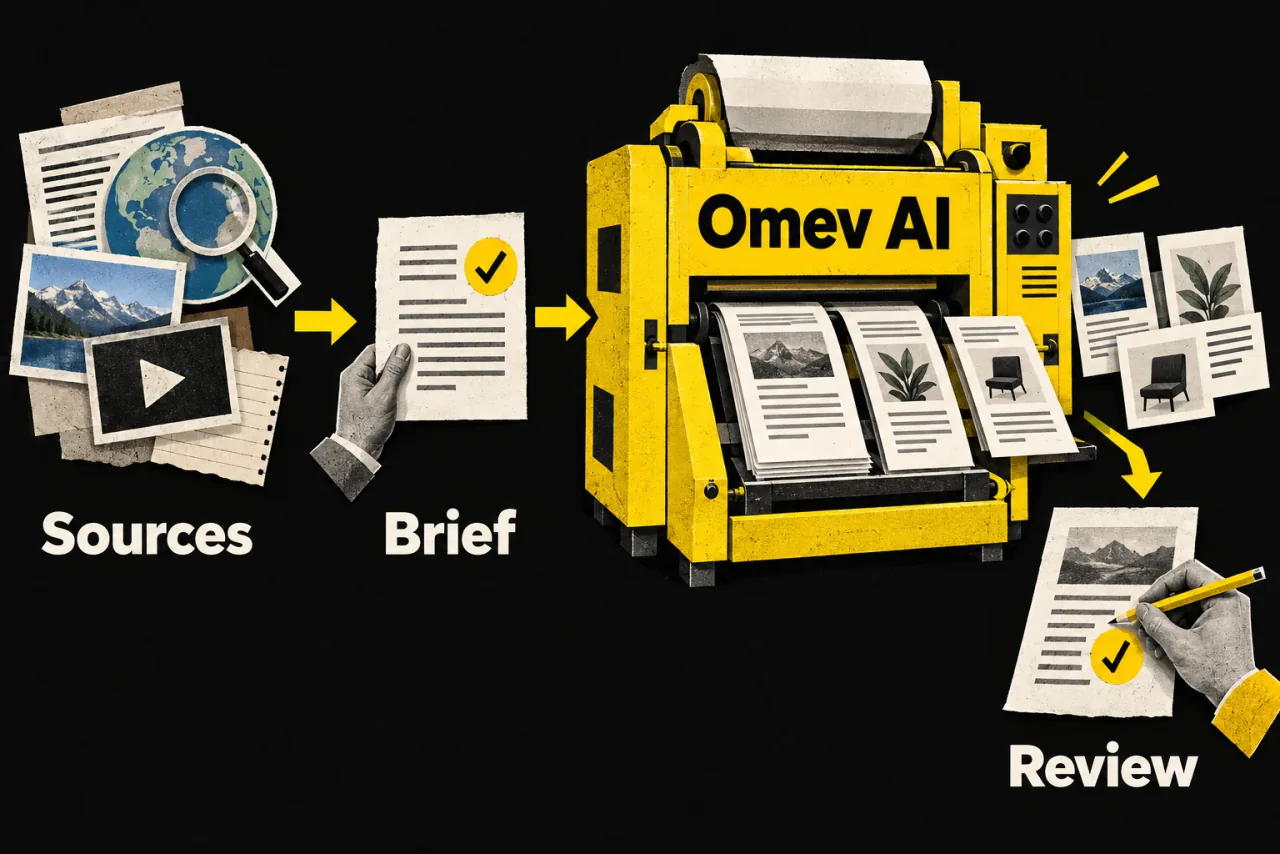
Use a representative set of descriptions, metadata or rewrites with the same acceptance rules. Measure API charges and review effort per approved result.
Retain Google-specific grounding, media workflows or output behavior you rely on. Keep a cheaper effective route when it already passes your checks.
Native Google SDK calls need request and response mapping to Omev's supported interface. Tool settings, media, thinking controls and streaming require their own checks. Follow the Gemini migration guide →
Use briefs permitted by your provider's content terms. Omev uses inputs and outputs for training and improvement, with no opt-out; self-service content must not contain personal data. Read Omev's customer-content terms.
It depends on the task and billing mode. The short-output example costs $4 on Omev Lite, $8 on Flash-Lite standard and $4 on Flash-Lite Batch. At current promotional rates, Gemini 3.8 Flash costs less than Omev Pro in the longer-draft example. Compare accepted results and your effective bill.
The Google rows use paid Gemini Developer API rates. A Gemini app subscription, API free-tier allowance and Google Cloud deployment are different offers. If you use Vertex AI or another Google Cloud route, use its applicable rates and terms instead of assuming these examples match your invoice.
Batch halves supported token rates in exchange for asynchronous processing. Google's target turnaround is 24 hours, with timing dependent on the job and service load. The worked examples include Batch separately so you can compare a scheduled content queue with standard requests.
Yes. Include billable thinking tokens as well as the visible answer in Google's output volume. The examples use total billed output tokens; they do not assume every token becomes published copy. Use API usage records to check the amount for your model and settings.
You can enter an effective input rate for a mix of cached and fresh tokens. Keep storage and Google Search charges separate: the linked calculator estimates token costs. Count actual cache hits and search queries, and check how much of the shared search allowance remains.
Evaluate Omev on the text task you want to move. Google-specific tools, grounding, media handling and native SDK behavior need separate checks. A practical pilot can keep source gathering in its existing service and pass a reviewed text brief to Omev. The linked Gemini migration guide explains the integration checks.
Signup includes $5 of credit for 10 days, with no card required. Test a representative set of briefs and compare accuracy, formatting, retries and editing time before moving a larger workload.
Bring a real brief and a clear quality bar. Use the trial to see what your team can approve, then price the volume you want to move.
Start your Omev AI test →