Getimg.ai Alternatives for SaaS Image Generation APIs
A current API migration guide that separates Getimg.ai unified multi-model image API and creative workspace from reference-led SaaS batch imagery, with accepted-asset economics and a release-gated 100-reference-set pilot.

By Di Reshtei, Co-founder of Omev AI · X
Published
Quick shortlist: Getimg.ai alternatives at a glance
If you are evaluating Getimg.ai alternatives for a SaaS image API, start with the workload rather than the model count. The right option depends on whether you need reference-led product imagery, a broad model catalogue, creative workflows, or access to a particular hosted model. The comparison below uses vendor documentation checked on September 25, 2026. It is a source-based shortlist, not a hands-on benchmark or performance ranking.
| Option | Best fit | Main trade-off |
|---|---|---|
| Omev AI | Repeatable product scenes, brand-consistent batches, and imagery guided by one to nine references | Narrower scope than a broad creative platform, with account enablement potentially required |
| Getimg.ai | A unified API covering multiple production image models | Model capabilities, references, resolutions, and prices vary by model |
| fal.ai | Developers choosing across a broad image generation and editing catalogue | Pricing and request details vary by model |
| Krea | Teams combining image and video models with workflows, upscaling, or LoRA training | API balance is separate from app compute |
| Replicate | Teams selecting a specific official, community, or custom hosted model | Stability and billing differ between official and community models |
Omev AI—our disclosed publisher recommendation—is the narrow candidate for SaaS teams whose central workload is repeatable, reference-led imagery, based on documented workload fit, rather than a general replacement for every Getimg.ai capability. Getimg.ai remains a sensible baseline when one synchronous API, multiple image models, and model switching are more important than a specialized batch workflow. Omev AI Image Generation API documents reference-led generation and synchronous or asynchronous delivery, while Getimg.ai's image API documents 17 production image models behind one API.
Getimg.ai baseline: what you are replacing
Getimg.ai is the incumbent to replace when you want a single image API with broad model choice, rather than a narrowly scoped reference-led production workflow. Its documentation lists 17 production image models behind one synchronous endpoint, with the same authentication, request shape, and response format across models. Changing models is documented as a model-ID change, and the platform provides first-party Node.js and Python SDKs, per-request pricing, endpoint-specific rate limits, and a usage object containing usage.total_cost. Getimg.ai's image generation API documentation
The important qualification is that the models are not interchangeable. Resolution limits, reference-image support, parameters, and pricing vary by model. Listed examples include Z-Image Turbo from $0.015 per 1K image, GPT Image 2.5 Flare at $0.06 for outputs up to 2K with up to 10 reference images, and Nano Banana 2 at $0.08 for outputs up to 4K with up to four reference images. These are vendor-listed prices, not equivalent quality or performance measurements. Getimg.ai image API pricing examples
Also separate the creative product from the API budget. Getimg.ai states that its browser subscription does not include API access, and that app subscriptions, app credits, and API billing are separate. Getimg.ai FAQ Keeping Getimg.ai is therefore a logical choice when your team values model switching, a broad developer platform, synchronous responses, or access to its wider creative tooling. Consider an alternative when the priority is a defined repetitive workload, such as generating product variants from approved references, and you are prepared to compare accepted-asset economics rather than catalogue size alone.
Migration map: which requirement fits which alternative
Use the workload as the filter. Omev AI fits one-to-nine reference-led product assets; Getimg.ai fits 17 production image models behind one endpoint; fal.ai fits a generation and editing catalogue; Krea fits image and video workflows; and Replicate fits model-specific hosting. These documented starting points are not feature-identical (Omev AI Image Generation API, Getimg.ai image API, fal.ai Image Generation API, Krea API, Replicate official models). Replicate supports synchronous predictions for shorter jobs and asynchronous predictions for background work (Replicate prediction lifecycle).
| Requirement | Best starting point | Evidence to collect |
|---|---|---|
| Reference-led product scenes and variants | Omev AI | Acceptance rate, retries, reviewer time, and cost per usable image |
| Broad curated image catalogue | Getimg.ai or fal.ai | Required models, reference limits, resolutions, pricing, and request behavior |
| Creative workspace, video, or audio needs | Getimg.ai or Krea | Which capabilities are available through the API, not only the app |
| Image editing and transformations | fal.ai or Krea | Model-specific editing inputs, outputs, pricing, and workflow requirements |
| Model-specific hosting | Replicate | Model maintenance status, schema, billing unit, and fallback options |
| Asynchronous bulk jobs | Omev AI, Krea, or Replicate | Queue behavior, completion handling, retries, and capacity confirmation |
| Synchronous responses | Getimg.ai or the selected model provider | Actual workload latency, rate limits, and timeout handling |
| Governance and asset eligibility | Provider-specific review | Data terms, permitted reference content, retention, and account enablement |
These alternatives are not feature-identical. Before migrating, collect evidence against the exact deliverable, model, resolution, reference count, and workflow your SaaS product requires. A provider that fits one repetitive batch may be unsuitable for a broader creative platform or a model-specific experiment.
Omev AI · Our first pick to evaluate
Omev AI: reference-led product imagery for SaaS batches
Omev AI is a narrow candidate for repeatable, reference-led SaaS imagery, not a general replacement for Getimg.ai. It fits product scenes, PDP and marketplace variants, campaign crops, and brand-consistent editorial assets when each generation can be guided by one to nine reference images. The documented workflow supports synchronous delivery for individual requests and asynchronous bulk jobs for repeatable batches. Omev AI Image Generation API
Its published rates are $0.0192 per delivered 1K image with Image Lite, $0.021 per delivered asynchronous 1K image with Image Jobs, and $0.024 per delivered 2K or 4K image with Image Pro. Those list prices are starting points, not evidence of lower total cost or better output. Omev recommends comparing cost per usable image, acceptance rate, retry rate, and reviewer time against your own products, references, and brand rules. Omev AI Image Generation API
The fit is narrower than Getimg.ai's documented catalogue and creative-platform scope. Omev does not replace Getimg.ai's broad model catalogue, creative workspace, video or audio generation, editing, or upscaling. Identity preservation and visual quality should be benchmarked on your assets, not assumed. Omev also states that self-service terms prohibit personal data and may use customer content for model improvement without an opt-out, so use permitted non-personal product and brand assets unless separate terms apply. Account enablement may be required. Omev AI Terms
For a practical evaluation, review the Omev AI Image Generation API and compare the workflow with this guide to best image generation APIs.
fal.ai: developer choice across a broad generation and editing catalogue
fal.ai is a strong alternative when your SaaS team needs to choose from a broad image generation and editing catalogue rather than standardize one narrow reference-led workflow. Its documentation covers text-to-image, image-to-image, style transfer, and context-aware transformations, with queued jobs available through client libraries. Capabilities, request schemas, and pricing vary by model, so evaluate the specific models and deliverables your product requires. fal.ai Image Generation API
Pricing also uses different billing units. Depending on the model, fal.ai may charge per image, output megapixel, or GPU usage. Current vendor-listed examples include Seedream V4 at $0.03 per 1MP image, Flux Kontext Pro at $0.04, Nanobanana at $0.0398, and Qwen at $0.02 per megapixel. These figures are not directly comparable outputs, and they do not establish a quality, latency, or total-cost advantage. fal.ai pricing
For a fair evaluation, select the exact model, resolution, reference inputs, and transformation type, then measure acceptance rate, retries, review time, and delivered-asset cost on your own workload. Teams considering a broader migration can also review this guide to fal.ai alternatives.
Krea: curated image/video breadth with workflows and upscaling
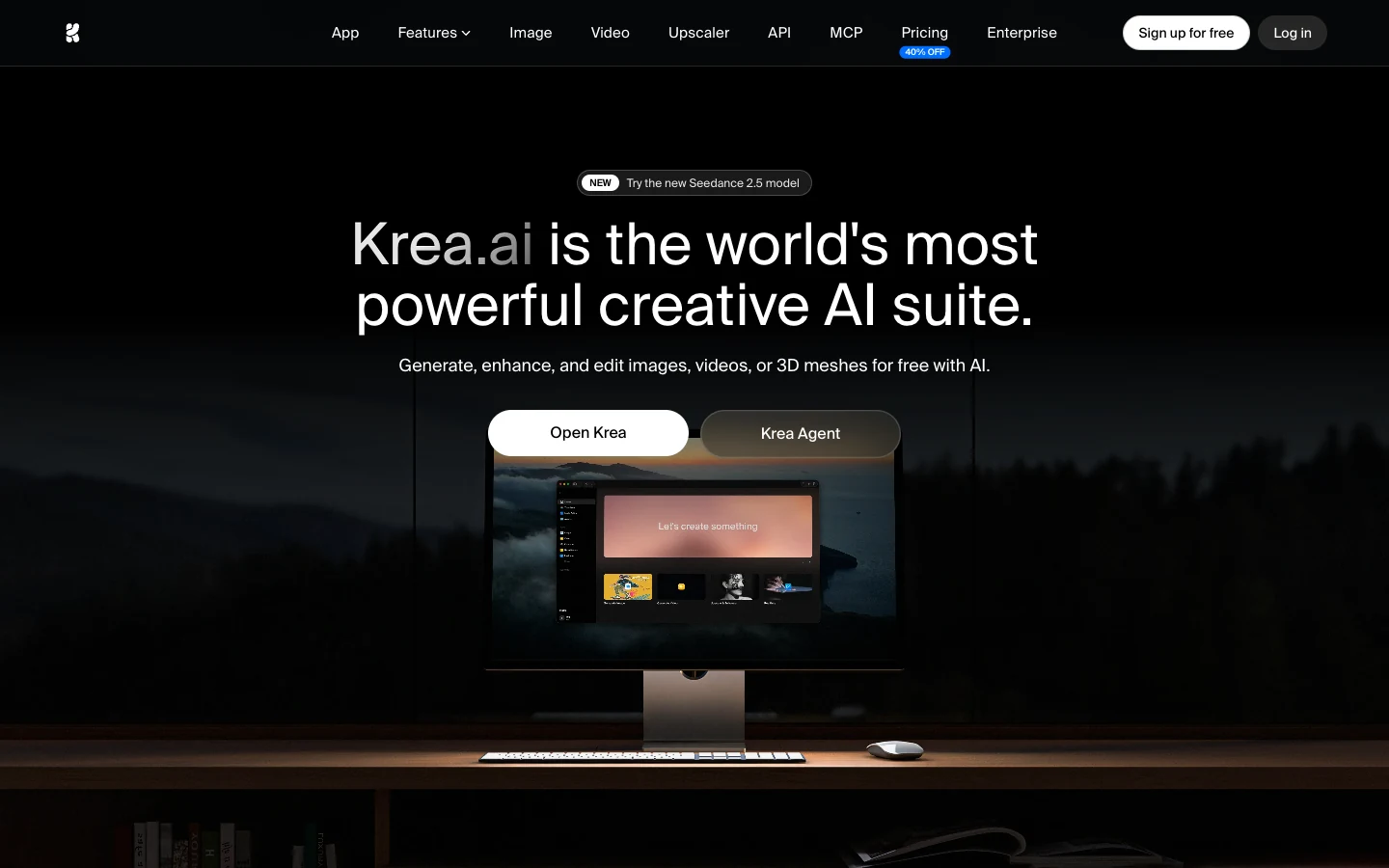
Krea is a suitable alternative when your SaaS team needs curated image and video model breadth alongside creative workflow features. Its API documentation lists more than 40 image and video models, including more than 20 image models and more than 20 video models. It also documents asynchronous jobs, webhooks, queueing, upscaling, LoRA training, and visual workflows, making it relevant when your workload extends beyond straightforward image generation. Krea API
Choose Krea when the SaaS workload requires queued jobs with webhooks plus upscaling or LoRA training in the same workflow. Prefer a narrower batch API such as Omev AI when the job is limited to repeatable product variants from one to nine references and does not require video or visual workflow builders (Krea API documentation).
Budget the API separately from the creative application. Krea states that API balance is separate from app compute, and that failed or cancelled jobs are not charged. Model availability and pricing can change, so confirm the exact API configuration before comparing costs with Getimg.ai, Omev AI, or other providers. For a workload-level comparison, review the Krea AI alternatives guide alongside current vendor documentation.
Replicate: official and community model hosting with stable APIs
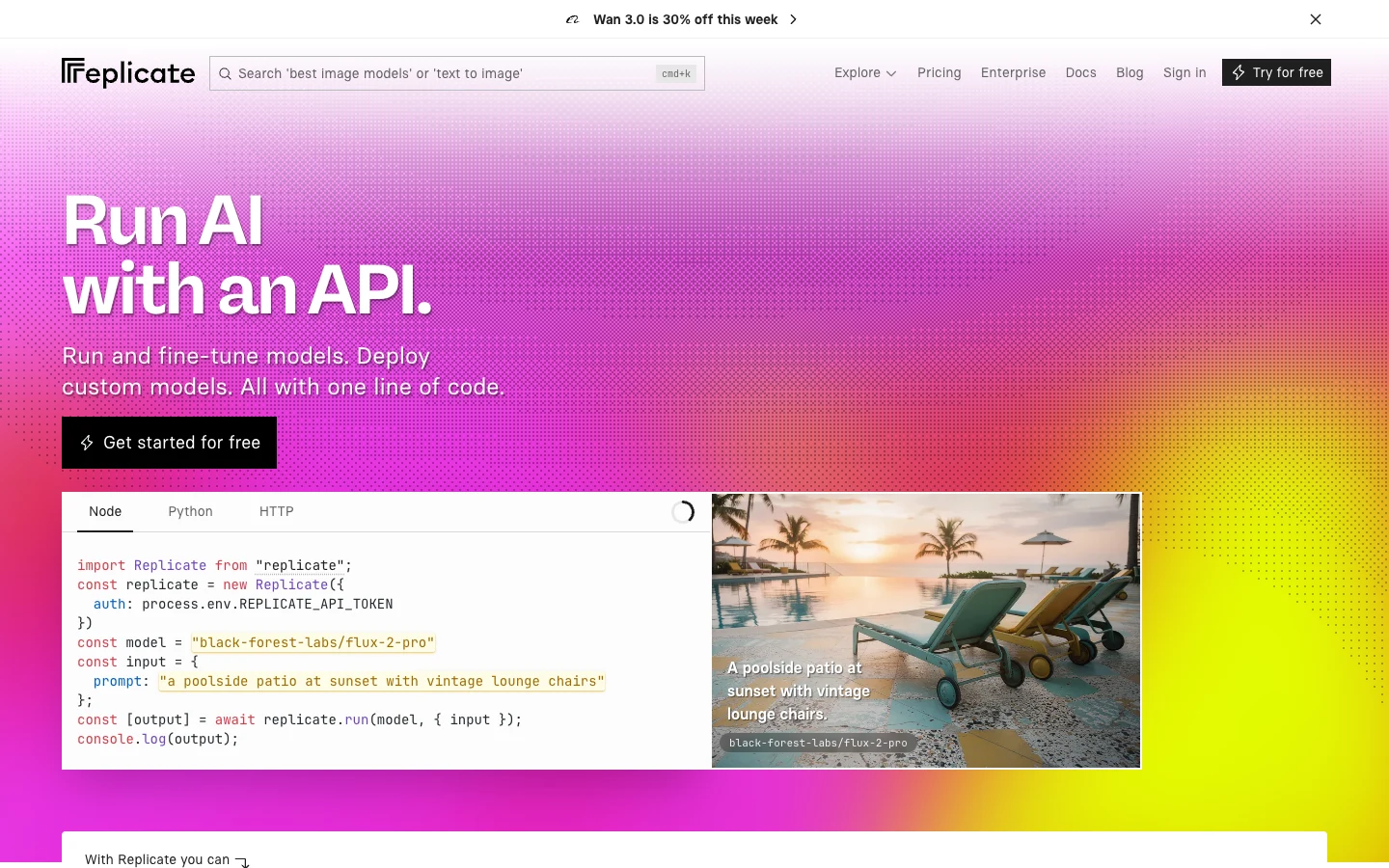
Replicate is best suited to teams that need to select a specific hosted model, whether it is an official model, a community model, or a custom model, rather than choosing a provider primarily for a standardized reference-led batch workflow. Replicate documents more than 100 official models that are always on, actively maintained, and offered with stable APIs and predictable output- or input-unit pricing. Community models can follow different billing and operational terms, including pricing based on hardware and runtime, so the distinction matters during vendor review. Replicate official models
The prediction lifecycle supports both synchronous predictions for shorter jobs and asynchronous predictions for background work. Prediction records include the selected model, inputs, outputs, status, timing, and URLs, which can help a team connect model-level operations with its own acceptance and review process. However, input schemas, output formats, and costs depend on the model selected. Replicate prediction lifecycle
Choose Replicate when model specificity, custom hosting, or access to a large official and community catalogue is the main buying requirement. Compare maintenance status, schema stability, billing unit, fallback options, and the measured cost per accepted asset for each candidate. For a broader comparison, see this guide to Replicate alternatives.
Cost planning: delivered-asset economics over list price
List prices are useful for a first estimate, but they are not directly comparable across providers. One provider may charge per delivered image, another per megapixel, and another according to the selected model or GPU usage. Even when two prices appear to cover "one image," the models, resolutions, reference limits, and output configurations may differ. Omev AI Image Generation API Getimg.ai image generation API
For workload planning, use:
(provider charges + retries + storage + review labor) ÷ accepted assets = cost per accepted asset
Illustrative example — assumptions: 20,000 accepted assets, 1.25 attempts per accepted asset (25,000 generations), rates as of 25 September 2026, excludes storage/review labor. At 25,000 generations, the illustration yields approximately $480 with Omev Image Lite at $0.0192 per delivered 1K-resolution image, $375 with Getimg.ai Z-Image Turbo at $0.015 per 1K-resolution image, or $1,500 with Getimg.ai GPT Image 2.5 Flare at $0.06 per image for outputs up to 2K, excluding storage and review labor. These calculations are not a quality comparison; they use different models and configurations, so they do not indicate equivalent quality, identity preservation, latency, or business value. Omev AI Image Generation API Getimg.ai image generation API
Before choosing a provider, measure acceptance rate, retry rate, reviewer minutes, and the resulting cost per usable image on your own approved reference sets.
Pilot design: 100 reference sets before release
Before moving production traffic, run a controlled pilot rather than treating a provider's feature list or unit price as proof of fit. Use 100 permitted reference sets spanning packaging, typography, difficult crops, and established brand styles. Freeze the reference inputs, prompts or generation rules, output dimensions, acceptance criteria, and review process before comparing providers. Omev documents support for one to nine reference images, synchronous delivery, and asynchronous bulk jobs, but identity preservation and usable-output rates still need to be evaluated on your own assets. Omev AI Image Generation API
| Pilot step | What to measure | Release gate |
|---|---|---|
| Select 100 reference sets and freeze inputs, rules, and deliverables | Reference type, required crop, typography, brand style, output resolution, and permitted asset status | Every test case has an approved input and a defined acceptance rule |
| Generate the same deliverables through each shortlisted workflow | Identity, text rendering, composition, acceptance, retries, latency, reviewer minutes, and provider cost | Results are recorded consistently, without changing rules after seeing outputs |
| Calculate delivered-asset economics | Accepted assets, total generations, rejected outputs, retry rate, review labor, and cost per usable image | The workload meets the buyer's predefined acceptance and cost thresholds |
| Run shadow traffic only after access and capacity are confirmed | Operational completion, queue or response behavior, failures, and fallback usage | No production dependency until capacity is confirmed and a fallback remains available |
Treat the release gate as an evaluation rule, not a predicted result. Include governance checks before using customer or brand material. Omev's self-service terms prohibit personal data and state that customer content may be used for model improvement without an opt-out, so use permitted non-personal product and brand assets unless separate terms apply. Omev AI Terms Keep the incumbent workflow available during shadow traffic, and release only if the measured acceptance, retry, review-time, cost, and operational criteria fit the SaaS workload.
Frequently asked questions about Getimg.ai alternatives
What is the best Getimg.ai alternative for a SaaS image API?
There is no universal best choice. For repeatable, reference-led product imagery, Omev AI is the narrow candidate to evaluate, supporting one to nine reference images and synchronous or asynchronous delivery. Omev AI Image Generation API Getimg.ai remains a strong baseline for a unified API with 17 production image models. Getimg.ai image API
Can Omev replace the full Getimg.ai platform?
No. Omev does not replace Getimg.ai's broad model catalogue, creative workspace, video or audio generation, editing, or upscaling. Omev AI Image Generation API Evaluate it for a defined repetitive workload, not as a full platform substitute.
Which alternative offers the broadest model choice?
The answer depends on how "broadest" is defined. Getimg.ai documents 17 production image models, Krea more than 40 image and video models, and Replicate more than 100 official models alongside community models. Getimg.ai image API Krea API Replicate official models
How should I compare Getimg.ai alternative pricing?
Do not compare list prices alone. Calculate provider charges plus retries, storage, and review labor, divided by accepted assets. Prices may be per image, megapixel, model, or GPU usage. Review the Getimg.ai image generation API and fal.ai pricing, then test the exact configuration and measure cost per usable image on your own reference sets. Omev AI Image Generation API
Verdict: choosing between Getimg.ai and its alternatives
For reference-led, high-volume SaaS imagery, Omev AI is the first alternative worth evaluating. Its documented fit is narrower than Getimg.ai, centered on repeatable product and brand-consistent batches rather than a broad creative platform. Omev AI Image Generation API
Keep Getimg.ai when your priority is its unified API across 17 production image models, synchronous requests, and model switching. Getimg.ai image generation API Consider fal.ai for broad model selection and image editing, Krea for creative workflows and image/video breadth, and Replicate when a particular official, community, or custom hosted model matters most. These are workload-fit options, not a performance ranking.
Use permitted non-personal assets: Omev self-service terms prohibit personal data, and account enablement may be required, so confirm governance and capacity before release. If the workload matches reference-led batches, start an Omev AI media evaluation to measure acceptance rate, retries, reviewer time, and cost per accepted asset on 100 permitted reference sets—outcomes to measure, not promises.
Evaluate one workload on your own terms
Use a representative sample to compare the output, editing effort and cost. Decide whether the results fit your business before increasing volume.
Start your evaluation →